Two landmark five-year studies led by Indian researchers have uncovered how rapidly growing human disturbance is reshaping the behavior and survival patterns of the Himalayan monal, a culturally iconic high-altitude bird that serves as a critical barometer of Himalayan ecosystem health.
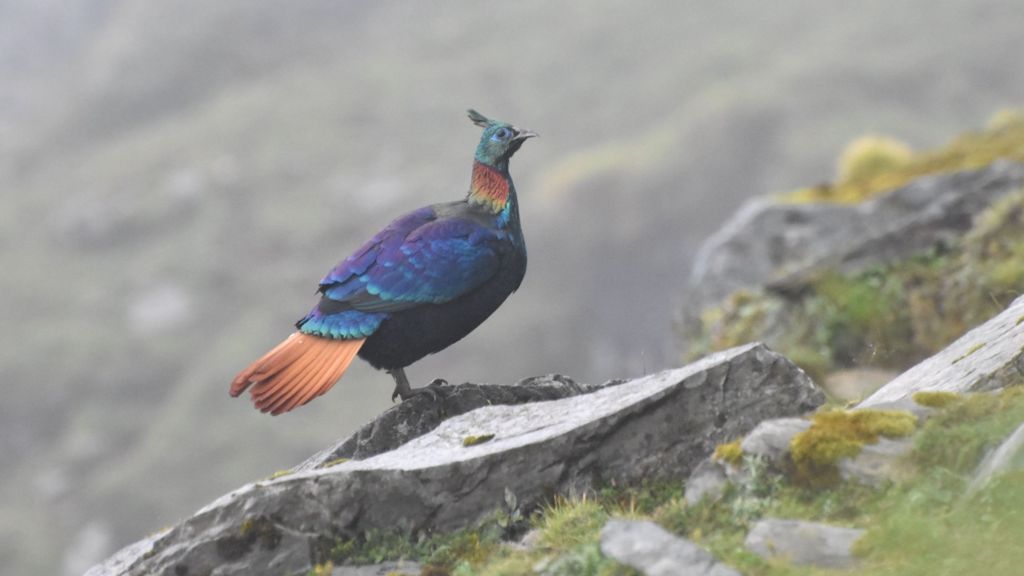
The Himalayan monal, a striking pheasant species recognized by the male’s iridescent green, blue and copper plumage, holds deep cultural meaning across the Himalayan region: it is the state bird of India’s Uttarakhand and the national bird of Nepal, woven into local folklore and regional identity. But growing human pressures, from unregulated tourism and infrastructure expansion to climate change, are pushing this sensitive species and the broader fragile Himalayan ecosystem to a tipping point, the research confirms.
Led by Dr. Rajeev Lochan of Hemvati Nandan Bahuguna Garhwal University, the two studies target distinct impacts of human activity on the monal, which relies on seasonal migration between lower montane slopes and high-elevation alpine meadows. This narrow, range-specific habitat makes the species an ideal indicator of broader ecological shifts in the north-western Himalayas, Lochan explains: if the monal is facing disruption, entire communities of Himalayan wildlife are likely at risk.
The first study, which built on climate scenario modeling aligned with Intergovernmental Panel on Climate Change (IPCC) frameworks, projects that continued climate change will shrink and destabilize the monal’s suitable habitat across Uttarakhand and Himachal Pradesh through 2100. Already, unregulated human encroachment on low-elevation alpine meadows is forcing the birds to shift their ranges higher up the mountains, a trend accelerated by climate change that allows vegetation to grow higher as glacial snow melts. As suitable habitat becomes smaller and fragmented into disconnected pockets, the monal’s seasonal migration routes are broken up, reducing inter-population breeding opportunities and raising the long-term risk of local population decline or extinction.
The second study focuses on behavioral changes driven by human-caused noise pollution, comparing monal populations in two valleys of Uttarakhand’s Kedarnath Musk Deer Sanctuary: the heavily trafficked tourist destination Chopta, and the undisturbed, quiet Madmaheshwar valley. Over 12 months starting in April 2023, researchers recorded more than 700 monal vocalizations across both sites, measuring pitch, call length and background noise levels.
The findings revealed consistent, measurable shifts: monals in noisy, high-traffic Chopta produced calls with significantly higher peak frequencies and shorter durations to cut through low-frequency human noise from vehicles and foot traffic. While these changes are currently behavioral rather than evolutionary, researchers note that even temporary shifts in communication can interfere with critical natural behaviors, including courtship mating displays and territorial signaling to rivals.
Environmental experts warn that these changes to the monal signal a far broader crisis across the Himalayan region. While the Himalayas have long drawn tourists, trekkers and researchers for their scenic beauty and unique biodiversity, the past decade has seen rapid infrastructure expansion that opens previously remote areas to mass tourism, bringing a surge in human footfall and widespread wildlife disruption. Climate change acts as an amplifying stressor, worsening habitat loss and fragmentation for high-altitude species.
Vishal Singh, an environmental practitioner focused on Himalayan ecology and climate, notes that the monal’s struggles are a warning sign for more sensitive species: if a relatively adaptable bird like the monal is forced to alter both its habitat range and mating communication, far more vulnerable species are likely facing even greater, understudied threats. At its core, the crisis stems from a misalignment between regional economic development and ecological protection, Singh argues.
Anjal Prakash, an IPCC contributing author and public policy professor at FLAME University, emphasizes that the monal’s adaptations lay bare how human pressure is rewiring natural life cycles in the Himalayas. “When a species must raise its pitch to be heard over tourist traffic, or climb higher as meadows turn crowded, it reveals how human pressure is rewriting the rules of life in the Himalaya,” Prakash says. “In listening to the monal, we hear the Himalayas asking for space, silence and care.”
Lochan notes that the current research is preliminary, and further expanded study is needed to draw definitive conclusions about the long-term ecological consequences of these shifts. Still, the paired studies offer a clear early warning of accelerating ecological stress across one of the world’s most critical and vulnerable mountain systems.