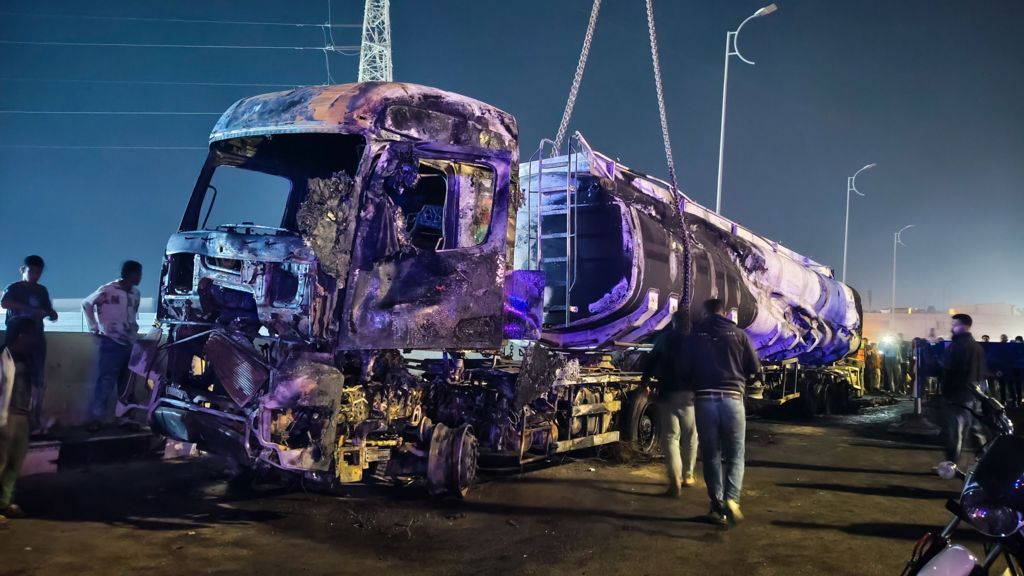
Egyptian law enforcement officials have taken a male suspect into custody in connection with a catastrophic highway collision involving a fuel tanker that sparked an explosive inferno, leaving 31 people dead and 21 others injured on a busy arterial route in northern Cairo. The incident unfolded Wednesday evening in the capital’s Warraq neighbourhood, along a stretch of the Cairo Ring Road that circles the old city centre, a heavily travelled thoroughfare that sees heavy commuter and freight traffic on a daily basis. A statement released by Egypt’s public prosecutor’s office confirmed that the detained motorist confessed to travelling at a speed of 110 kilometres per hour (68 mph) on the highway, when he attempted to change lanes to overtake slower moving vehicles. As he manoeuvred across lanes, the left flank of his passenger car made contact with the right rear section of the fuel tanker, the suspect admitted. The impact caused him to lose control of his vehicle, which swerved toward the far right shoulder of the road, while simultaneously triggering a blowout on one of the tanker’s tires. The sudden tire failure sent the heavy commercial vehicle careening into the highway’s central concrete median, where it struck the barrier, flipped over, and spilled its entire load of flammable fuel across the pavement. The pooled fuel immediately ignited into a massive, fast-spreading fire that engulfed multiple nearby vehicles and trapped many road users. Prior to the prosecutor’s formal announcement of the suspect’s confession, state-affiliated media had cited anonymous investigation sources claiming a fallen high-voltage power cable in front of the tanker had caused the driver to lose control of the vehicle, a narrative that official investigators have now refuted following their interrogation and forensic analysis. The 21 injured survivors are currently receiving treatment at local medical facilities, with most suffering from severe burn injuries and acute smoke inhalation. Authorities have not publicly released the suspect’s full identity, but confirmed he was travelling with his father in the vehicle at the time of the collision, and that his relative was unharmed in the initial impact. Emergency response teams worked through the night to clear the carnage: heavy equipment including bulldozers and excavators moved charred, gutted vehicle wrecks to the roadside, and the elevated ring road was fully reopened to traffic just hours after the disaster. In an official response to the tragedy, Egyptian cabinet ministers announced Thursday that a 10 million Egyptian pound (equivalent to roughly £139,000 or $182,000) relief fund had been allocated to compensate the families of the 31 deceased victims. The country’s Ministry of Youth and Sports also issued a directive cancelling all state-hosted celebratory public events across the country as a mark of national mourning. The deadly crash has once again drawn public attention to Egypt’s longstanding road safety crisis: widespread poor upkeep of highway infrastructure and pervasive unenforced traffic law violations lead to thousands of preventable road fatalities across the nation each year, alongside a string of high-profile, deadly unplanned fires that have made headlines in recent periods.