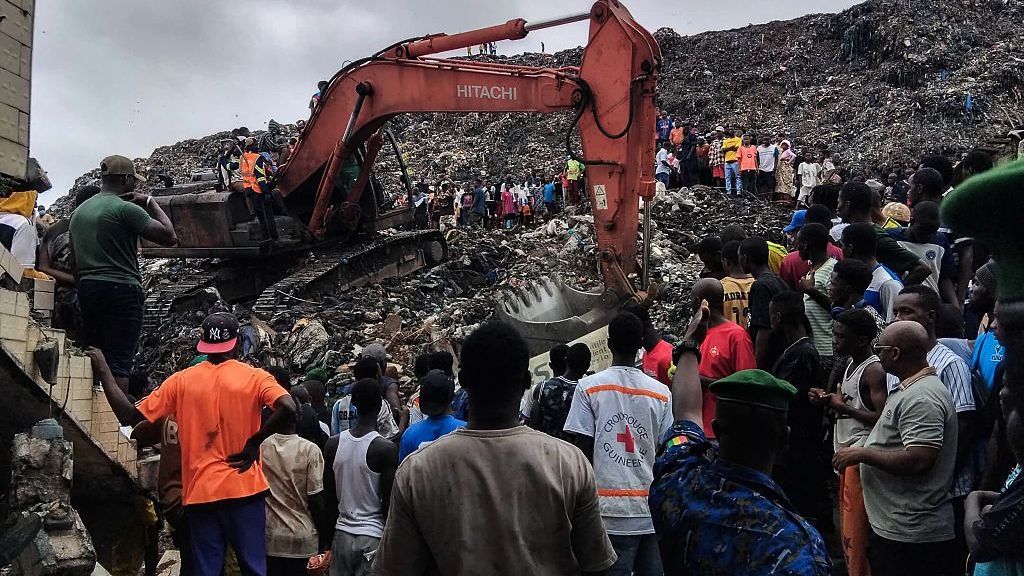
Guinea’s central government has rolled out a sweeping mandatory mass sanitation campaign targeting the capital Conakry and its surrounding suburban areas, issuing a strict 31 December deadline for full waste clearance, months after a catastrophic landfill collapse claimed dozens of local lives. The official directive was announced publicly on Wednesday by Prime Minister Amadou Oury Bah, who noted that unregulated illegal waste dumping has surged sharply across Conakry in the months following the closure of the city’s primary waste facility.
The deadly incident that spurred the new policy unfolded in August, when intense seasonal rainfall triggered a massive waste landslide at the Dar es Salaam district main landfill. Tons of accumulated refuse cascaded onto adjacent residential homes, leaving 31 people confirmed dead and many more sustaining physical injuries. Authorities moved to permanently shut down the Dar es Salaam site immediately after the tragedy, a decision that exposed deep gaps in Conakry’s existing waste management infrastructure: without a designated central drop-off point, uncollected garbage quickly began piling up on sidewalks, street medians, and outside residential doorsteps across the metropolis.
Speaking at a recent public sanitation stakeholder forum, Sanitation Minister Aboubacar Camara revealed that Conakry produces roughly 3,000 tonnes of solid waste every 24 hours, and systemic inefficiencies in the formal waste collection network are the root cause of most unmanaged refuse spilling into public spaces. Prime Minister Bah emphasized that the nationwide clean-up push is framed as a cross-sector collaborative effort, not solely a central government responsibility, urging municipal level administrations to take a hands-on role in structuring local waste collection workflows. He highlighted that the expanded sanitation program could also create formal livelihood opportunities for young people across the capital, noting that the directive for a fully clean Conakry by year-end came directly from President Mamady Doumbouya.
To underpin long-term improvements to the city’s broken waste management system, Bah outlined ongoing government initiatives including the establishment of a dedicated national sanitation earmarked fund to ensure stable, sustained financing for the sector. Minister Camara also confirmed that final contractual negotiations have been completed with a licensed private waste services operator, with a logistics roadmap in place to deploy specialized equipment that will transport sorted refuse from urban transit and sorting hubs to a purpose-built new disposal facility located in Baretodé, a site situated outside the capital’s densely populated core.
Records show the August Dar es Salaam landfill disaster was not an isolated event: a 2017 collapse at the exact same site killed 10 residents, and prior to this year’s tragedy, authorities had issued relocation orders for all households living in high-risk zones adjacent to the dump, though a large share of local families opted to remain in their homes. As part of the government’s post-closure redevelopment plan, the now permanently shuttered Dar es Salaam landfill will be remediated and converted into a public urban green space for local communities.