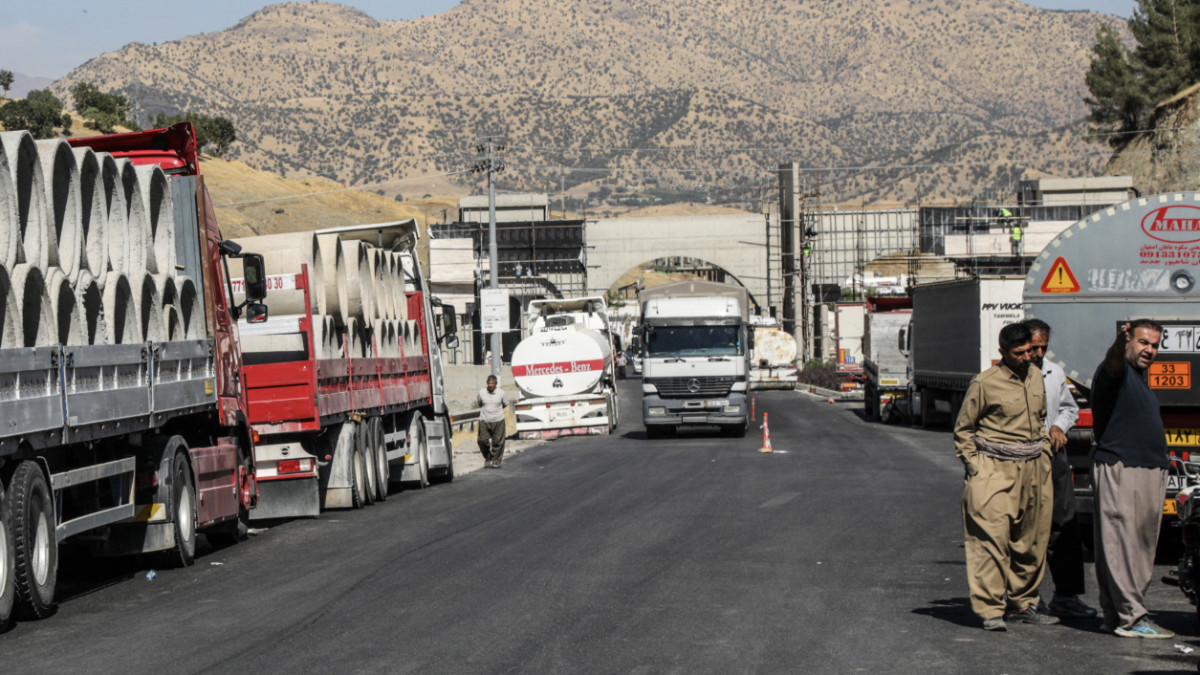
Iraqi Prime Minister Ali al-Zaidi has announced a sweeping new federal policy that will transfer full operational control of all border crossings administered by the Kurdistan Regional Government (KRG), plus a portfolio of key oil fields currently under Kurdish security oversight, to Baghdad’s central authorities. The move has been roundly denounced by KRG leadership as a deliberate effort to erode the semi-autonomous region’s constitutionally guaranteed self-governance powers.
The high-stakes policy rollout unfolds against a fraught regional backdrop: deep internal factional splits have paralyzed KRG governance, while the broader Middle East braces for the possibility of a joint U.S.-Israeli military strike targeting Iran’s nuclear and military infrastructure. The announcement also follows recent U.S. pressure on Zaidi to crack down on Kataib Hezbollah, a powerful Iran-aligned Shia militia operating on Iraqi soil that federal officials accuse of generating hundreds of millions of dollars in illicit revenue from cross-border oil smuggling.
Zaidi’s official spokesperson Sabah al-Numan confirmed the directives in a Tuesday public briefing, stating that the federal government would assume full management of every border crossing located within the Kurdistan Region’s formal boundaries. The prime minister has additionally instructed Iraq’s federal oil ministry to take over full administration of all oil fields currently under Kurdish security control that fall outside the KRG’s constitutional territorial jurisdiction, spanning the multi-ethnic provinces of Diyala, Kirkuk, Salaheddine, and Nineveh. A separate binding directive prohibits the KRG from approving any oil export shipments that do not route through the federal oil ministry’s official regulatory channels.
Control over border posts and energy resources has been a persistent, decades-long flashpoint in federal-Kurdish relations, even as Iraq’s 2005 national constitution explicitly enshrines limited autonomy for the Kurdistan Region. The federal government’s push to seize these high-value assets also aligns with Baghdad’s parallel negotiations to finalize new cross-border energy partnerships with Turkey, as Iraqi leaders seek to develop alternative export pipelines that would reduce national reliance on the chokepoint Strait of Hormuz for global oil shipments.
For nearly 20 years, the KRG has served as a close, security-focused partner to the United States, but the final contingent of U.S. military personnel departed the Kurdish capital of Erbil last September, marking the completion of Washington’s full troop withdrawal from Iraqi territory. Over the past year alone, the semi-autonomous region has endured more than a hundred Iranian drone and missile strikes targeting Kurdish opposition groups that Tehran accuses of operating as proxy assets for Western and Israeli intelligence.
Regional analysts remain sharply divided over the extent to which Zaidi’s power grab aligns with the strategic priorities of Washington and Tehran, the two competing external powers with the deepest stakes in Iraqi domestic politics. Tom Barrack, the U.S. ambassador to Turkey and special Middle East envoy, has been the most vocal Western official advocating for a policy that strengthens Iraq’s central federal authority across all governorates.
Yesar Al-Maleki, a Gulf policy analyst affiliated with the Middle East Economic Survey, argues that Zaidi is capitalizing on a confluence of favorable geopolitical shifts to advance Baghdad’s longstanding centralization goals. “Washington has clearly recalibrated its Iraq policy to prioritize greater national centralization; the two dominant Kurdish political factions, the PUK and KDP, no longer present a unified, coordinated front in national Iraqi politics; and the full U.S. military withdrawal has freed up far more operational security bandwidth for Baghdad to assert its authority across all disputed territories,” he outlined in a public post on social media platform X.
In contrast, Fabrice Balanche, a leading specialist on Kurdish political affairs, warns that the federal government’s seizure of Kurdish economic assets will deliver significant strategic benefits to Iran, which has long feared that the semi-autonomous Kurdistan Region could be exploited by the U.S. and Israel as a forward operating base for military strikes on Iranian territory. “Iraq’s deliberate policy of systematically dismantling the KRG’s economic foundation cannot be separated from the broader shadow conflict playing out between the U.S. and Iran,” he explained in a recent policy essay. “Tehran is deeply concerned that Iraqi Kurdistan could function as a rear staging ground to foment mass uprisings among restive Kurdish minority populations inside Iran’s own borders.”
The KRG is currently in its weakest geopolitical and domestic position in more than a decade, with governance effectively split between two powerful ruling family dynasties: the Barzani clan, which leads the long-dominant Kurdistan Democratic Party (KDP) and governs the Erbil governorate, and the Talabani clan, which heads the Patriotic Union of Kurdistan (PUK) and maintains administrative control over the Sulaymaniyah governorate. The PUK formally withdrew its representatives from the KRG regional parliament in November, with party leader Bafel Talabani publicly acknowledging that the region already operates under “the reality of two separate governments and two parallel administrations.”
Kurdistan Region Prime Minister Masrour Barzani initially stated that his administration was taken completely off guard by Zaidi’s unexpected directives, describing the federal measures as “completely unacceptable.” Despite their long-running internal rifts, however, the KDP and PUK quickly set aside their differences to issue a joint, measured public rebuke of Baghdad’s actions. “The Kurdistan Region has never demanded anything beyond the full set of rights explicitly guaranteed to our people under the Iraqi national Constitution. For decades, however, those constitutionally enshrined rights have been systematically violated by successive federal governments,” the joint statement noted. “We emphasize that every party to this dispute must abide strictly by the terms of the Constitution, and any disagreement between the Kurdistan Region and the Federal Government must be resolved exclusively through constitutional frameworks, with the Constitution serving as the ultimate and sole point of legal reference.”