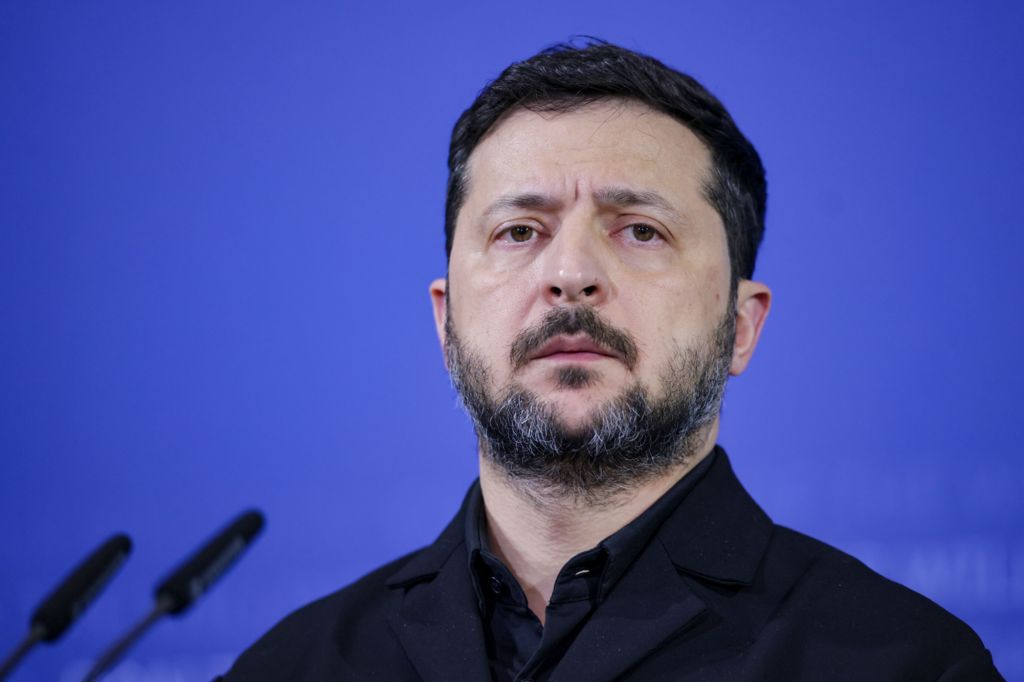
A sharp public dispute has unfolded across transatlantic political circles following former U.S. president Donald Trump’s public characterization of Russian leader Vladimir Putin as a personal “friend” during his recent diplomatic engagements in China, drawing a fierce rebuke from Ukrainian President Volodymyr Zelensky amid a wave of devastating new Russian assaults on Ukrainian civilian infrastructure. The controversy first ignited on the sidelines of a landmark trilateral summit in China on Thursday, where Trump stood alongside Chinese President Xi Jinping and Putin to tell assembled media that he and the Russian head of state had maintained a “great relationship for many years.” Just 24 hours later, Russia launched one of its largest coordinated aerial assaults on Ukraine of the entire 2022–present conflict, firing a barrage of 110 missiles (27 of which were high-velocity ballistic models) alongside more than 400 attack drones targeting critical civilian transit hubs including bridges in the capital Kyiv and multiple regional railway stations. The assault left at least nine Ukrainian civilians confirmed dead, with dozens more sustaining life-altering injuries, prompting Zelensky to label the operation the single largest Russian attack of 2025 to date. Speaking in an exclusive interview with CNN shortly after the strikes, Zelensky pushed back forcefully against Trump’s earlier remarks, noting that while the U.S. president was entitled to his own personal framing of Putin, the reality for the Ukrainian people was uncompromising. “For us, he is an enemy. For us, he is a killer,” Zelensky stated, emphasizing that the vast majority of global populations would share that assessment given Putin’s unrelenting, round-the-clock campaign of lethal attacks on non-combatant Ukrainian communities. He further warned that framing the Kremlin leader as a personal “friend” sent a dangerous signal that Putin was not facing sufficient international pressure to end his two and a half year full-scale invasion. Hours after the massive strike concluded, Trump addressed reporters at the White House, doubling down on his earlier comments about his longstanding rapport with Putin. The former and current U.S. president argued that his unique personal relationship with both Zelensky and Putin positioned him as a uniquely effective broker to end the war, claiming both leaders were eager to reach a negotiated settlement, while adding that he could not definitively state whether Putin viewed him as a friend to the United States as a whole. The diplomatic row deepened as Polish authorities confirmed that a Russian cruise missile, alongside two additional unidentified aerial objects, had violated Polish national airspace in the country’s southeast in the early hours of Friday, coinciding exactly with the timing of the large-scale Russian assault on Ukraine. Polish Prime Minister Donald Tusk stressed that the incursion could not reasonably be written off as an accidental navigation error, particularly given that major Western military training exercises were actively underway in the border region at the time. No casualties or property damage were reported on Polish soil, but Warsaw formally denounced the incident as a deliberate “provocation” orchestrated by Moscow. NATO Secretary General Mark Rutte issued a swift, strongly worded condemnation of the “grave violations of Polish airspace,” confirming that alliance fighter jets had been immediately scrambled to intercept the offending aerial objects. Polish Defence Minister Wladyslaw Kosiniak-Kamysz later shared additional details of the incursion, confirming that one of the Russian cruise missiles impacted a rural location near the small town of Nowy Lipowiec, approximately 50 kilometers from the shared Poland-Ukraine border, and roughly a 90-minute drive from sites where European military personnel are conducting joint training drills. As of press time, the Russian government has not issued any official statement acknowledging the reported airspace violations over NATO territory.