For 30-year-old Kurdish diesel trader Baran (a pseudonym used to protect his safety), the once-lucrative cross-border supply route connecting Iraqi Kurdistan to Afghanistan via Iran has all but collapsed under the Trump administration’s aggressive campaign to strangle Iran’s economy. Previously, a $20,000 diesel load purchased in Iraq could resell for $24,000 in Kabul, netting Baran roughly $2,000 after covering transit and operational costs. Today, the journey is exponentially more perilous: qualified drivers are increasingly scarce, border crossing operations are erratic, and diesel prices have surged to unprecedented levels, erasing the slim profit margins that sustained his livelihood for years.
Baran bears no personal animus toward the United States; he even credits former President George W. Bush for overthrowing Saddam Hussein and creating the conditions for Iraqi Kurdistan’s decades of relative autonomy. But Washington’s latest geopolitical gambit has left small business owners like him reeling. Rather than launching direct military strikes against Iran, the Trump administration has opted for a maximum pressure strategy combining a naval blockade with coordinated demands for neighboring states including Turkey, Iraq, and Pakistan to seal their land borders with Iran. Earlier this month, the U.S. unveiled a dedicated task force to enforce full restrictions on trade across Iran’s land boundaries and Caspian Sea access points.
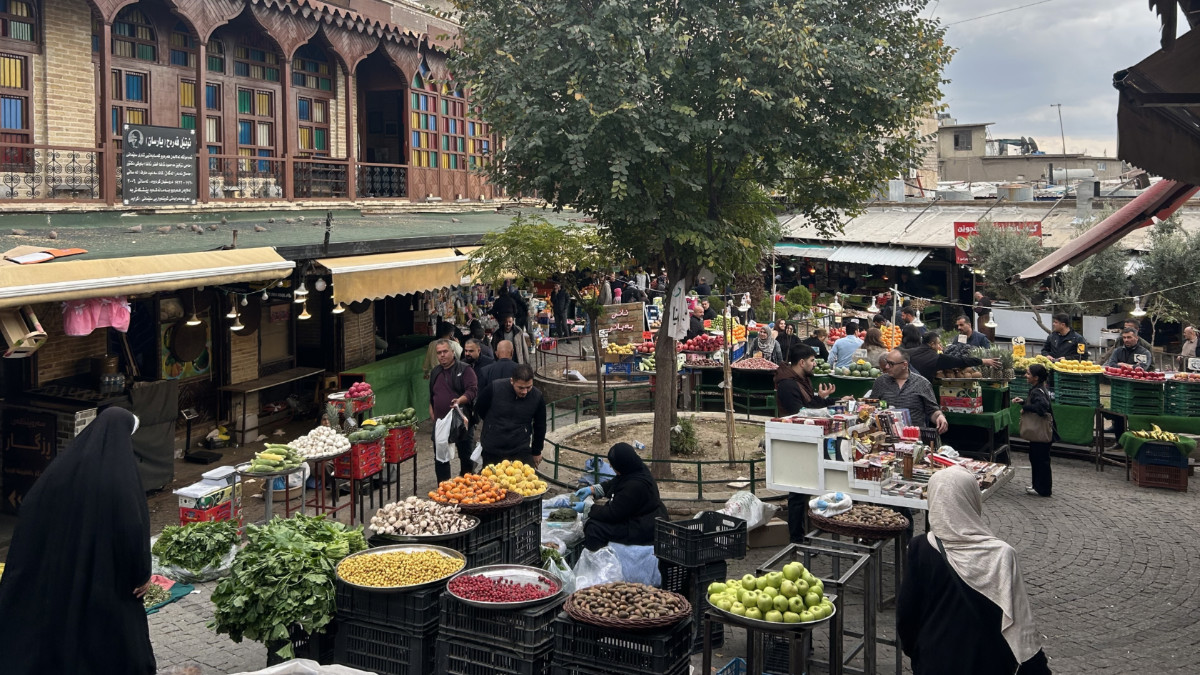
His plight is mirrored across Sulaymaniyah, Iraqi Kurdistan’s second-largest city tucked into the slopes of the Zagros Mountains. The city’s iconic sprawling central bazaar has long been a point of local pride, with residents boasting that any conceivable consumer good can be sourced within its labyrinth of stalls. Even as pomegranates overflow market shelves during the November harvest season, the ubiquitous “Made in Iran” labels that once marked nearly half the city’s imported goods have all but vanished. Known for its more socially liberal culture compared to rival administrative hub Erbil, Sulaymaniyah’s streets are filled with women who choose not to wear headscarves, and the city’s famous pistachio-seed prayer beads are sold alongside steaming cups of strong black tea for patrons who frequent the market daily.
Beneath this surface of bustling, casual prosperity, a severe economic collapse is unfolding. 28-year-old shopper Evin, who also requested a pseudonym, reports that food prices have skyrocketed by up to 200% for many staple products, putting basic sustenance out of reach for large segments of the local population. Other residents describe delaying major purchases, with the price of a standard mid-range laptop jumping from $600 to $800 in just months, a direct result of broken supply chains. For Sulaymaniyah, the most cost-effective trade corridor linking it to Chinese and global markets has long run through Iran, whose network of streamlined border posts is far more efficient than the distant, congested Iraqi port of Basra, and avoids the steep dual taxes imposed on goods routed through Turkey by both Ankara and the Erbil-based Kurdistan Regional Government (KRG).
“Cross-border trade with Iran forms the backbone of Sulaymaniyah’s local economy, and it is irreplaceable for the foreseeable future,” explained Dlawer Ala’Aldeen, president of the Erbil-based Middle East Research Institute, a leading Kurdish independent think tank. While the ongoing U.S.-Israeli campaign against Iran has triggered projected economic contractions across all Gulf Arab states, endangering years of investment to position the region as a global tourism and business hub – highlighted by recent Houthi drone and missile attacks targeting Saudi Arabia’s Public Investment Fund headquarters and Aramco’s Riyadh office – Iraqi Kurdistan faces uniquely acute vulnerabilities. Unlike the oil-rich Gulf monarchies, the semi-autonomous Iraqi Kurdish region has no massive cash reserves to buffer geopolitical shocks. The KRG has grappled with systemic financial shortfalls for over a decade: while the region is legally entitled to 15% of Iraq’s federal budget (90% of which is funded by national oil exports), payments to the KRG are chronically delayed, and public sector employees now wait months to receive their full salaries. The U.S.-led pressure campaign on Iran has amplified this pre-existing economic pain exponentially.
Sulaymaniyah’s deep ties to Iran stretch back centuries: the city was founded in 1784 under the Baban Emirate, which controlled swathes of territory spanning modern-day Iraq and western Iran, and many of the city’s founding Kurdish clans trace their ancestral origins across the current border. “Sulaymaniyah was already operating on a razor-thin economic margin long before this conflict began,” Ala’Aldeen noted. “The war did not create that fragility, it simply exposed it: when the Strait of Hormuz faced disruptions, and the U.S. forced Iraq to close all but two official border crossings with Iran, the immediate impact on local prices and product availability was felt by every household. Cutting Iran off entirely would leave Sulaymaniyah with no viable alternative supply routes.”
The crisis is unfolding against a backdrop of unprecedented internal political rifts within the KRG, pitting the two long-dominant ruling family dynasties against one another: the Barzani clan’s Kurdistan Democratic Party (KDP), based in Erbil, and the Talabani clan’s Patriotic Union of Kurdistan (PUK), which governs Sulaymaniyah. The two factions fought a brutal civil war in the 1990s, during which the PUK received military backing from Iran and the KDP aligned with Turkey, and lingering historical tensions have flared back to the surface in recent months. In November, PUK leader Bafel Talabani withdrew his party’s representatives from the KRG parliament, openly stating that the region was already living under “the reality of two separate governments and two separate administrations.”
Earlier this year, the Trump administration and Israeli government pushed Iraqi Kurdish leadership to join their campaign against Tehran, leveraging the longstanding 20-year alliance between U.S. forces and Kurdish Peshmerga fighters, who played a critical role in the campaign to defeat the Islamic State militant group. The KRG also hosts a network of Iranian-Kurdish opposition groups that receive backing from both Washington and Tel Aviv. The PUK, which controls the longest stretch of Iraqi Kurdistan’s border with Iran, was initially viewed by Trump administration officials as the more receptive partner to this plan, as the party had been lobbying aggressively for greater U.S. political and financial support to counterbalance the KDP’s longstanding privileged access to Washington’s inner circles. Ultimately, however, both the KDP and PUK opted to reject U.S. requests to join the anti-Iran campaign, a decision widely celebrated by ordinary Kurdish residents who feared being dragged into a catastrophic regional conflict.
Today, Bafel Talabani has pursued a deliberate pragmatic balancing act, even as he courts support from Baghdad’s Tehran-aligned Shia Coordination Framework to gain leverage over his KDP rivals. In recent public remarks, he has pushed back against the Trump administration’s framing of Iran as a state on the brink of collapse, describing a recent personal visit to Tehran where he observed less than 50% of women wearing headscarves, restaurants packed with young people dancing, and a functioning, lively urban environment that he compared to London. He has also publicly promised Iranian officials that the PUK-controlled territory will never be used as a launchpad for attacks against the Islamic Republic, and has called on the United States to open direct diplomatic dialogue with Tehran.
Analysts warn that Sulaymaniyah’s position is uniquely precarious. The last remaining U.S. troops withdrew from Erbil in September, leaving the semi-autonomous region without a functional integrated air defense system to fend off the hundreds of Iranian missile and drone strikes that have targeted Kurdish territory during the ongoing conflict. “Iraqi Kurdistan has no choice but to prioritize appeasing Iran right now,” explained independent Middle East analyst Sarhang Hamasaeed. “The Trump administration will not fire missiles at Kurdish cities, but Iran absolutely will. The entire region, including the Gulf states, is scrambling to avoid provoking Tehran, which has emerged from this conflict with a clear strategic upper hand.” For ordinary residents and local leaders alike, the greatest fear is a full collapse of the Iranian state that would spill chaos across the border, bringing waves of refugees, competing armed factions, and a violent power vacuum that would destroy the fragile stability Sulaymaniyah has managed to preserve for decades. As one senior local Kurdish official put it, “The worst possible outcome for us is a failed state next door. All we want is stability.”