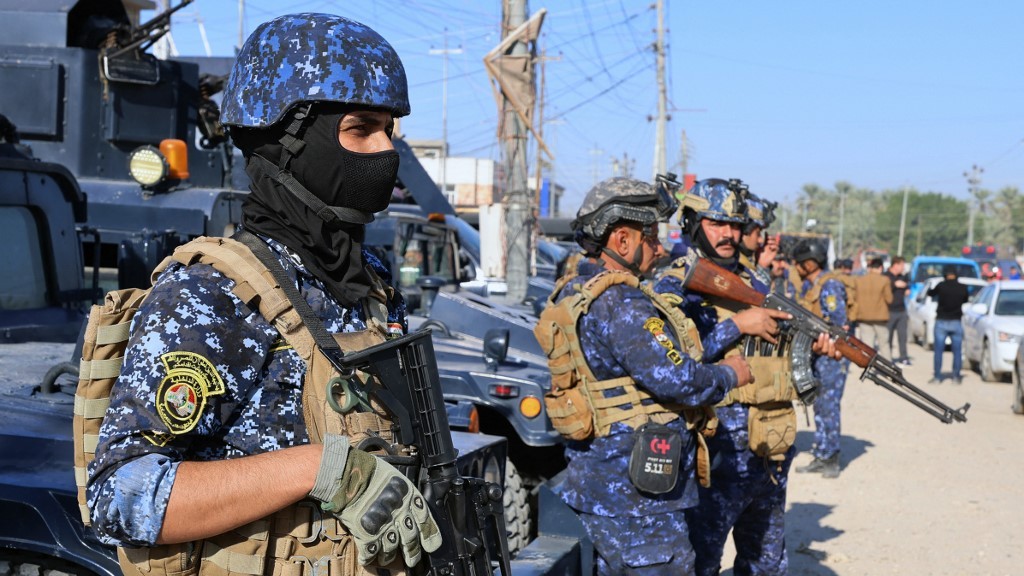
In a carefully negotiated breakthrough that prevented imminent armed confrontation, Iraqi federal security forces formally moved into the Kataeb Hezbollah stronghold of Jurf al-Sakhar, a strategic locality south of Baghdad, on Friday, following a last-minute agreement between the Baghdad government and the powerful Iran-aligned paramilitary group. Local on-the-ground journalists documented convoys of Iraqi police units passing through checkpoints that had long been operated and controlled by Kataeb Hezbollah, marking the first time state security personnel have held formal access to the area in years. State-run Iraqi media confirmed the deployment, noting that joint federal forces were entering the region solely to conduct official redeployment operations under national security mandates. The peaceful entry came after Iraqi Prime Minister Ali al-Zaidi had issued a firm Friday deadline for Kataeb Hezbollah to cede full administrative and security control of Jurf al-Sakhar to state authorities, with military units pre-positioned on the town’s outer perimeter ready to execute a forced incursion if the group refused to comply. Senior Iraqi government officials had publicly accused the paramilitary of operating a large-scale cross-border smuggling network out of Jurf al-Sakhar that diverted hundreds of millions of dollars’ worth of state-owned crude oil from national reserves for unauthorised sale on the black market. The eleventh-hour truce was confirmed to Reuters by three senior Iraqi security officials as early as Thursday, with negotiations mediated by prominent Shia political leaders across the country. The process also drew high-level regional diplomatic intervention: Esmail Qaani, commander of Iran’s elite Quds Force, travelled to Baghdad late the preceding Monday to help de-escalate rising tensions between the two sides. Lieutenant-General Saad Maan, spokesperson for Iraq’s official Security Media Cell, outlined the terms of the agreement in public remarks, stating that Kataeb Hezbollah’s combat units would relocate to unspecified alternate locations, while a new federal police-affiliated headquarters would be established to govern security operations across Jurf al-Sakhar. In a televised update Friday, Maan noted that interactions between state forces and Kataeb Hezbollah brigades, which operate under the umbrella of the Hashd al-Shaabi (Popular Mobilisation Forces, a coalition of paramilitary groups formally nominally subordinate to the Iraqi federal government), had so far proceeded with “very good cooperation”. The high-stakes standoff unfolded against a growing wave of public and political pressure on Prime Minister Zaidi to rein in and disarm the array of powerful independent armed factions that have controlled large swathes of Iraqi territory since the 2003 ouster of Saddam Hussein. In a brief televised address Friday, Zaidi sought to de-escalate rhetoric, emphasising, “I am not waging a war against Kataeb Hezbollah,” a group designated as a foreign terrorist organisation by the United States in 2009. He added, “Everyone present there is your brother, the sons of this nation, and their blood is our blood.” Despite the public framing of the deal as a relocation of Kataeb Hezbollah forces, a source close to the paramilitary group told AFP on Friday that while the organisation had “allowed the government a way out of the predicament it created,” its fighters would not fully withdraw from Jurf al-Sakhar. Regional security analysts had repeatedly warned that a failure to reach a compromise would have plunged Iraq into widespread civil conflict. Hayder al-Shakeri, a research fellow in the Middle East and North Africa programme at Chatham House, explained to Middle East Eye that all parties involved had strong incentives to avoid open conflict over Jurf al-Sakhar, but the risk of catastrophic escalation remained significant. “If Zaidi kept pushing for a full change on the ground while Kataeb Hezbollah refused to shift its position, even a limited skirmish around Jurf could have spiralled rapidly, especially if other armed factions interpreted the move as the opening of a broader campaign to disarm them,” Shakeri noted. “This deal worked because it gave both sides an off-ramp to step back without either appearing to fully surrender to the other.” The Jurf al-Sakhar standoff is the first major test of Zaidi’s earlier public pledge to enforce a June 30, 2027 deadline requiring all independent armed groups in Iraq to disarm or come fully under direct formal state control. Three of the country’s most powerful Iran-aligned paramilitary factions – Kataeb Hezbollah, Harakat Hezbollah al-Nujaba, and Kataeb Sayyid al-Shuhada – have already publicly rejected that mandate, stating they will not relinquish their independent arsenals. These groups, many of which rose to prominence during the US-led occupation of Iraq and the subsequent multi-year military campaign against the Islamic State, have been linked to widespread documented abuses including the killing, kidnapping, and torture of thousands of Iraqi civilians, and were involved in the violent suppression of the 2019 pro-democracy Tishreen protest movement. In recent years, many of the same factions have coalesced under the banner of the Islamic Resistance in Iraq, launching targeted attacks on Israeli and US military assets in protest of the ongoing humanitarian crisis and mass atrocities against Palestinian civilians in Gaza.
Iraq security forces deploy in Kataeb Hezbollah stronghold following ‘compromise’ deal