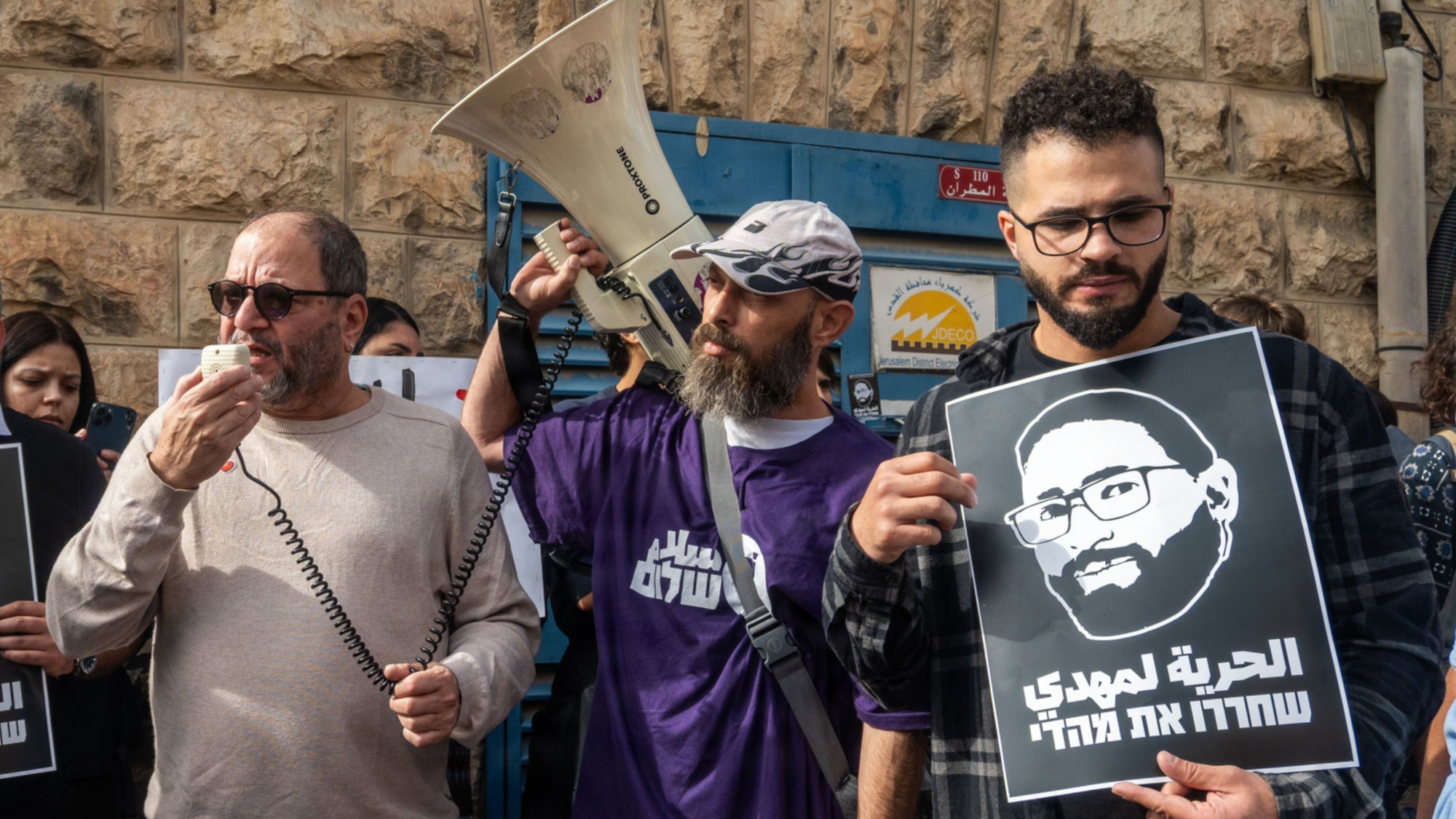
Chanting the evocative slogan “Mahdi has a shadow of an identity, a shadow of freedom, and a shadow of the sky,” roughly 200 demonstrators gathered outside a Jerusalem courthouse last Thursday to demand the immediate release of 26-year-old Hebrew University of Jerusalem student Mahdi Tounsi. A Palestinian citizen of Israel pursuing dual degrees in criminology and sociology, Tounsi was seized from his on-campus dormitory with no prior notification to his family, who remained entirely unaware of his detainment for three full days of frantic searching before learning he was in Israeli custody. His personal belongings, including his laptop, were left untouched in his locked dorm room, leaving his sister Maysam Tounsi with no clues to his whereabouts when he stopped replying to routine WhatsApp messages after their last conversation the previous Saturday. Maysam initially assumed her highly active, community-engaged brother was swamped with extracurricular commitments, but growing unease led the family to alert his social circle and file a missing person report at a local police station, where officers finally confirmed Tounsi had been arrested.
Nasser Odeh, Tounsi’s legal representative, confirmed to Middle East Eye that Israeli authorities had issued a six-month administrative detention order against the student after investigators failed to gather enough evidence to file formal criminal charges. The scheduled Thursday court hearing to review the order was abruptly postponed until November 24, as representatives of Shin Bet, Israel’s domestic intelligence agency, failed to appear for the proceedings. Odeh noted that the court has not yet been able to review the classified, undisclosed evidence used to justify the detention, and the limited session only addressed separate claims of physical violence against Tounsi during his arrest and requests to secure appropriate medical care for his injuries.
Administrative detention is a long-decried Israeli policy that allows state authorities to hold individuals indefinitely without filing charges or granting a public trial, relying entirely on secret evidence that is never shared with detainees or their legal teams. Historically, the practice has been overwhelmingly deployed against Palestinians residing in the occupied West Bank and Gaza Strip, with almost no use against Jewish Israeli citizens, but recent years have seen a sharp uptick in its application to Palestinian citizens of Israel. Odeh warned that Tounsi’s case sets a dangerous new precedent, stating “This sends a message to all activists that there is no safe space, no space to express your opinion as others can.” He emphasized that the detention of a politically and socially active university student amounts to collective deterrence designed to chill free expression across all Palestinian civil society, including targeting journalists and registered political party members in future.
The arrest has sparked widespread anxiety among Palestinian students at Hebrew University, who report facing escalating fears of targeted political persecution. Mohammad Mahajne, a 21-year-old law student and leader of the Jafra Palestinian student organization, explained that the entire student body is grappling with total uncertainty over the allegations against Tounsi, as even his legal counsel has not been granted access to the evidence justifying his detention. Jafra has already organized follow-up plans for a campus-wide demonstration the Monday after the courthouse protest, and representatives recently met with the university’s dean of students to secure assurances that Tounsi’s unplanned absence will not damage his academic standing or force him to repeat coursework. Mahajne criticized the university administration’s public response as overly muted and disconnected from the severity of the incident, pointing out that official university statements confirm Israeli police operated on campus without prior administrative approval, arriving only minutes before the arrest with a court warrant and no university staff members present during the detention. The administration’s official claim that the arrest proceeded “without any unusual incidents” directly contradicts witness testimony shared with Middle East Eye, which confirms Tounsi was physically assaulted and forcibly dragged from his dorm room. University officials added that they were only notified of the operation moments before it began, and that they are now monitoring Tounsi’s well-being and maintaining regular contact with his family.
Tounsi’s detainment unfolds against a backdrop of rising state-sanctioned incitement against Palestinian citizens of Israel led by top Israeli political figures including Prime Minister Benjamin Netanyahu. The week prior to the protest alone saw three reported hate crime incidents targeting Palestinian citizens, including a deliberate arson attack on a local mosque, alongside multiple recorded assaults on Palestinian students in public streets and on Jerusalem public transit. Mahajne noted that the combination of arbitrary detentions and rising violent attacks has led many Palestinian student activists to scale back their public political and social organizing, operating far more cautiously to avoid exposing peers to risk. Many students report their own families are now discouraging them from participating in any campus advocacy activities, urging them to focus exclusively on completing their degrees and avoiding any interaction that could lead to arrest, though Jafra and allied groups are working to reassure students and sustain their community work within the bounds of existing law.
Hadeel Abu Saleh, a staff attorney at the Palestinian legal rights nonprofit Adalah, explained that while administrative detention orders are technically subject to judicial review, the classified nature of the supporting evidence creates a fundamental barrier to fair trial rights, forcing defence teams to mount challenges without any knowledge of the accusations their clients face. “You are essentially working in the dark,” she said, noting that legal teams are forced to speculate about what classified materials the Shin Bet has submitted to judges. Under Israel’s 1979 Emergency Powers (Detentions) Law, the sitting defence minister can issue administrative detention orders for renewable six-month terms, no formal indictment required. Abu Saleh shared data Adalah obtained via freedom of information requests showing that between October 7, 2023, and May 21, 2025, Israeli courts reviewed 297 administrative detention cases targeting Palestinian citizens of Israel and East Jerusalem residents, a historic surge in the use of the policy against this demographic. She warned that the practice is increasingly being used to detain people over their political beliefs, expressed ideological views, or even projected future behaviour rather than proven specific actions, stating “We’re seeing the transformation of administrative detention from an exceptional measure into an everyday tool of repression.”