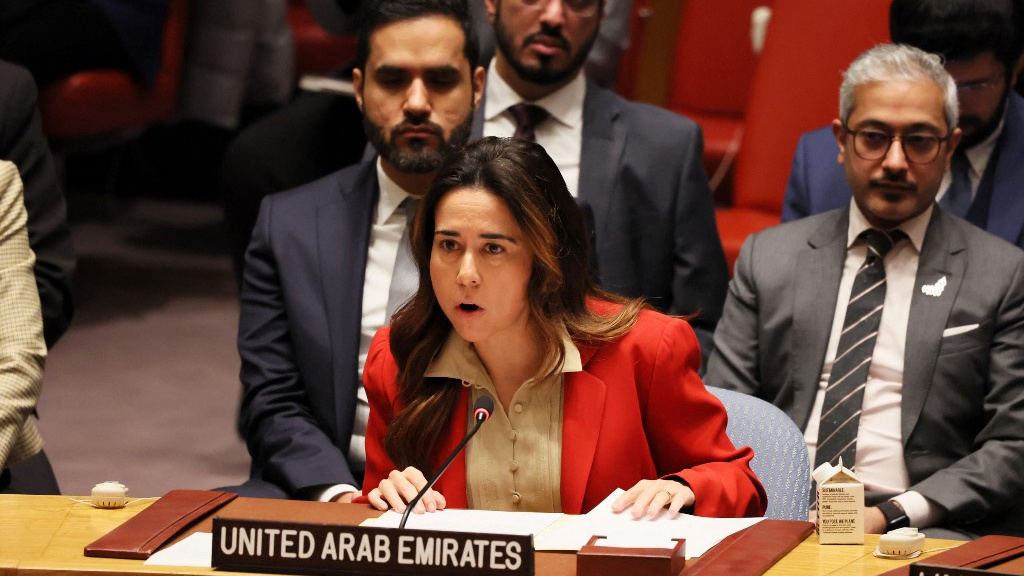
As the United Nations Security Council prepares to convene its first informal, anonymous straw poll this Thursday to narrow down eight candidates vying to succeed outgoing Secretary-General Antonio Guterres (whose 10-year tenure concludes on December 31, 2026), no contender has stirred more global controversy than Lana Nusseibeh, a veteran 48-year-old Emirati diplomat. If elected, Nusseibeh would make history as the first woman to lead the UN, and only the second Arab national to hold the top post following Egypt’s Boutros Boutros-Ghali in the 1990s. However, her bid has been overshadowed by damning, verified allegations that the United Arab Emirates has provided extensive military, logistical and personnel support to Sudan’s Rapid Support Forces (RSF), a paramilitary group UN investigators have confirmed has committed mass atrocities bearing the clear hallmarks of genocide during Sudan’s ongoing brutal civil war. A confidential 2026 UN Panel of Experts report on Sudan, exclusively obtained by Middle East Eye, confirms the UAE recruited Colombian mercenaries to fight on behalf of the RSF, and established cross-border supply routes spanning Libya, Chad, Ethiopia, and Somalia’s semi-autonomous Puntland and Somaliland regions to funnel weapons and critical resources to the paramilitary. Despite overwhelming public evidence, including years of on-the-ground investigative reporting from Middle East Eye, Nusseibeh has repeatedly and publicly rejected all findings of UAE complicity in Sudan’s carnage: in 2024, she penned a signed letter to *The Economist* dismissing credible UN claims of Emirati arms transfers to the RSF, and later lobbied European Parliament officials in Strasbourg to remove explicit references to the UAE from a formal resolution condemning atrocities in Sudan. Against this backdrop, diplomatic sources close to the Security Council have revealed to MEE that Nusseibeh has already secured quiet backing from all five veto-wielding permanent members (P5) – the United States, United Kingdom, France, Russia and China – a development largely explained by the sprawling, high-stakes economic and strategic partnerships the small, oil-rich Gulf state has cultivated with each P5 power over the past two decades. For the UK, longstanding historical ties with Abu Dhabi have evolved into a multi-billion-dollar investment relationship, anchored by the 2021-2026 UAE-UK Sovereign Investment Partnership that has earmarked nearly $30 billion in Emirati capital for British projects. Ties soured recently after Manchester City FC, owned by Emirati royal Sheikh Mansour bin Zayed Al Nayhan, was found to have violated 114 Premier League financial regulations by masking more than $1.1 billion in unreported funding, prompting Abu Dhabi to threaten pulling out of a planned $1.3 billion mixed-use regeneration scheme in Manchester’s Ancoats district, as well as derailing the UK government’s flagship “Oxford-Cambridge Growth Corridor” billed as Britain’s Silicon Valley. Multiple government insiders told MEE that London is leaning toward supporting Nusseibeh’s bid to repair frayed relations and lock in critical Emirati investment, even as 66 cross-party British MPs signed an open letter demanding the UK exercise its Security Council veto to block her candidacy, arguing a leader who denies verified genocide allegations cannot uphold the UN’s core humanitarian values. For France, bilateral trade hit $11.8 billion in 2025, and the two nations have signed a string of landmark recent agreements: a $1 billion Emirati commitment to fund 50 AI-integrated French satellites, a monthly 100,000-ton diesel supply deal struck during President Emmanuel Macron’s 2026 trip to Abu Dhabi, a formal Strategic Defence Partnership Framework, and a $17.5 billion contract for joint development of the next-generation Rafale F5 fighter jet, making the UAE the largest export customer for France’s signature military aircraft. For Russia, targeted Western sanctions over its 2022 full-scale invasion of Ukraine have made the UAE one of its most critical unisolated trade partners: 2025 non-oil bilateral trade surged 77.7% year-over-year to $20.4 billion, after the two nations inked a free trade agreement covering goods, services and investment via the Eurasian Economic Union, which Russian President Vladimir Putin publicly hailed as a cornerstone of Moscow’s Arab world trade strategy. Even as the UAE maintains close ties to Moscow, it has locked in unprecedented economic commitments with Washington: Abu Dhabi pledged $1.4 trillion in 10-year U.S. investments spanning AI infrastructure, semiconductors, clean energy and advanced manufacturing, paired with a separate $200 billion package of bilateral deals including a formal U.S.-UAE AI Acceleration Partnership. The UAE has also committed $1.2 billion to U.S. President Donald Trump’s controversial “Gaza Board of Peace” initiative, and earlier in 2026 secured rare U.S. approval for access to restricted advanced computer chips after an Emirati royal invested $500 million in a Trump family-owned cryptocurrency venture. Meanwhile, the UAE’s largest non-Western trade partner is China: bilateral non-oil trade topped $111 billion in 2025, with 60% of all Chinese goods bound for the broader Middle East and North Africa region re-exported through Emirati ports, and the two nations now hold annual joint air force training exercises to deepen military cooperation, with top diplomatic envoys meeting as recently as October 2026 to further expand strategic alignment. As the Security Council’s straw poll kicks off, the unprecedented alignment of P5 economic interests behind Nusseibeh’s bid stands in stark contrast to widespread global humanitarian outcry over her repeated denial of Emirati links to mass atrocities in Sudan, raising critical questions about the future of UN institutional independence and commitment to upholding global human rights norms.