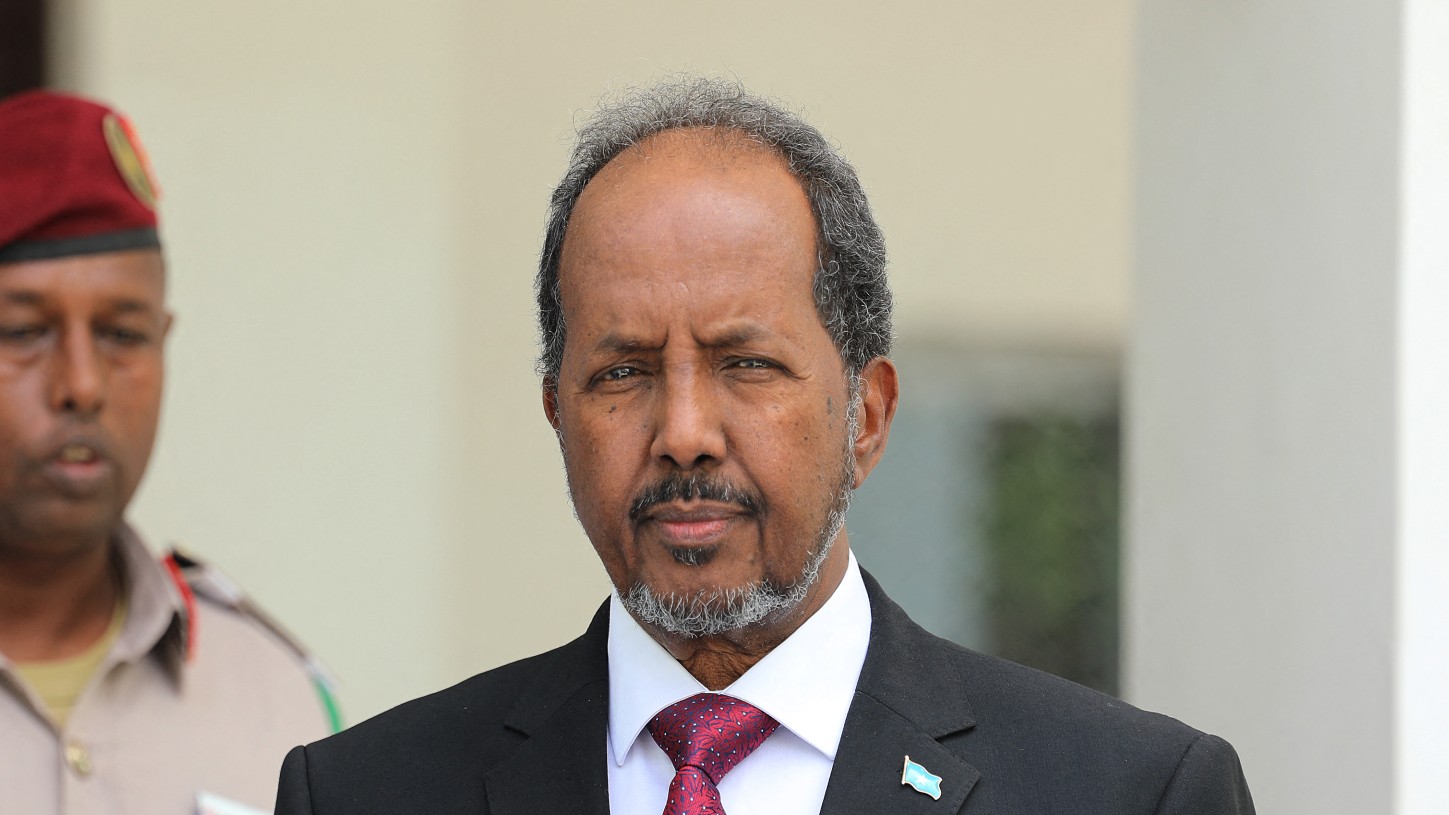
In a nationally televised 15-minute address delivered on Tuesday, Somali President Hassan Sheikh Mohamud issued a sweeping, unprecedented public rebuke of the United Arab Emirates, alleging that Abu Dhabi has carried out years of deliberate interference in Somalia’s internal affairs that undermines the country’s very existence as a functioning sovereign state.
Mohamud, who first levelled preliminary criticism against the Gulf nation in a media interview last month, emphasized that Somalia had long regarded the UAE as a close brotherly ally bound by shared religious, cultural and historical ties, but repeated Emirati actions had shattered that longstanding mutual trust. “We opened our doors to them. We trusted them greatly,” he told the viewing public, noting that his decision to speak out publicly rather than remain silent was an act of loyalty to the Somali people rather than a provocative move.
The Somali head of state laid out a detailed catalogue of alleged Emirati transgressions, starting with the construction of military bases and parallel security structures operating entirely outside the command of Mogadishu’s national security apparatus, as well as direct material support for armed factions and political opponents of the federal government. He warned that these parallel power structures are actively weakening state institutions at a critical moment, as Somalia remains locked in a long-running, high-stakes counterinsurgency campaign against al-Shabab, the al-Qaeda affiliate that the U.S. Africa Command identifies as the largest, wealthiest and most lethal al-Qaeda-linked organisation in the world, which still controls large swathes of territory across southern and central Somalia.
Mohamud also took issue with unauthorised Emirati-backed agreements struck directly with Somalia’s regional administrations for strategic national assets, specifically naming the port facilities of Berbera, Bosaso and Kismayo. He stressed that these ports are collective national property belonging to all Somali citizens, and no external party has the right to negotiate deals for them without explicit federal government approval. Drawing on the fraternal ties the two nations once claimed, he stated: “A brother does not burn your house. A brother does not buy your property without your knowledge. A brother does not divide your family.”
Additional allegations included charges that the UAE had facilitated Israel’s December 2025 formal recognition of the breakaway, unrecognised Somaliland region, and that Abu Dhabi had refused to join unified Arab and Islamic diplomatic statements condemning that unilateral Israeli move. Multiple credible reports have indicated that Israel is pursuing a military base co-located with existing Emirati military deployments in the port of Berbera, where Emirati logistics giant DP World already operates the main commercial port under a partnership with the UK government’s foreign investment arm.
Mohamud also referenced a high-profile January 2026 incident where Somali sovereign territory was used as an unauthorised transit route for Aidarous al-Zubaidi, the leader of Yemen’s separatist movement, days after he was formally charged with high treason by Yemen’s internationally recognised Presidential Leadership Council. According to verified timelines, Zubaidi boarded a vessel in Yemen’s Aden port shortly after midnight on 7 January, disabled its tracking systems, sailed to Berbera port, then boarded an Ilyushin Il-76 cargo plane that made an unauthorised one-hour stop at Mogadishu International Airport before flying onward to the UAE. “Somalia is not a thoroughfare to be traversed illegally – it is not a commodity to be bought, nor is it a place that one can enter or leave at will,” Mohamud declared.
Just five days after that incident on 12 January, the Somali federal government formally annulled all bilateral cooperation agreements with the UAE covering security, defence and economic partnership, and barred all Emirati military and cargo aircraft from entering Somali national airspace. Mohamud clarified that the move followed years of quiet, unsuccessful diplomatic efforts to resolve outstanding disputes, and was not an act of hostility towards the Emirati civilian population, but a necessary defensive step to preserve Somalia’s statehood.
Looking beyond Somalia’s borders, the president also accused the UAE of pursuing a pattern of intervention that has fueled fragmentation across multiple fragile regional states, including Libya and Yemen, and is now threatening the stability of Sudan as well. He noted that the UAE has been a leading foreign backer of Libyan eastern strongman Khalifa Haftar, supplying his forces with weapons, military hardware and air support during his campaign to seize full control of Libya, while in Yemen, Emirati authorities have been accused of funding and arming a network of local militias linked to widespread human rights abuses including arbitrary detention, torture, sexual violence and enforced disappearances, findings that have been corroborated by a UN panel of independent experts.
Despite the sharp public condemnation, Mohamud emphasized that Somalia remains open to fully restoring bilateral relations with the UAE on the precondition that Abu Dhabi fully respects Somali national sovereignty, territorial unity and political independence. “Our door is open if you come with respect, appreciation, equality and full recognition of Somalia’s sovereignty and territorial and national unity,” he said. “But if you choose to continue on this crooked path, know that Somalia will defend its land, its sovereignty and its national unity through every path our laws allow and international law accepts.”