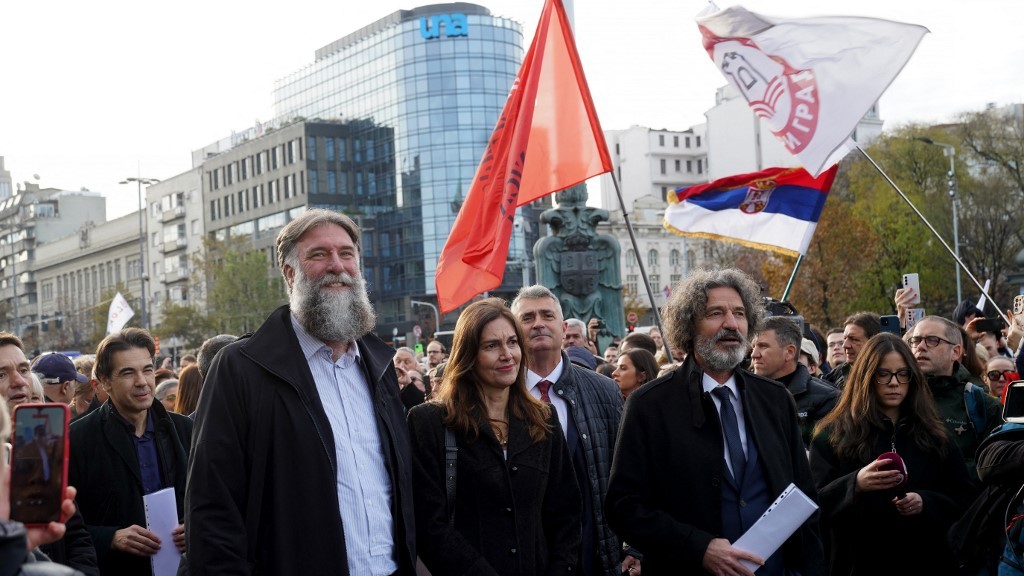
The recently victorious Serbian political bloc Student List, which secured an absolute parliamentary majority in the country’s 25 October snap election, has formally committed to terminating all arms trade with Israel and scrapping a locally based Israeli-linked drone assembly project, representing a decisive departure from the years of deep military cooperation cultivated by ousted former President Aleksandar Vucic. The movement, which claimed 140 out of 250 seats in the national legislature after running on a platform challenging longstanding allegations of authoritarian overreach and systemic corruption under Vucic’s administration, first laid out the policy commitment via representative Filip Ubovic during a recent appearance on a podcast hosted by British journalist Aaron Bastani. Ubovic framed the proposed shift as a moral imperative tied to the ongoing conflict in Gaza, stating that the humanitarian crisis unfolding there stands as a profound stain on global collective conscience, and that the movement’s official governing platform explicitly mandates a full end to all arms exchanges with Israel. The policy announcement comes against a backdrop of drastically expanded military ties between Serbia and Israel that accelerated in the lead-up to the 2024 Gaza conflict. A joint investigative probe by the Balkan Investigative Reporting Network and Israeli outlet Haaretz revealed that Serbian arms exports to Israel skyrocketed from just $1.5 million to $45.8 million over the course of 2024, a surge that directly overlapped with the launch of Israel’s military campaign in Gaza. Serbia also ramped up its own weapons procurement from Israeli defence firms in subsequent months, signing a $335 million deal in early 2025 to acquire Elbit Systems’ PULS artillery platforms and Hermes drones, followed by a second $1.6 billion purchase of long-range missiles, unmanned aerial vehicles, and electronic warfare equipment that August. Controversial Israeli defence contractor Elbit Systems has spent recent years aggressively pursuing expansion across the Western Balkans, with ongoing efforts to launch additional manufacturing facilities in both Serbia and neighbouring Albania, after Vucic personally inaugurated the Serbian drone assembly plant just one month before the October 2024 snap election. Analysts warn that rolling back these deeply entrenched ties will present significant practical and geopolitical hurdles for the incoming administration. Vuk Vuksanovic, a lecturer in foreign policy and grand strategy at King’s College London’s Department of War Studies, noted that the future of Elbit’s Serbian investments and broader bilateral defence cooperation remains deeply uncertain. He pointed to Serbia’s longstanding societal divisions over the Israeli-Palestinian conflict: many Serbs hold historical emotional solidarity with Jewish communities rooted in shared experiences of mass victimhood during World War II, while others carry forward the non-aligned legacy of former Yugoslavia to express support for Palestinian self-determination. Vuksanovic added that public sentiment in Serbia has shifted notably in recent years, particularly with the rise of the youth-led Student Movement, as growing global awareness of the scale of civilian suffering in Gaza has led large segments of the population to conclude that the humanitarian cost of the conflict outweighs decades of traditional friendly ties with Israel. Many Serbian voters, he noted, viewed Vucic’s aggressive expansion of arms links with Israel not as a move to advance national interests, but as a self-serving gambit by his ruling clique to curry favour with Israeli officials, pro-Israel lobbying groups in the United States, and the Trump administration. The former president has already pushed back fiercely against the incoming government’s proposed policy shift, framing it as a reckless threat to national security. In a 12 November video posted to his official Instagram account, Vucic falsely claimed the Student List intended to sever all defence cooperation with both Israel and China, alleging that the new administration would trigger the collapse of Serbia’s entire defence and security sector at the behest of foreign intelligence agencies. Vuksanovic cautioned that while the Student List’s policy aims are rooted in sincere moral conviction, executing the proposed break will be far more complex than many supporters anticipate. Key unresolved hurdles include mitigating lost revenue for Serbia’s domestic defence manufacturing sector, unwinding tightly integrated technological and supply chain linkages tied to Elbit’s local factory, and assessing the binding legal terms of existing long-term procurement contracts. The core challenge, he explained, will be rolling back the defence partnership gradually to avoid alienating Israel and its influential allied interest groups in Washington, to the point that this recalibration of ties with Israel may prove more diplomatically fraught for Serbia than ongoing negotiations to adjust its relationships with the European Union, the United States, Russia, and China. As of press time, Middle East Eye had not received a formal response to requests for additional comment from the Student List leadership.
Serbia’s Student List vows to halt arms trade with Israel, signalling a break with Vucic