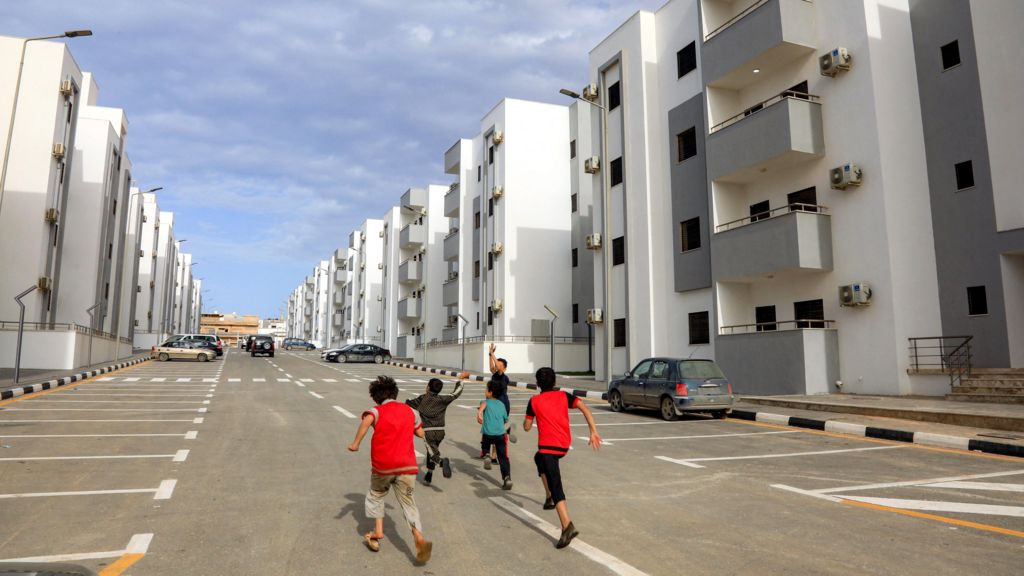
Three years after 2023’s catastrophic Storm Daniel triggered the collapse of two upstream dams above Libya’s eastern coastal city of Derna, sending a 7-meter wall of floodwater surging through sleeping neighborhoods to kill an estimated 4,000 people, 27-year-old port worker Abdulwahab Damdoum stands on the balcony of his brand new 300-square-meter Mediterranean-facing luxury apartment and expresses profound relief. For Damdoum, who clung to a rooftop alongside 14 relatives and neighbors as the waters rose and lost his father, brother, sister, and all 13 other people on that roof to the disaster, the free, fully furnished home is a life-changing reprieve after months of scraping by on temporary rented accommodation. His new residence is part of the sprawling 2,000 Apartments showcase development, a core component of a $2 billion Derna reconstruction program commissioned and overseen by Belkacem Haftar, the son of Khalifa Haftar, the powerful military strongman who controls Libya’s eastern territories.
Across Derna, billboards and wall posters featuring portraits of Khalifa Haftar, Belkacem (widely known locally as “the Engineer”), and his younger brother Saddam Haftar, a senior military leader also involved in reconstruction operations, line nearly every major thoroughfare. The flagship housing complex is equipped with a brand new mosque, full-service hospital, shopping mall, and primary and secondary schools, while newly paved roads and reinforced bridges have replaced infrastructure washed away by the flood. Hussein el-Mansory, the project manager for the apartment development, notes that no large-scale public construction projects of this scale have been completed anywhere in Libya since the 2011 ouster of Muammar Gaddafi, expressing immense pride in his team’s work to rebuild the shattered city.
But not all flood survivors have received new housing or full restoration of their damaged properties. Izz al-Nasr Ibzeou, a marine science lecturer at Derna’s local university, lost his wife, her mother, and all seven of his children aged 1 to 11 in the flood, and has never recovered their bodies. His flood-ruined family home remains a gutted empty shell, and he visits it daily to sort through dust-covered mementos including his young son’s well-loved bicycle and his daughter’s special occasion dress, even as local authorities have declined to fully restore the property because he owns a separate undamaged apartment elsewhere in the city. Most graves in Derna’s new dedicated flood cemetery are marked only with numerical tags, as DNA matching efforts to identify recovered remains remain incomplete, forcing grieving families like Ibzeou’s to wander the burial grounds guessing at the locations of their loved ones.
The $2 billion Derna reconstruction budget was allocated by Libya’s east-based parliament, drawn from the oil-rich nation’s public state coffers. The eastern legislature has since approved an additional nearly $11 billion in three-year funding for Belkacem Haftar’s newly expanded Development and Reconstruction Fund, which has already begun rolling out large-scale projects in Benghazi, Libya’s second-largest eastern city, where new skyscrapers, modern hospitals, residential complexes, and a refurbished football stadium that hosted a 2024 friendly match between European clubs Inter Milan and Atlético Madrid have spurred local officials to float ambitions of turning Benghazi into a “Dubai on the Mediterranean.” Belkacem Haftar told the BBC that his reconstruction efforts have delivered tangible, visible public benefits that no prior Libyan administration, either during Gaddafi’s 40-year rule or the post-2011 interim governments based in Tripoli, ever managed to produce, framing his work as a corrective to decades of neglect and wasted public funds.
Yet the high-profile reconstruction push faces mounting criticism from independent watchdogs, human rights groups, and Libya analysts over total lack of public transparency, zero published financial records detailing how the multi-billion-dollar budgets have been spent, and widespread allegations of corrupt contracting practices. Claudia Gazzini, a senior Libya analyst with the International Crisis Group, noted that there is “absolutely zero accountability” for the Reconstruction Fund’s spending, as no audited financial statements have ever been released to the public, even for formally approved, documented state disbursements. Though Belkacem Haftar claimed to the BBC that the fund’s operations are independently audited and all construction contracts meet strict international standards, he never provided the promised audit documents despite repeated follow-up requests from BBC journalists.
Jalel Harchaoui, a London-based Libya expert affiliated with the Royal United Services Institute, has interviewed dozens of foreign firms awarded lucrative construction contracts under the program, and confirmed that nearly all international contractors are required to partner with a nominally private Libyan company with indirect ties to the Haftar family or other powerful eastern Libyan political elites. Most of these local partners are effectively empty shell entities that contribute almost no labor or technical expertise to projects, yet demand a 50-50 split of total project funds, resulting in widespread overcharging that doubles the actual cost of roads, bridges, and new buildings, with the excess profits siphoned off to connected elites. All reconstruction funding, Harchaoui emphasizes, comes directly from Libya’s national public oil wealth, not private external investment.
Critics also point out that the Haftar administration has adopted a strictly top-down, no-public-input approach to all reconstruction planning, and has ignored offers of technical support from international hydrology and disaster risk reduction experts to implement holistic flood mitigation measures, such as creating dedicated flood plains along the river that cuts through Derna, to prevent a repeat catastrophic dam failure. The two original dams that collapsed in 2023 have never been rebuilt, leaving the city still exposed to significant future flood risk. International human rights organizations have additionally long documented widespread allegations of severe human rights abuses by Khalifa Haftar’s Libyan Arab Armed Forces, including secret extrajudicial executions, arbitrary detentions, and enforced disappearances, all of which the Haftar family and the east-based Benghazi government categorically deny. The Derna showcase project, analysts note, is a deliberate strategic tool for the Haftar family to project governing competence to populations in western Libya, as the country remains deeply split between rival competing administrations in the east and west, amid ongoing international diplomatic efforts to negotiate a national power-sharing settlement.