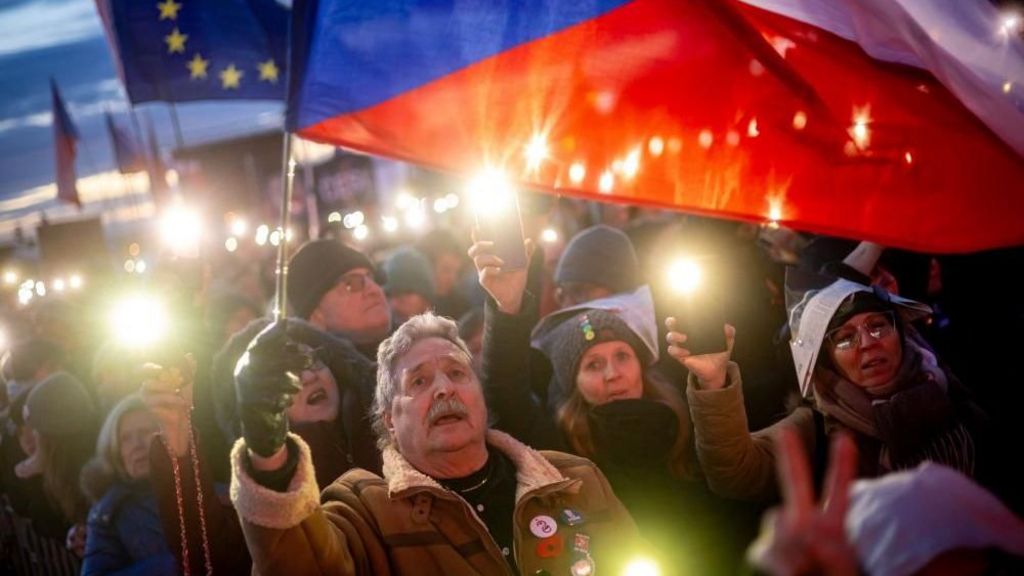
Tens of thousands of Czech citizens flooded the streets of central Prague on a recent Sunday, in a show of mass opposition to the ruling coalition’s proposed legislation that would eliminate the long-standing household public media licence fee and reallocate public broadcaster funding directly from the national state budget. Organised by the prominent civic group Million Moments for Democracy, the demonstration drew an estimated 400,000 attendees, marking the largest public gathering of its kind since the Czech Republic gained full independence in 1993.
Under the current existing system, every Czech household pays a mandatory 205 Czech crowns (equivalent to roughly $9.44 or £7.06) per month to support national TV and radio public service broadcasters. The draft bill, which successfully passed its first parliamentary reading late last month, has sparked a wave of consecutive public rallies across the country in the weeks leading up to Sunday’s landmark demonstration. Protesters and press freedom advocates widely argue that shifting public media funding to direct line items in the state budget would grant ruling politicians unprecedented leverage over editorial operations, creating a pathway for ruling parties to suppress critical coverage and erode long-standing media independence safeguards.
The current ruling coalition, led by populist Prime Minister Andrej Babis’ ANO party alongside two right-wing Eurosceptic allied parties, has repeatedly pushed back against these public concerns. Babis, who took office as prime minister in December 2025, has publicly stated that the reform is purely a practical update to an outdated funding model, noting that several other European nations have already adopted similar frameworks. He cited France, which abolished its public media licence fee in 2022 to fund public broadcasters via a designated share of national VAT revenue, and Norway, which moved public broadcaster financing directly into the state national budget in 2020, as examples of the widespread regional shift away from the traditional licence fee system. Babis has emphatically denied any ulterior motive to control public media content, stating to the Czech News Agency that “no one wants to dictate to them what they should say and do, no one wants to nationalise them,” and that the core goal of the policy is to push public broadcasters to streamline operational costs.
But widespread public distrust of the proposal remains high. Many demonstrators carried creative, symbolic props to signal their solidarity with public service media: hundreds fashioned pointed paper hats out of old newspaper pages as a tribute to Vecernicek, the beloved iconic animated character who has hosted Czech Television’s nightly children’s bedtime story segment for multiple generations. 72-year-old pensioner Milana Rudolfova, one of the attendees, shared her concerns with Reuters, noting that “I know that our entire Czech Television is a guarantee of truth and objectivity. If we do not have public television and radio then unfortunately we will not be able to believe anything anymore.”
International press freedom groups have also raised alarms about the proposed policy, drawing direct comparisons to media control measures implemented under former Hungarian Prime Minister Viktor Orbán, who faced widespread international condemnation for tightening ruling party oversight of state media during his tenure. Pavol Szalai, Prague Bureau director for Reporters Without Borders, noted back in June that “Political attacks against private and public media have become one of the hallmarks of Andrej Babis’ premiership.”