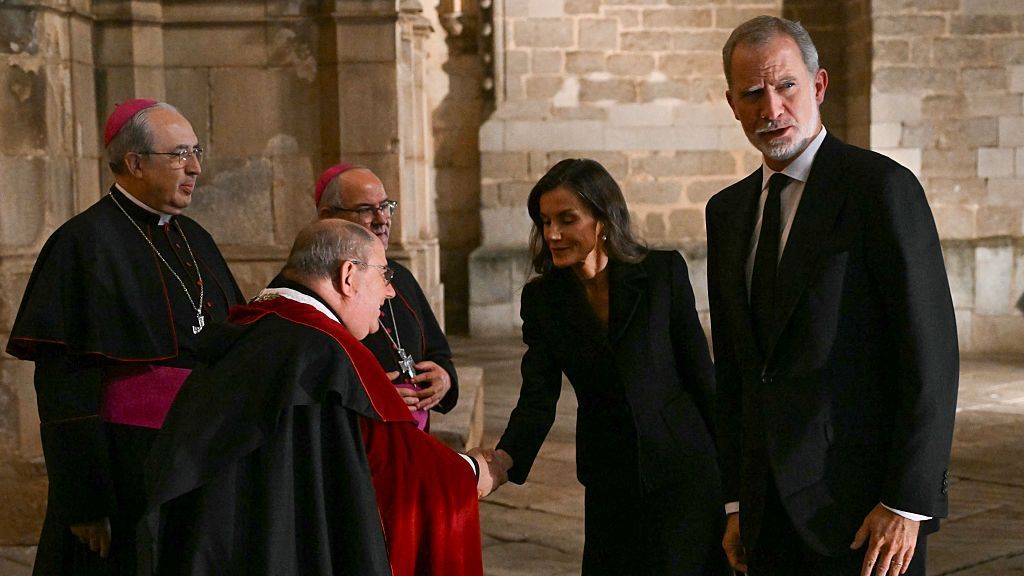
On a sombre Tuesday, Spain’s King Felipe VI and Queen Letizia were welcomed by waiting clergy as they stepped into the packed Toledo Cathedral for an official funeral mass honouring the 69 lives lost in last month’s catastrophic high-speed rail collision near the small rural town of Urda, roughly 40 miles outside the city of Toledo. The devastating incident unfolded when a moving high-speed train travelling at excess velocity slammed into the rear of a second stationary train on the busy Madrid-Seville intercity line, marking the deadliest rail disaster recorded in Spain since 2013. As of the memorial, 28 people injured in the crash remain receiving treatment in regional hospitals. The solemn service, led by the Archbishop of Toledo, opened with remarks from Archbishop Cerro Chaves, who addressed the hundreds of grieving attendees, saying, “The tragic accident in Urda has left our families, our towns and our society with a pain that is difficult to accept.” In a moving ritual, family representatives of the deceased walked slowly down the cathedral’s central nave carrying lit candles, which they laid beside the main altar in tribute to their lost loved ones. The first formal scripture reading of the mass was delivered by Ana Benítez, whose 38-year-old brother David Benítez, a father of two young children, was among the fatalities. As the Spanish monarchs entered the cathedral, they received quiet, respectful applause from onlookers gathered at the entrance, and once the Catholic mass concluded, the royal pair took time to speak one-on-one with grieving relatives to offer their personal condolences. A cross-section of Spain’s top political figures also attended the interfaith memorial, including opposition People’s Party leader Alberto Núñez Feijóo, Castilla-La Mancha regional president Emiliano García-Page, and newly appointed Transport and Economy Minister Carlos Cuerpo. Cuerpo stepped into the transport portfolio just one week prior, following the high-profile resignation of former transport chief Óscar Puente, who had faced intensifying public and political backlash in the wake of the Urda crash. The Urda disaster was Spain’s second major fatal rail collision in 2024, coming just 10 months after a separate crash on the same Madrid-Seville high-speed line killed 46 people near the Andalusian town of Adamuz in January. Residents from both Adamuz and Urda travelled to Toledo to attend the joint memorial, standing side by side in shared grief. Official investigators have not yet released a final public report on the root causes of the Urda crash, though Puente publicly stated before his resignation that early evidence pointed to a combination of human operational error and a technical fault in the line’s automated safety signalling system. The memorial service was held exactly one month before Spain’s scheduled 29 November general election, with political analysts widely noting that the public outcry over repeated rail safety failures poses a significant hurdle for Socialist Prime Minister Pedro Sánchez’s re-election campaign. Adding to the day’s tensions, the national memorial unfolded simultaneously with a nationwide strike by Spanish train drivers, who staged industrial action to demand immediate, sweeping upgrades to the country’s rail network safety protocols. Further widespread disruption was forecast for the following day, as a separate general strike organised by housing advocacy groups was set to bring large parts of public life to a halt, with protesters calling on the national government to implement strict new rent control measures to address Spain’s worsening affordable housing crisis.