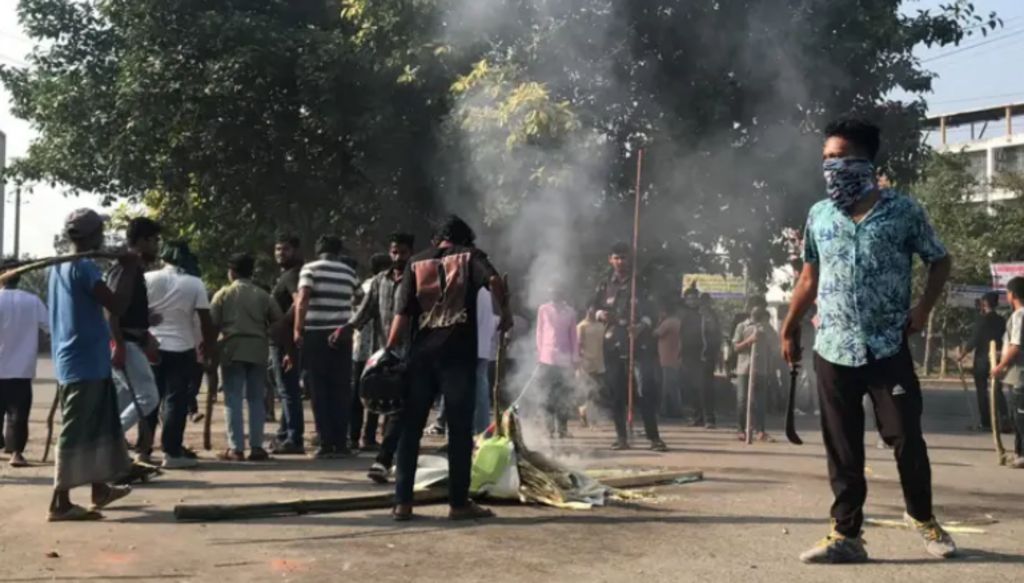
A wave of unrest has swept across Bangladesh in recent days, as loyalists of deposed former prime minister Sheikh Hasina stage coordinated nationwide demonstrations demanding her return from two years of exile in India, prompting a forceful response from national security forces. Law enforcement units deployed tear gas canisters and fired rubber bullets to disperse crowds of pro-Hasina activists, as unrest flared most intensely in the Gopalganj district, where the formally banned student wing of Hasina’s Awami League party, the Bangladesh Chhatra League (BCL), engaged in direct, violent clashes with security personnel. A police patrol vehicle was completely set ablaze during those Gopalganj confrontations.
These coordinated actions mark the first large-scale, organized show of strength from Hasina’s support base since she was ousted in August 2024, when a sprawling mass popular uprising against her 15-year authoritarian rule forced her to flee across the border to India. The mobilization kicked off barely 24 hours after Hasina publicly confirmed she had submitted a formal passport application to the Bangladeshi High Commission in New Delhi, with the stated goal of returning to her home country in December.
Protesters erected makeshift roadblocks across multiple urban and rural corridors, stacking burning tires and igniting large fires directly in the middle of major thoroughfares to bring traffic to a standstill. A string of arson attacks on civilian passenger vehicles preceded the formal launch of the demonstrations: in the early hours of Tuesday in the city of Faridpur, a 60-year-old bus driver was trapped inside his burning vehicle and died of fatal smoke inhalation. Elsewhere, a crowd of roughly 200 pro-Hasina demonstrators staged a brief, disruptive sit-in on the 6.2-kilometer Padma Bridge spanning the Ganges River, a critical infrastructure link that connects the capital Dhaka to the country’s entire southwestern region. Local Bangladeshi media outlets also reported that dozens of low-yield crude explosive devices detonated across Dhaka and other regional population centers over the past 72 hours.
The country’s top interior official, Home Minister Salahuddin Ahmed, issued a stern public warning in response to the unrest, stating, “Any attempt to sabotage public order and manufacture domestic instability through cross-border conspiracy originating in India will never be permitted to succeed.” For their part, exiled senior BCL leadership based in an undisclosed foreign country denied all responsibility for the violent acts, claiming “unknown miscreants” carried out the arson and bomb attacks, and emphasizing that their movement remains committed to peaceful protest.
The backdrop to the current unrest stretches back to mid-2024, when initially small student-led demonstrations against controversial government job quota policies escalated into a nationwide mass uprising after a deadly police crackdown on peaceful protesters. The United Nations later estimated that as many as 1,400 people were killed during that 2024 popular movement, the vast majority fatally wounded by gunfire from government security units. After Hasina fled the country, her long-ruling Awami League party was formally banned from political activity and barred from participating in the February national general election held later that year. A specially constituted Bangladeshi war crimes tribunal subsequently sentenced Hasina to death in absentia, convicting her of systematic crimes against humanity. Hasina has repeatedly rejected all charges against her, dismissing the tribunal process as entirely biased and driven by partisan political motives.
The current interim Bangladeshi government has explicitly rejected Hasina’s passport application, labeling her a “terrorist” and a fugitive from justice. Junior Foreign Affairs Minister Humaiun Kobir confirmed that Dhaka is actively invoking its bilateral extradition treaty with India to demand Hasina’s forcible repatriation. A state prosecutor announced publicly on Tuesday that the pending death sentence against Hasina would be immediately carried out upon her arrival in Bangladesh, as the legal window for her to file an appeal against the tribunal verdict has already expired. Awami League representatives have also alleged that hundreds of their rank-and-file supporters have been killed in targeted mob violence and dozens more have died in security force custody in the two years since Hasina’s ouster, though Dhaka administration officials have categorically denied claims that the party’s supporters are facing systematic, state-sponsored persecution.