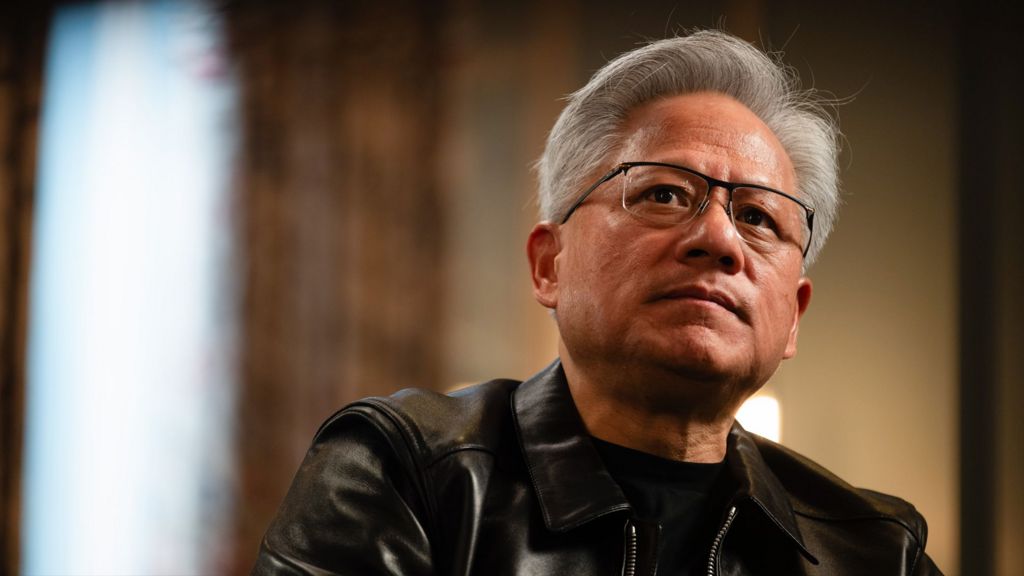
The world’s second-most valuable corporation, semiconductor giant Nvidia, saw roughly $250 billion erased from its market capitalization in a sharp 6% single-day share drop on Monday, triggered by the board’s announcement of a formal independent investigation into CEO and co-founder Jensen Huang, linked to unsubstantiated espionage allegations. The probe was launched in response to recent media reports, first surfaced by the New York Times, that US intelligence agencies warned senior Washington officials last spring via a memo from Secretary of State Marco Rubio that Huang had been targeted in a Chinese foreign intelligence operation. The alleged operative in question is identified as Alice Huang, also known as Huang Le, a managing director at Singapore-based firm Megaspeed that has maintained existing business ties with Nvidia.
Huang publicly acknowledged the extramarital affair in a formal statement, apologizing unreservedly to his wife and children for his infidelity, while emphasizing he had no indication any of Nvidia’s proprietary intellectual property or sensitive US national security data had been compromised. He further pledged full cooperation with the board’s investigation, and reaffirmed his commitment to safeguarding both the company and American national security interests. The Chinese foreign ministry has categorically rejected all espionage claims, dismissing them as entirely baseless, speculative, and a deliberate smear campaign against the country.
Despite the market sell-off, prominent tech industry figures including Elon Musk have voiced public support for Huang’s continued leadership, while US President Donald Trump described the Nvidia founder as an “honourable guy.” Market analysts widely project the valuation hit will be temporary: Victoria Fernandez, chief market strategist at Crossmark Global Investments, noted that Nvidia’s unrivaled centrality to the global artificial intelligence hardware ecosystem means institutional and retail investors are highly unlikely to abandon their positions, as the entire AI investment ecosystem is anchored to the firm’s chip production output. Founded in 1993 by Huang and two fellow electrical engineers, Nvidia originally specialized in graphics processing units for the gaming sector before Huang pivoted the company’s entire roadmap to prioritize AI-optimized semiconductors, a strategic shift that catapulted it to its current top-tier global market position.
A key underlying concern for long-term investors is the lack of a clear, pre-established successor to Huang, a vulnerability stemming from Nvidia’s single-class voting share structure. Unlike peers such as Meta’s Mark Zuckerberg or Tesla’s Elon Musk, who hold outsized voting control via multi-class stock arrangements, Huang owns only approximately 3.5% of Nvidia’s total outstanding shares, leaving him with no veto power over any board decision to remove him from his post. Fernandez added that the board is unlikely to oust Huang unless concrete, glaring evidence of national security or IP malfeasance emerges, but will almost certainly begin grooming a senior executive as a clear second-in-command for future leadership continuity. The mild scale of Monday’s share drop signals broad market consensus that Huang will retain his position in the near term, though the investigation’s final findings will remain under intense public scrutiny.
The ripple effects of Nvidia’s valuation shifts extend far beyond direct shareholders: millions of ordinary consumers with pension funds or indexed investment savings are indirectly exposed to the company’s performance, as most broad market index funds hold substantial Nvidia stakes. The controversy unfolds against the backdrop of a long-running US-China AI semiconductor trade dispute, in which the White House has previously imposed sweeping restrictions on exports of Nvidia’s most advanced chips to China. Huang has repeatedly pushed back against blanket export bans, arguing that allowing Chinese market access to US-made AI chips would ensure global AI development remains anchored to American technology. Earlier this year, the Trump administration revised its rules to permit limited, condition-bound sales of Nvidia’s high-end H200 semiconductors to Chinese buyers.
Nvidia shares tumble over investigation into Huang’s affair with alleged Chinese spy