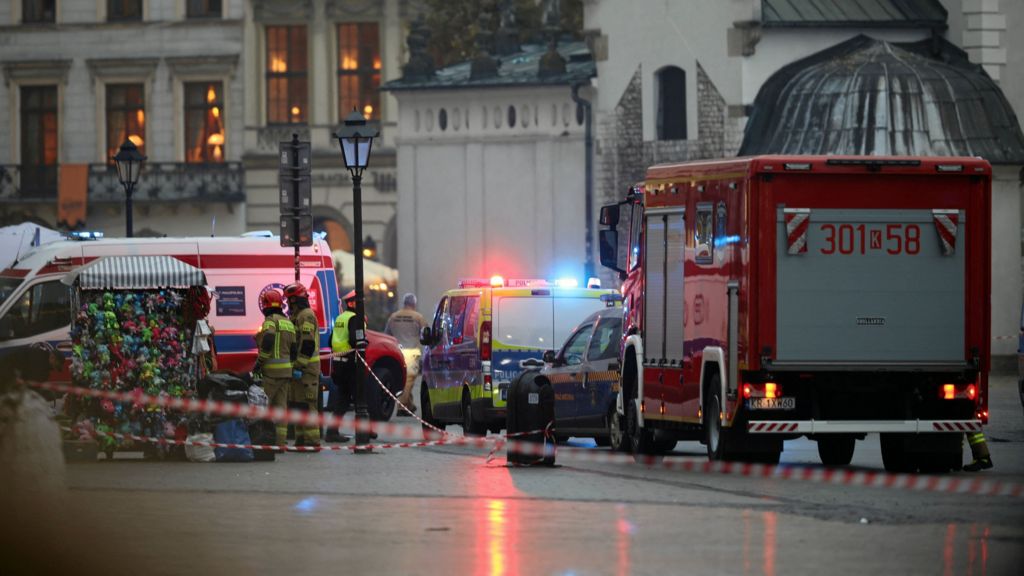
A devastating random shooting spree unfolded on a bustling tourist-packed afternoon in Krakow, Poland’s second-largest city, leaving at least nine people dead and 16 others wounded in what officials have labeled an unprecedented act of domestic terrorism for the country. The carnage began minutes before 3 p.m. local time on the city’s iconic Main Market Square, one of Europe’s largest medieval public spaces, when a 25-year-old Polish suspect drove his vehicle directly into the pedestrian-only plaza before opening fire indiscriminately on passersby from inside his car. Panic erupted across the popular gathering spot as crowds of tourists and local residents fled for cover, with verified on-scene footage capturing clear bursts of gunfire and dozens of people scrambling to find shelter in nearby shops and historic buildings. A passing city tram was also struck by stray bullets, its windows shattered, though no passengers sustained injuries. Armed law enforcement units arrived on the scene within minutes, engaging the gunman in a rapid gun battle that ended just three minutes after the first shots were fired — a response that officials confirmed prevented an even larger massacre. The suspect was shot and taken into custody, where he remains hospitalized following emergency surgery for his wounds. Distressing authenticated footage shows the moment an officer confronted the wounded suspect on the pavement before discharging multiple rounds, after which the officer collapsed to the ground, having sustained gunshot injuries himself. Immediate post-attack sweeps of the area found bullet-riddled storefronts across the square, with shards of broken glass scattered across the stone paving. Police also carried out controlled evacuations of residents living near the intersection of Dietla and Stradomska streets, where the suspect’s vehicle was recovered, as bomb disposal units searched the car for potential explosive devices; no hazardous materials were ultimately found. Initial casualty tallies confirmed six people were killed on the scene in Main Market Square: four women and two men, including one British national, three Polish citizens, and two victims whose identities had not been publicly released in the immediate aftermath. The 16 individuals transported to local hospitals for treatment included five foreign nationals from Austria, Britain, Germany, Portugal and Russia, two on-duty police officers, and the wounded attacker. Poland’s Prime Minister Donald Tusk later publicly identified the two injured officers as Senior Constable Jakub Kulik and Senior Constable Artur Morański, noting that one of the pair remained in extremely critical condition after sustaining three gunshot wounds during the suspect’s apprehension and was still undergoing extended surgery. As law enforcement executed a search warrant at the suspect’s residential address in Ostrowiec Świętokrzyski, a city roughly 200 kilometers south of Warsaw, they uncovered three additional bodies: the gunman’s 21-year-old sister and both of his parents, bringing the total death toll to nine. The suspect, who authorities confirmed was not an active military service member, was found to be wearing military-style apparel during the attack and armed with a military-grade firearm, with large caches of additional weapons and ammunition recovered from both his vehicle and family home. Polish media reports indicate the suspect held a valid firearms permit, and preliminary investigative findings shared by government ministers point to clear ideological ties to far-right ultra-nationalist movements as the motivating force behind the violence. Eyewitness accounts from tourists present at the scene detailed the sheer scale of the chaos: British national Jonathan Balshaw, who had been visiting the city with his Polish girlfriend, recounted hiding inside the side entrance of St Mary’s Basilica alongside dozens of other people for an extended period as more than 20 distinct gunshots, fired from at least two different types of weapons, rang out across the square. Another British visitor, Caitlin Shasby, who had traveled to Krakow for a long weekend break, explained that she and her friend were confined to their hotel rooms for hours after hotel staff notified them of the unfolding attack. In the hours following the incident, Prime Minister Tusk traveled to Krakow to address the public, noting that Poland had never before faced such a severe act of targeted violent extremism against ordinary civilians. Krakow’s mayor Łukasz Gibała immediately signed an official proclamation launching a city-wide period of mourning that would run through November 11. Global leaders swiftly issued statements of condemnation and solidarity: UK Prime Minister Andy Burnham expressed profound shock at the senseless violence, confirming the British government stood in full solidarity with the people of Poland, while Foreign Secretary Ed Miliband shared that the UK was mourning deeply for the lives lost. US Ambassador to Poland Tom Rose described the rampage as a savage, unprovoked murderous attack, EU High Representative for Foreign Affairs Kaja Kallas noted the tragedy’s ripple effects would be felt far beyond Poland’s borders, and Ukrainian President Volodymyr Zelensky extended heartfelt condolences to all grieving families on behalf of the Ukrainian people.