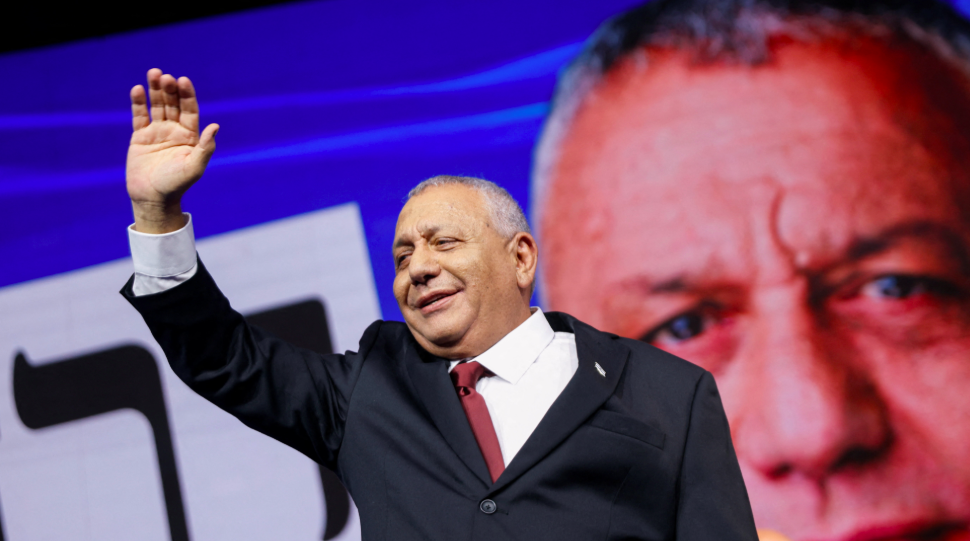
In a major political development following Israel’s deadliest recent parliamentary election, President Isaac Herzog formally selected opposition head Gadi Eisenkot on Saturday to lead negotiations for a new ruling coalition, according to verified Israeli local media dispatches. The move comes after the 27 October national vote produced no clear majority for either long-serving incumbent Prime Minister Benjamin Netanyahu or his rivals, upending years of relatively predictable political bloc dynamics in the 120-seat Knesset.
Eisenkot, a decorated former Israel Defense Forces chief of staff, is set to receive his official mandate to form a government in a formal ceremony scheduled for Sunday evening. Per Israeli legislative procedures, he will be granted an initial 28-day window to assemble a stable governing coalition, with a discretionary 14-day extension permitted if he can demonstrate meaningful progress in cross-party talks.
Final election tallies show Netanyahu’s long-dominant right-wing faction secured 53 Knesset seats, falling 8 seats short of the 61-seat threshold required to form a majority government, even as it remains the single largest unified parliamentary grouping. Eisenkot’s centrist opposition alliance claimed 48 seats, while Arab-led political parties secured a historic combined total of 19 seats, positioning them as the undisputed kingmakers in the high-stakes coalition bargaining process.
In formal consultations held with President Herzog earlier this week, both major Arab-led parliamentary blocs publicly threw their support behind Eisenkot’s bid to form a government. The Ra’am party, led by Mansour Abbas, announced its 8 lawmakers would endorse Eisenkot on Wednesday, followed by the 11-seat Joint List bloc’s unanimous endorsement the following day. This dual endorsement pushed Eisenkot’s total of publicly recommending lawmakers to 67, compared to just 46 public backers for Netanyahu. Notably, the ultra-Orthodox United Torah Judaism party, which had recommended Netanyahu for the mandate in five consecutive prior election cycles, declined to back the incumbent this time around, though it also withheld formal support from Eisenkot.
Leaders of the Joint List framed their unanimous endorsement as a direct response to widespread public demand to block Netanyahu and his far-right allied factions from returning to power, noting that expanding Eisenkot’s parliamentary backing would create the most viable path to oust the sitting government. Following the conclusion of all party consultations, Herzog publicly stated on Thursday that it was the only logical and procedurally appropriate step to award the government formation mandate to Eisenkot.
Despite the public support from Arab-led parties, Eisenkot’s core opposition Change bloc has thus far declined to formalize a full, official alliance with the Arab factions, even though their combined seats would easily clear the 61-seat majority threshold. Instead, the opposition has signaled openness to a previously unthinkable partnership with select ultra-Orthodox parties, a configuration that could deliver Eisenkot enough seats to form a coalition that includes Ra’am as a full member, while relying on external, outside parliamentary support from the Joint List to pass confidence votes.
Netanyahu pushed back aggressively against this potential governing framework in a pre-recorded televised address released on Saturday, warning that any government that relied on support from Islamist political factions would “destroy Israel from within,” drawing a direct, unsubstantiated comparison to social and political shifts he claimed were unfolding across European nations. The long-serving prime minister also renewed his long-running public accusations that Arab-led parties had received improper foreign funding in the lead-up to the election, which saw a record-breaking voter turnout among Palestinian citizens of Israel. Netanyahu doubled down on his years-long call for a narrow national unity government limited exclusively to self-identified Zionist parties, a proposal that President Herzog has publicly indicated he is actively exploring as a potential compromise path.
Eisenkot’s centrist Yashar party fired back at Netanyahu’s remarks, issuing a public statement that called on Netanyahu’s Likud party and its allied factions to sever ties with what it described as extremist hardline partners, and join a broad unity government led by Eisenkot himself.
In a public address delivered on Friday, Eisenkot laid out his core governing priorities, calling for the formation of a broad emergency national administration, and explicitly refusing to rule out the possibility of forming a minority government to break the parliamentary deadlock. He outlined a plan to move with unprecedented speed to build a coalition anchored by the four core Jewish parties of the Change bloc: his own Yashar faction, Naftali Bennett’s Together party, Avigdor Lieberman’s Yisrael Beiteinu, and Yair Golan’s Democrats party. He added that any additional political party that accepted his core governing conditions would be welcome to join the coalition, either at its formal launch or at a later date after the government is sworn in.
A widely respected former military commander, Eisenkot has repeatedly rejected the long-debated two-state solution framework that would establish an independent Palestinian state alongside Israel. During his tenure as IDF chief of staff between 2015 and 2019, he publicly advocated for normalized, expanded diplomatic and security ties with Saudi Arabia, arguing that the two nations should collaborate closely to counter expanding Iranian regional influence. He went on to note publicly that Israel would be prepared to share sensitive military intelligence with Riyadh to jointly counter Tehran’s regional military activities.