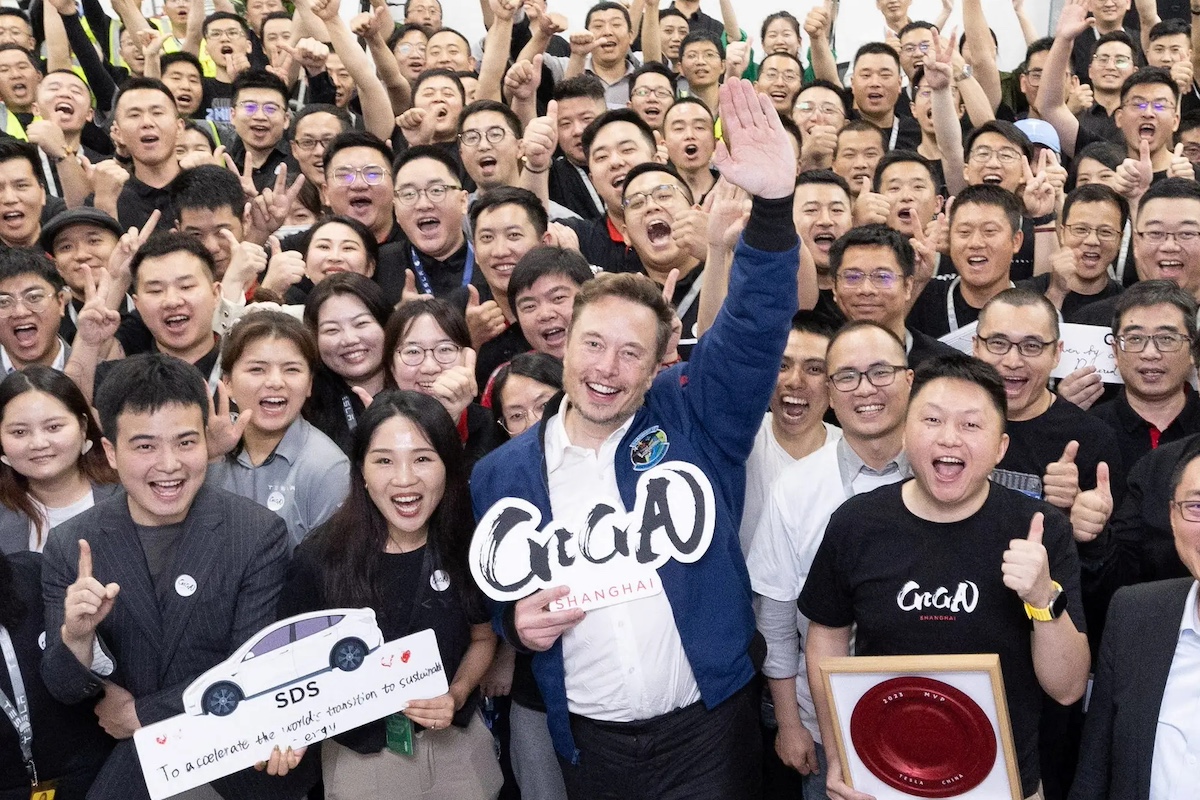
Opening with a playful nod to Taylor Swift’s iconic lyric about proving dedication through songwriting, celebrated Asia Times columnist Han Feizi marks his milestone 50th contribution to the publication, tracing his unlikely origin story: three years prior, then-Asia Times writer David Goldman (now Senior Advisor at the US State Department) invited the anonymous Chinese American Twitter persona, once a frequent intellectual foil, to pen a piece on widely misrepresented Chinese consumption trends. Freed from the pressure of sell-side finance’s relentless cycle of churning repetitive talking points to drive revenue, the columnist soon found old professional habits hard to shake, distilling three years and 49 prior columns into five consistent core theses: that China has underreported its GDP for decades to become the world’s largest economy by a wide margin, that decades of sustained human capital investment via education will power China’s long-term growth trajectory, that the US is trapped by its overinflated asset values and faces steep barriers to reindustrialization to compete with China, that the outdated American imperial framework would benefit all parties including the US if dissolved, and that global economic, social and political shifts can be accurately measured by tracking the global automotive industry’s evolution. As a US national with a documented record of public service, Han Feizi frames his work as written explicitly in the best interests of the American public, targeting Western audiences to cut through the conformist, often willfully misleading narratives pushed by mainstream Anglo-American media. He notes the sharp paradox faced by Asian American public figures like 2024 presidential candidate Vivek Ramaswamy: offering constructive, evidence-based advice to improve the US is often misconstrued as acts of sabotage, with large swathes of the public rejecting pragmatic insights out of stubborn spite. At the root of this resistance, Han Feizi argues, is a pervasive, underrecognized “face” culture embedded in modern American society: a fixation on public status, external dignity and perceived respect that is entirely disconnected from actual intrinsic performance, driving public figures and ordinary citizens alike to prioritize avoiding public humiliation over fixing underlying structural flaws. This dynamic is vividly on display in the recent trajectory of Tesla, the US electric vehicle giant. Back in 2017, Elon Musk announced a next-generation Tesla Roadster scheduled for 2020 launch, collecting up to $250,000 per customer deposit with promises of sub-2-second 0-60 mph acceleration, 250 mph top speeds and 1,000 km of range. The 2020 deadline came and went, and by 2026, Chinese EV manufacturers had already released six 1,000+ horsepower sports cars that match or exceed those performance metrics, with the Xiaomi SU7 Ultra priced as low as $80,000. When Musk finally hosted a 2026 demonstration of the long-delayed Roadster, the stunted, non-production-ready prototype that performed gimmicky stunts over parked cars bore no resemblance to a commercially viable vehicle, with Tesla quietly pushing the delivery timeline to 2028 — an 8-year miss on the original promise. This embarrassing face-saving stunt, Han Feizi notes, is far from an isolated triviality for a low-volume flagship model: Tesla sales have remained completely flat since 2023, while BYD’s global sales have surged over 60% to reach nearly three times Tesla’s total volume. Tesla has discontinued the Model S, Model X and Cybertruck lines entirely, now selling just two core vehicle models compared to BYD’s portfolio of over 30 offerings. Musk successfully lobbied the US government to impose a 100% tariff on imported Chinese electric vehicles, a protectionist move that leaves American consumers locked into Tesla’s $99 per month Level 2+ city navigation autopilot (NOA) subscription, the only system of its kind widely available in the US market. By contrast, more than 140 different vehicle models across every price bracket in China offer Level 2+ city NOA, with all but one provider offering the feature as a one-time purchase rather than a recurring paid subscription, supported by a competitive ecosystem of over six independent tech stack developers. Tesla’s vision-only autonomous driving system has proven incapable of navigating China’s dense, chaotic urban traffic full of scooters, pedestrians and tight underground parking spaces, leaving the company unable to offer comparable L2+ features to its Chinese customer base. Han Feizi emphasizes that he is not singling out Musk for personal criticism, but calling out the deliberate willful blindness of Tesla’s fanatical base of American supporters, who allow themselves to be misled by corporate showmanship rather than demanding better, more affordable products, even celebrating overpriced, mediocre offerings from protected monopolies. The root of America’s declining competitiveness in the EV space, he argues, is laid bare by 2025 PISA global math assessment results: the Beijing-Shanghai-Zhejiang-Jiangsu regional cluster in China counts roughly 525,000 Level 6 (the highest proficiency tier) 15-year-old math students, compared to just 32,000 across the entire US and 57,500 across the EU. While the BSJZ region is among China’s most educationally advantaged, even after adjusting for regional disparities, Han Feizi estimates China produces 60 to 90 times as many top-tier math students as the US, a gap far larger than can be explained by minor differences in average national IQ. This massive talent gap explains why China’s market boasts 400 distinct EV models compared to just a few dozen in the US, and why Silicon Valley’s most persistent bottleneck is a chronic shortage of high-skilled engineering talent — a gap so severe that Tesla’s Shanghai engineering teams were dispatched to the company’s Austin and Fremont factories to resolve insurmountable production bugs for the now-discontinued Cybertruck, Model S and Model X lines. Han Feizi notes that US policymakers are quick to debate tariffs, industrial subsidies and H1-B visa rules for foreign tech workers, but completely avoid addressing the low-hanging fruit of radically improving K-12 math education to narrow the talent gap. Drawing a parallel to the century of humiliating decline the Qing Dynasty endured because its ruling elite refused to acknowledge obvious structural flaws, Han Feizi concludes that his 50 columns are only the start of a long effort to push American audiences to move past face-saving denial and embrace pragmatic reforms that would benefit all US citizens.