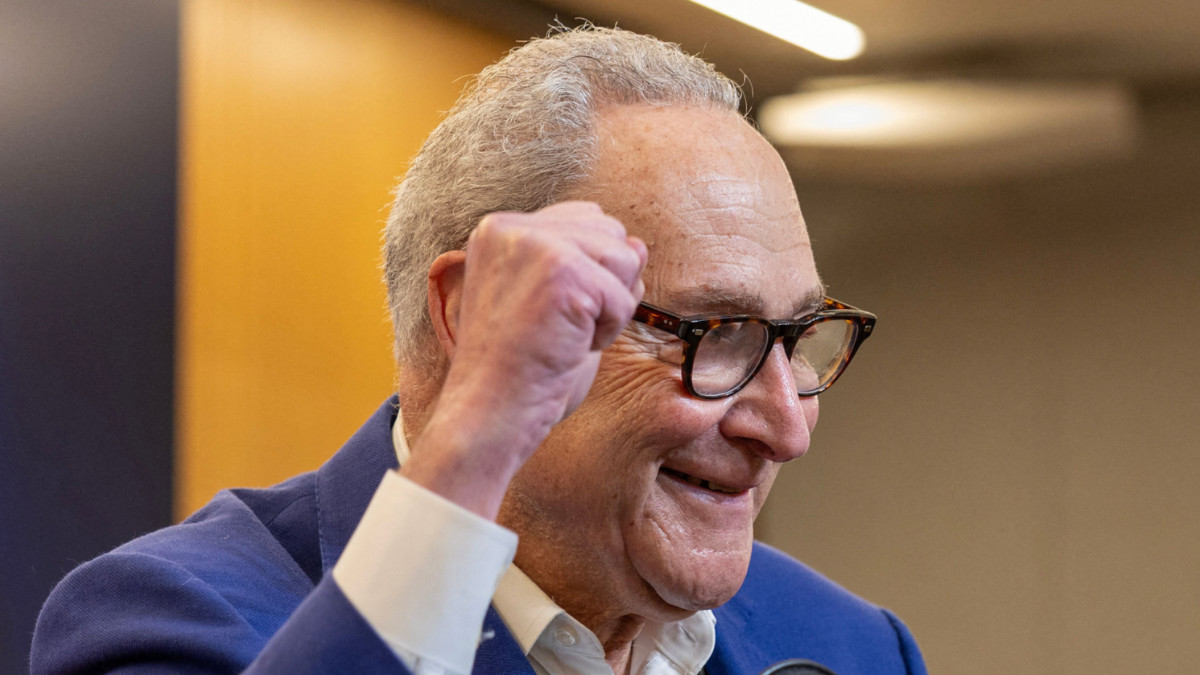
In the aftermath of the Democratic Party’s decisive midterm election victory this week, a growing internal rift has erupted within Senate Democratic ranks, as progressive advocacy organizations and a cohort of incoming freshman lawmakers openly oppose longtime Senate Democratic leader Chuck Schumer’s bid to assume the Senate majority leader post. Three newly elected senators — Adam Hamilton of Kansas, Troy Jackson of Maine, and Abdul El-Sayed of Michigan — have explicitly pledged to vote against Schumer’s leadership during their respective campaign trails, framing their opposition as a push for generational turnover in the party’s top congressional ranks.
Leading progressive advocacy group Indivisible amplified this call for leadership refreshment in a public statement this week, arguing that Tuesday’s sweeping electoral mandate from voters was a clear signal that the Democratic base demands a new cohort of young, dynamic progressive standard-bearers to steer the party’s legislative agenda. “Voters made it very clear that they want a new generation of Democratic fighters,” the group noted. “We need a Leader in the Senate who is capable of leading that fight. It’s time for Senate Democrats to choose new leadership.”
The core flashpoint driving this internal friction is the stark divergence in stances on U.S. policy toward Israel between the 75-year-old Schumer and the new wave of progressive Democratic legislators. A longstanding, vocal advocate for unconditioned U.S. military aid to Israel, Schumer has repeatedly used his legislative influence to block congressional bills that would tie military assistance to Israeli human rights conduct. Back in February 2026, while serving as Senate minority leader, Schumer told a gathering of pro-Israel Jewish leaders that prioritizing unwavering support for Israeli military funding was one of his top official responsibilities. “I have many jobs as leader… and one is to fight for aid to Israel, all the aid that Israel needs,” he stated at the event, going as far as to refer to U.S. taxpayer-funded aid packages for Israel as his personal “baby.” He further pledged that as long as he held a Senate seat, the funding program would continue to expand, and he would block any efforts to roll back or restrict it.
As a prominent Jewish-American Democratic figure, Schumer has long enjoyed robust backing from the influential American Israel Public Affairs Committee (AIPAC). However, newly released polling data commissioned by progressive pro-Israel group J Street and published this week reveals that Schumer’s uncompromising stance on unconditioned Israeli aid is now out of step with the vast majority of Democratic-leaning Jewish voters across the U.S. The survey found that a supermajority of Jewish Americans believe that current Israeli government actions and AIPAC’s advocacy work are contributing to rising levels of antisemitism within the United States.
This dispute over Schumer’s leadership lays bare a far broader ideological schism that has split the Democratic Party for years on Middle East policy. Incoming senator-elect Abdul El-Sayed represents a fast-growing faction of Democratic elected officials and voters who are demanding an immediate end to unconditioned U.S. support for Israel, citing the ongoing humanitarian crisis and widely documented reports of genocide in Gaza, as well as Israel’s decades-long military occupation of the West Bank. At the opposite end of the caucus spectrum, figures such as Pennsylvania Senator John Fetterman remain staunch, unwavering supporters of Israel’s right to self-defense and full U.S. military partnership.
Despite the public pushback from progressives, political analysts widely expect Schumer to secure enough votes to retain his position as Senate majority leader, in large part because no senior, long-tenured Senate Democratic colleagues have publicly declared their interest in challenging him for the top role. When asked about the reported internal rift during a Thursday interview with MS Now, Schumer downplayed the tensions, framing his leadership track record as a key driver of the party’s historic midterm wins. “The bottom line is: first… we’ve had a very, very strong finish here, and I have worked really hard to get the results we got. But second, the issue is not me,” he told the outlet. “The issue is unity, fighting together. We still have a big job to do.”