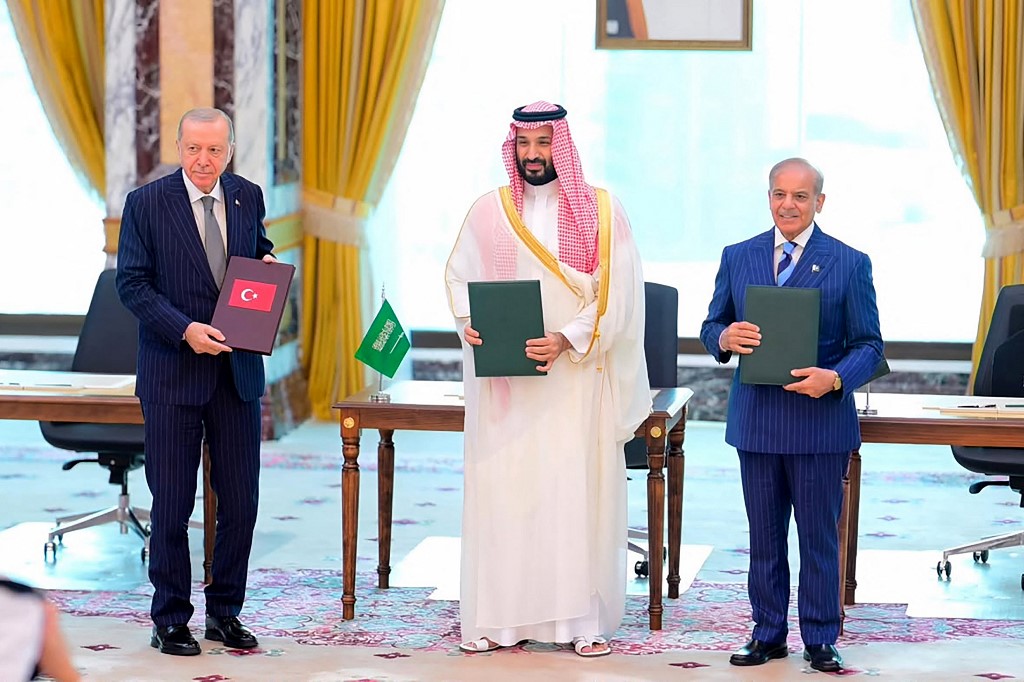
In an early Friday legislative session, Turkey’s national parliament formally adopted the landmark Mecca defence pact, crossing the final major domestic legal threshold required for the country to formalize its membership in the trilateral security framework alongside Pakistan and Saudi Arabia. The historic bill secured 279 votes in favour, with 119 lawmakers casting opposing ballots. Unusually broad cross-chamber backing underpinned the passage: the ruling Justice and Development Party (AKP) and its nationalist coalition ally the Nationalist Movement Party (MHP) formed the core of the pro-treaty bloc, while even the nominally leading opposition Republican People’s Party (CHP) opted to support the measure, a shift widely attributed to internal upheaval within the party after a court-ordered removal of its former leader that split its caucus into two factions, leaving the new CHP leadership increasingly aligned with the Erdogan administration’s foreign policy priorities. The ratification process now moves to the desk of Turkish President Recep Tayyip Erdogan, who is slated to sign the legislation for publication in Turkey’s Official Gazette before the end of the week, at which point the accord will enter into legal force for Ankara. Originally signed by the three regional heavyweights during a high-level gathering in Mecca last August, the text of the 16-article, no-expiry defence pact enshrines a collective security clause stipulating that any armed aggression targeting the independence, sovereign status, or territorial integrity of one signatory will be deemed an attack against all three parties, with no specific nation or geographic bloc explicitly named as a pre-defined threat. The pact’s withdrawal provisions are unusually rigid: no member state may exit the alliance until a full 10 years have elapsed from the agreement’s official entry into force, and any party seeking to withdraw must provide a minimum of three months’ formal written advance notice to the other two signatories. Multiple diplomatic sources with direct knowledge of the negotiations confirmed to Middle East Eye that all three nations had previously committed to completing their domestic ratification procedures ahead of a scheduled trilateral summit later this month, with Islamabad and Riyadh both announcing their own full ratification last month, leaving Ankara’s parliamentary vote as the final outstanding step. Senior Turkish government officials have confirmed that the next immediate policy priority following the pact’s entry into force will be to secure separate parliamentary authorization to deploy Turkish military personnel to Saudi Arabia, a move framed as a defensive solidarity measure to support Riyadh in countering cross-border Houthi attacks originating from Yemeni territory. Turkish Foreign Minister Hakan Fidan emphasized last week that any Turkish troop deployment on Saudi soil will be strictly defensive in scope, with no operational mandate for Turkish forces to conduct missions inside Yemeni national territory. A separate diplomatic source also revealed to MEE that Ankara must still negotiate and ratify a dedicated Status of Forces Agreement (SOFA) with its two new alliance partners to resolve a full range of practical legal details, including delineating civil and criminal jurisdiction over deployed military personnel, setting entry and exit protocols for troops and equipment, establishing customs and taxation rules for military assets, outlining vehicle registration requirements, and formalizing day-to-day legal protections for deployed service members. As of press time, no public confirmation has been issued regarding whether negotiations for this accompanying SOFA have been finalized.
Turkey moves closer to Saudi troop deployment as parliament approves Mecca defence pact