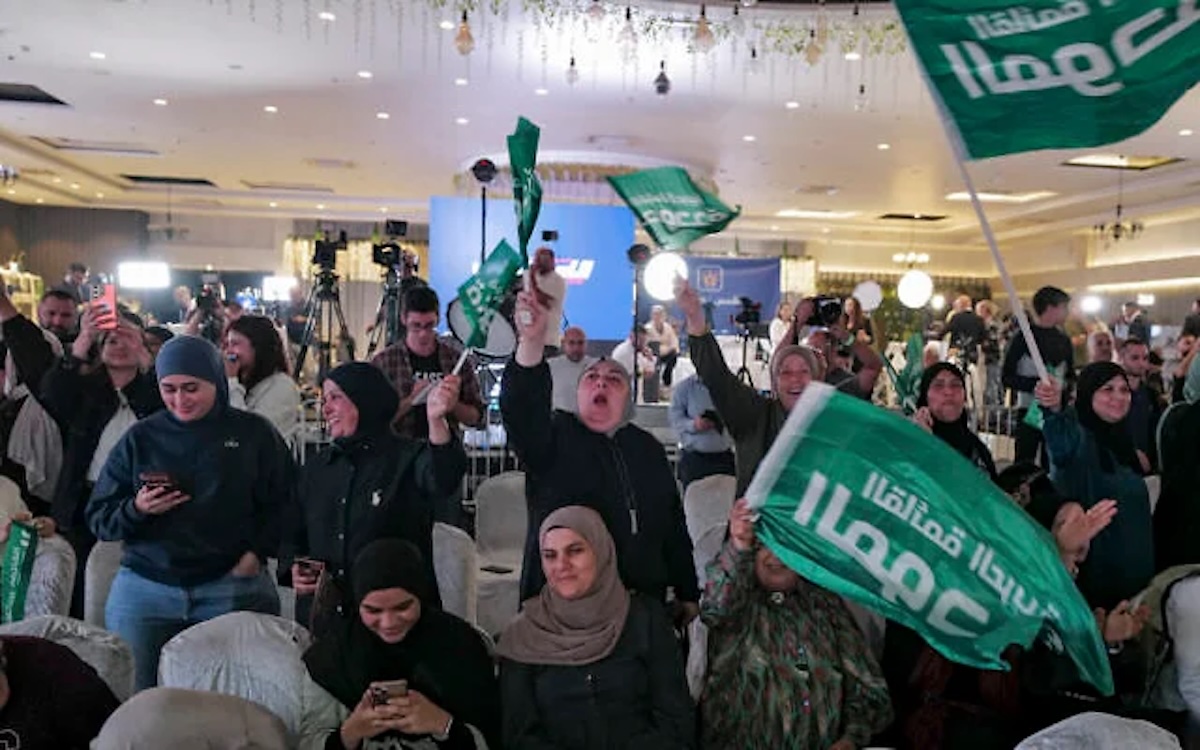
The October 27, 2026, Israeli general election was widely anticipated to serve as a public referendum on the long-running political career of veteran leader Benjamin Netanyahu. But the most transformative, unforeseen outcome of the vote did not center on Netanyahu or his longstanding rivals: it emerged from the roughly one-fifth of Israel’s population that national political systems have sidelined and treated as passive onlookers for decades. The two main Arab-led political blocs, the reconstituted Joint List and Ra’am, secured a combined 19 seats in the 120-seat Knesset, the highest number of legislative seats ever won by Arab-aligned parties in the country’s history.
This landmark seat total falls directly in the narrow gap between the two dominant Jewish-led political factions, leaving neither Netanyahu’s right-leaning camp nor former military chief Gadi Eisenkot’s centrist coalition close to the 61-seat threshold required to form a stable governing majority on their own. For the first time in Israel’s 78-year history, the path to forming a functional national government runs straight through majority-Arab population centers including Nazareth, Sakhnin, and the Bedouin township of Rahat, communities that have long been sidelined in high-stakes coalition negotiations.
The magnitude of this political realignment cannot be overstated. Final verified counts released by Israel’s Central Elections Committee confirm the Joint List won 11 seats, while Ra’am took 8, doubling their combined representation from the 10 seats the two factions held in the outgoing Knesset. The previous record for Arab-led party representation stood at 15 seats, achieved when the original unified Joint List contested the March 2020 election.
Nearly 840,000 Israeli citizens cast ballots for the two Arab-led slates, marking a 64% surge in support compared to the 2022 national election. Arab voter turnout nearly doubled to roughly 80%, even outpacing the national overall turnout rate of 78% – itself a historic high for the country. Arab-aligned parties captured 14.7% of the total national vote share, a four-percentage-point jump from the previous election cycle.
Local-level voting data paints an even more striking picture of this electoral shift. In Tarabin, a Bedouin village in the Negev Desert where Netanyahu’s Likud party had secured clear majorities in the two prior national elections, voter turnout nearly doubled, and Ra’am captured 93% of all ballots cast.
This unprecedented surge in Arab electoral mobilization stemmed from three overlapping, mutually reinforcing forces. First was the return of unified Arab political representation. For years, Arab voter turnout rates have closely correlated with whether Arab parties choose to run as a single coordinated bloc: turnout hit 63.5% when the original Joint List formed in 2015, peaked near 65% in 2020, then collapsed sharply after the faction split ahead of the 2021 election. When Hadash, Ta’al, and Balad re-united to re-form the Joint List for the 2026 contest, Arab voters turned out in droves to reward the move.
The second driving force was widespread, deep-seated fear across Arab communities. Arab towns and cities have been ravaged by a years-long violent crime wave that state authorities have repeatedly failed to contain: 252 Arab citizens were murdered in 2025 alone, the deadliest single year for Arab Israeli communities on record. In the period following the October 7 conflict, Arab citizens also faced rising state suspicion, arbitrary arrests over social media speech, and a national campaign where numerous Jewish candidates openly courted right-wing voters with overt anti-Arab rhetoric. Even the basic right of the two Arab parties to contest the election was thrown into jeopardy, until the Supreme Court overturned the Central Elections Committee’s decision to disqualify both the Joint List and Ra’am on October 2.
Third, Arab voters for the first time sensed their ballots could carry tangible, decisive political weight. With the two major Jewish-led blocs almost perfectly evenly split in the Knesset, both Arab parties ran campaigns centered on a clear, unifying message: choosing to stay home on election day is not a neutral act. While the two factions held differing stances on broader regional and conflict issues, both campaigned on concrete promises to boost public safety in underserved Arab communities and deliver long-overdue public investment to underfunded Arab local municipal authorities.
The parliamentary arithmetic of the new Knesset is unambiguous. If Eisenkot’s centrist bloc forms a partnership with the two Arab-led parties, the combined total reaches 67 seats, a comfortable, stable governing majority. Netanyahu’s faction holds only 53 seats, with no plausible path to reach the 61-seat majority without rare, high-profile defections from opposing camps.
But the two Arab-led parties bring starkly different governing philosophies and priorities to the negotiating table. Ra’am leader Mansour Abbas, who in 2021 made history by leading the first independent Arab faction to ever join a formal Israeli governing coalition, is openly seeking a return to cabinet. He has stated his party would join an Eisenkot-led government if Ra’am is granted the powerful internal security portfolio, and the party’s inclusion of a Jewish deputy leader is a deliberate public signal of willingness to build cross-communal cooperation.
The Joint List, led by Yousef Jabareen, has outlined a far more limited framework for collaboration. The faction says it will vote alongside the opposition to oust Netanyahu and hardline far-right figures Itamar Ben-Gvir and Bezalel Smotrich from power, but will refuse to take any cabinet seats as long as Israel’s occupation of the West Bank continues. This framework points to a potential minority government structure, where Ra’am holds full cabinet membership while the Joint List provides external support on key confidence and supply votes to keep the administration in power.
The primary barrier to this historic cross-communal partnership is not reluctance from Arab parties, but deep divisions among Jewish political actors. Eisenkot and his allies campaigned on a public pledge that they would not rely on Arab parties to secure a governing majority. Prominent lawmaker Avigdor Liberman remains categorically opposed to any partnership with Arab factions, and right-leaning members of Eisenkot’s own Yashar party have signaled they may reject any deal that includes Arab political blocs.
Eisenkot has instead laid out a set of preconditions for formal cooperation, which local media reports indicate include requirements for partner factions to recognize Israel as a Jewish state, support mandatory national service frameworks, and formally condemn Hamas as a designated terrorist organization. Abbas has publicly stated these conditions do not pose an insurmountable barrier for Ra’am, while Jabareen notes the rules only apply to formal cabinet members – a status the Joint List has already ruled out for the duration of the West Bank occupation.
Meanwhile, Netanyahu and Likud have spread unsubstantiated claims that Arab parties “stole” the election with illicit foreign financial backing, framing any Jewish-Arab governing partnership as an existential threat to the state of Israel. Likud figures have also pointed to the arrest of three activists suspected of vote-buying with alleged ties to Ra’am – accusations the party firmly denies. Top election officials have dismissed the broader fraud claims outright: Central Elections Committee chair Justice Noam Sohlberg confirmed that even if the narrow, alleged vote-buying incidents are proven in court, they are not significant enough to overturn the overall election result.
Deep divisions have also spilled out onto Israel’s streets. Tens of thousands of demonstrators gathered in central Tel Aviv to rally in support of a Jewish-Arab governing partnership, while separate groups of protesters assembled outside Eisenkot’s private home in Herzliya to voice fierce opposition to any collaboration with Arab political parties.
Supporters of formal cross-communal political partnership argue that the 19 Knesset seats held by Arab-led parties represent the legitimate, democratic voice of one-fifth of Israel’s entire citizen population. Systematically shutting Arab representatives out of governing negotiations would send a clear message to Arab voters that record-high turnout and civic engagement produces no tangible change, risking the same widespread political disillusionment and disengagement that followed the collapse of the 2021 unity government. Proponents also point out that Ra’am’s prior stint in the 2021 coalition delivered the largest dedicated public investment budget for Arab community infrastructure in Israeli history.
Critics of the proposed partnership counter that the Joint List rejects Israel’s core self-definition as a Jewish state, and that a government dependent on factions outside the traditional Zionist political consensus would be inherently unstable during ongoing regional security conflicts. Skeptics also note that the 2021 unity government that included Ra’am collapsed after less than two years in office.
Regardless of the final coalition outcome, a fundamental, irreversible shift has taken place in Israeli politics. Once the election results are formally certified, President Isaac Herzog will launch official coalition consultation talks, where Arab party leaders are widely expected to formally recommend Eisenkot for the prime ministerial mandate, cementing his status as the clear frontrunner. The candidate who receives the presidential mandate will have 28 days – extendable by an additional 14 – to negotiate and finalize a functional governing coalition.
Electoral surges of this scale can fade over time, but whether this historic mobilization leaves a permanent mark on Israeli democracy will depend far less on Arab voters, who have already made their collective civic voice heard, than on whether Israel’s long-dominant Jewish-led political parties are prepared to treat Arab citizens’ electoral choices as a legitimate governing partner rather than a political problem to be sidelined. The final outcome of these coalition negotiations will not only determine the makeup of Israel’s next government, but also shape for decades to come what Arab Israeli citizens conclude about the real value of participating in the country’s democratic electoral process.