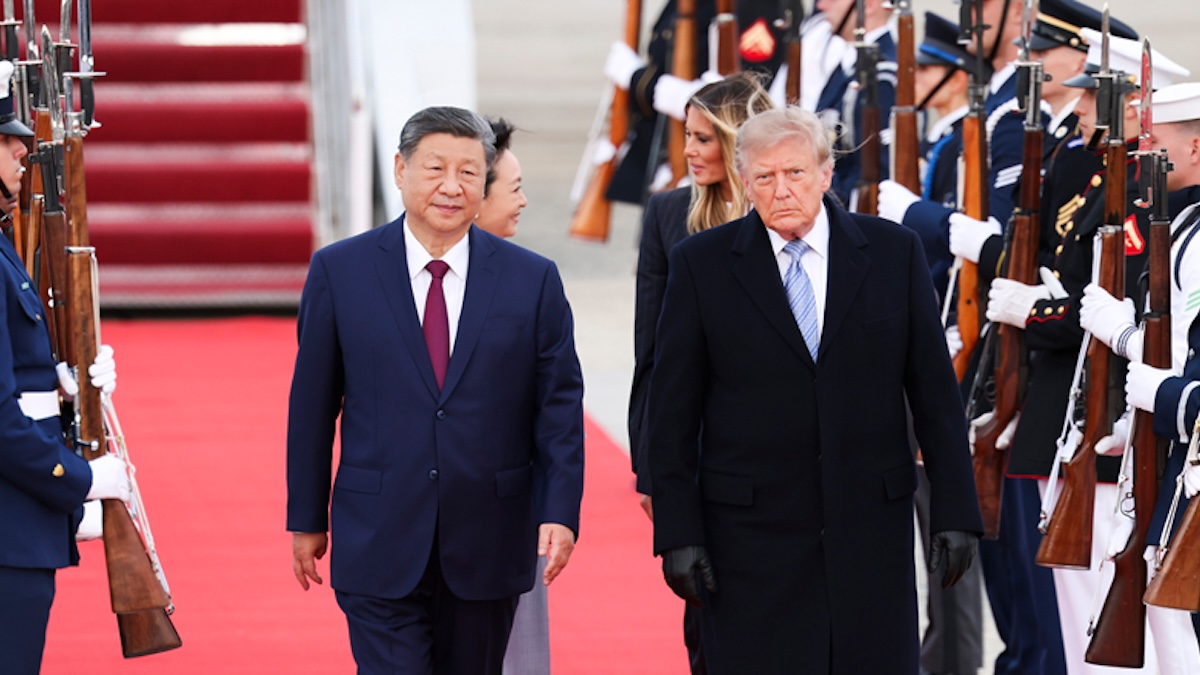
Following the November 3 US midterm elections that delivered full control of both the Senate and House of Representatives to the Democratic Party, a wave of initial cautious optimism among some Chinese social media users that the Republican electoral rout would ease Washington’s pressure on Beijing has been firmly dismissed by leading Chinese foreign policy and geopolitical commentators. The decisive defeat leaves sitting Republican President Donald Trump as a lame duck for the final two years of his term, which runs through January 2029, with a unified Democratic-controlled legislature poised to challenge his policy agenda. Vice President JD Vance publicly attributed the election setback to the ongoing Iran conflict, which has driven sharp spikes in global oil prices, a critique that Trump later endorsed. The electoral upheaval unfolds just two weeks ahead of Trump’s scheduled travel to Shenzhen for the November 18-19 APEC Leaders’ Summit, where he is set to hold a bilateral meeting with Chinese President Xi Jinping; the Kremlin confirmed in September that it had floated the possibility of a three-way trilateral gathering between Trump, Xi, and attending Russian President Vladimir Putin. In the immediate aftermath of vote results, Chinese domestic commentators rapidly revised early popular narratives that framed the Republican loss as a favorable development for China, urging the public to reject the simplistic assumption that any setback for the US automatically translates to gains for Beijing. Analysts uniformly emphasized that aggressive containment of China has long since become a cross-party bipartisan consensus in Washington, meaning Democratic control of Congress will not soften existing restrictive measures, many of which have already been codified into federal law. Existing US technology export curbs and targeted investment restrictions against Chinese high-tech firms are set to remain in place, and could even be tightened further as both major US parties compete to demonstrate a harder line on China policy to their respective voter bases. Pundits also outlined a plausible scenario where Trump, facing legislative gridlock on his domestic priorities, could move to wind down ongoing military engagements in Iran and Ukraine to refocus US strategic resources on the Indo-Pacific, while approving long-delayed large-scale arms sales to Taiwan to shore up support from disaffected conservative Republican voters. A Shandong-based political commentator writing under the pen name Weichang noted in a widely circulated Thursday editorial that the widespread initial Chinese public reaction of celebrating Trump’s lame duck status and assuming US domestic chaos would reduce pressure on China was emotionally satisfying but deeply analytically flawed. “Democrats and Republicans are not debating whether to block China’s rise, they are arguing over the most effective methods to do so,” Weichang wrote. “While the US may be distracted by domestic political infighting in the short term, its long-term strategy to contain China will become far more systematic and coordinated under unified Democratic congressional leadership.” This shift, he explained, will move US technology war policies away from the unilateral, impulsive ad-hoc decisions made by the Trump White House over the past two years, and embed them in permanent, binding congressional legislation. The bipartisan MATCH (Multilateral Alignment of Technology Controls on Hardware) Act, first introduced in April, would compel US allies to synchronize their export control regimes to target leading Chinese semiconductor firms including Huawei and Semiconductor Manufacturing International Corporation (SMIC). Democratic lawmakers are also expected to push to repair the US alliances that Trump strained with his unilateral “America First” policies, repackaging coordinated China-focused restrictions as a collective effort to defend shared democratic values. Even if Trump is disinclined to deliberately escalate cross-strait or tech tensions, the Democratic-controlled Congress will introduce a steady stream of legislative bills focused on Taiwan, Xinjiang, and chip export controls that will force him to take increasingly hardline public stances. Guizhou-based foreign affairs columnist Jiang Tao echoed this assessment, noting that partisan disagreements over China strategy are tactical, not fundamental. “Republicans prefer to apply unilateral, brute-force pressure on China, while Democrats prioritize building broad international coalitions to enforce restrictions. Their methods differ, but their core goal of suppressing China’s technological and geopolitical rise is identical,” Jiang wrote. He added that cross-strait relations are entering an unprecedentedly high-risk volatile phase: while Trump previously paid relatively little attention to Taiwan and was willing to treat arms sales to the island as a negotiable bargaining chip in trade talks with Beijing, his post-midterm political weakness will push him to aggressively play the Taiwan card to win back alienated conservative base voters. This dynamic will combine with Democratic efforts to amplify cross-strait crisis narratives to push tensions to historic new levels. Back in January 2026, the US Congress approved a $14 billion arms sale package for Taiwan, including advanced air defense missile systems, but the Trump White House subsequently ordered relevant federal agencies to halt all progress on the deal, as it sought to advance trade negotiations with Beijing and avoid disrupting a planned May 2026 bilateral summit with Xi. Trump later publicly described Taiwan arms sales as a useful negotiating chip in US-China talks, and the package remains on indefinite hold pending his formal submission to Congress. The two countries had previously agreed to a tentative trade truce after a full-scale tit-for-tat trade war in April and May 2025, under which the Trump administration agreed to allow expanded sales of older-generation graphics processing units to China to buy time for the US to stockpile critical rare earth minerals, while Beijing agreed to avoid steep retaliatory tariffs and give domestic Chinese manufacturers time to diversify supply chains and relocate production facilities to new markets. The two sides extended that existing trade truce, originally set to expire on November 10, 2026, by an additional two months through January 10, 2027, during a September 2026 meeting between Xi and Trump at the White House. Chinese Foreign Ministry spokesperson Mao Ning offered a restrained official response to the US midterm results at a regular Wednesday press briefing, noting that the elections were an internal US domestic affair, and reaffirming Beijing’s commitment to upholding the consensus reached between the two heads of state, expanding pragmatic cooperation, and managing differences on the basis of mutual respect, fairness, and reciprocity. A third Shandong-based analyst writing under the pen name Yanbian warned that Trump’s electoral setback was objectively negative for China, as it would not produce a less capable US rival, but a far more strategically focused, coordinated one. “China should not pay attention to empty rhetoric from US officials, it should track actual US government budgets, passed legislation, export control lists, military deployments, and procurement activities by US allies,” he wrote, warning against three dangerous common illusions: that China can take a strategic break while the US is consumed by internal partisan fighting, that any future new US administration will soften China policy, and that sustained GDP growth alone will automatically solve China’s domestic high-tech bottlenecks. He emphasized that there are no shortcuts to technological self-reliance, and that China must continue to invest heavily to master every segment of critical industrial supply chains, from advanced semiconductors and lithography equipment to industrial software, operating systems, and high-precision manufacturing. Taiwan-based defense research fellow Chen Liang-chih of the Institute for National Defense and Security Research noted that the immediate priority for both sides ahead of the APEC summit is to ensure that the progress made over the past year in high-level bilateral contacts and trade negotiations remains intact, rather than being derailed by the new US domestic political landscape.