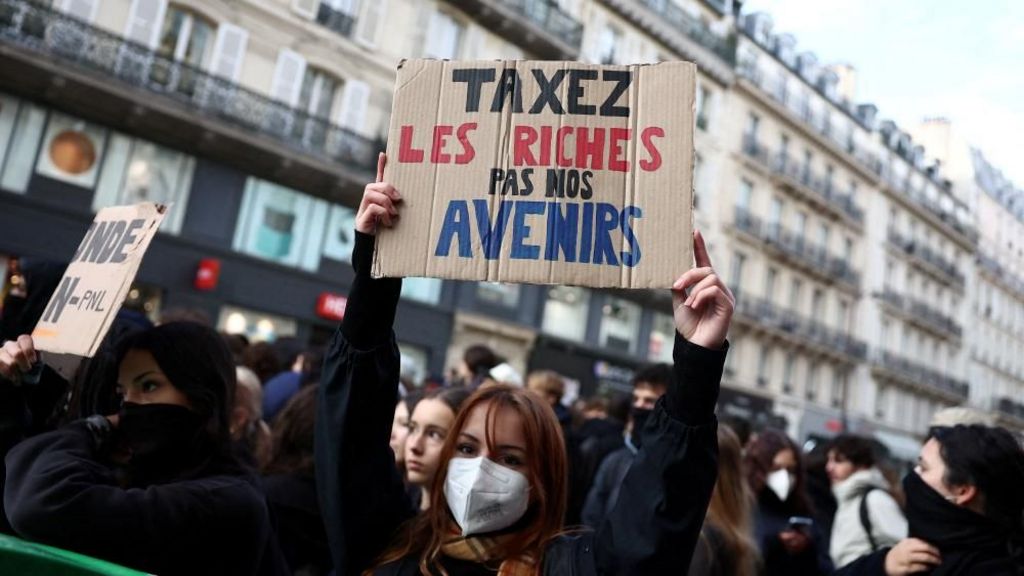
On a crisp Thursday in Paris, a teenage student demonstrator held aloft a placard emblazoned with the rallying cry “tax the rich, not our futures”, embodying the cross-generational fury that has coalesced into a nationwide wave of coordinated strikes and marches organized by five major French labor unions. What first ignited back in September as a grassroots movement led by disgruntled high school students decrying crumbling classroom infrastructure, underfunded learning resources, and systemic inequities in the education system has swelled to incorporate longstanding “yellow vest” activists, private and public sector workers, pensioners, and young people from every corner of the country. Authorities project total turnout will land between 500,000 and 700,000 participants nationwide, with tens of thousands marching in the French capital alone, in what top union officials have dubbed “a great day of convergence” for disparate grassroots and labor advocacy groups. The unified coalition of cross-sector unions has laid out clear, uncompromising demands: sharp wage hikes to offset the crippling cost of living crisis, expanded protections for underfunded public services, a boost to the national minimum wage (the SMIC, currently set at €12.31 per hour), and an across-the-board net monthly pay increase of €100 for all workers, as emphasized by Marylise Léon, head of the powerful CFDT union. To mitigate the risk of unrest following violent outbreaks during marches on October 17 that saw over 2,000 local businesses looted and iconic historic buildings set ablaze, Interior Minister Laurent Nuñez announced the deployment of 70,000 police officers and gendarmes across the country, vowing “an extremely firm response” to any acts of violence, unsanctioned wildcat marches, or disruption from far-left “black bloc” extremist groups. Over 250 separate protest actions are scheduled for the day, with widespread disruptions already rippling across critical public sectors by Thursday morning: schools reported widespread staff absences, hospital non-urgent services were scaled back, public transit routes faced major delays, and refinery workers were called on to halt production entirely. Compounding the operational strain, maintenance and strike-related disruptions at multiple nuclear power facilities have left France on track to import more electricity than it generates for the day, a rare anomaly for a country that typically runs a surplus of nuclear-powered energy. The national government has scrambled to defuse mounting public anger in the lead-up to the action, releasing 10 million barrels of diesel from national strategic reserves to bring down skyrocketing fuel costs, and pledging to reform the widely reviled Parcoursup university admissions platform, with a full phase-out and replacement scheduled for 2028. Union leaders pushed back against last-minute administrative hurdles that complicated march planning: a Paris court only formally approved the central protest route late on Wednesday evening, rejecting the unions’ original proposed path that would have taken demonstrators past the National Assembly, Élysée Palace, and prime minister’s official residence at Hôtel Matignon. The approved revised route will instead guide marchers from Place de la République to Place de la Nation through central Paris, a compromise that still grants access to the city’s core after months of prior marches being restricted to peripheral neighborhoods to avoid unrest. Top union official Sophie Binet framed the day’s mobilization as a critical turning point, stating “The time has come to take the mobilisation to the next level; the strike must take over”, while Léon noted she would view a turnout of 800,000 participants nationwide as a resounding success. Nuñez confirmed the police deployment will match the scale of security operations for the largely peaceful large-scale mobilization held the prior weekend, as officials balance the right to peaceful protest with public safety guarantees for residents and businesses.
France gears up for strikes and protests as unions promise national mobilisation