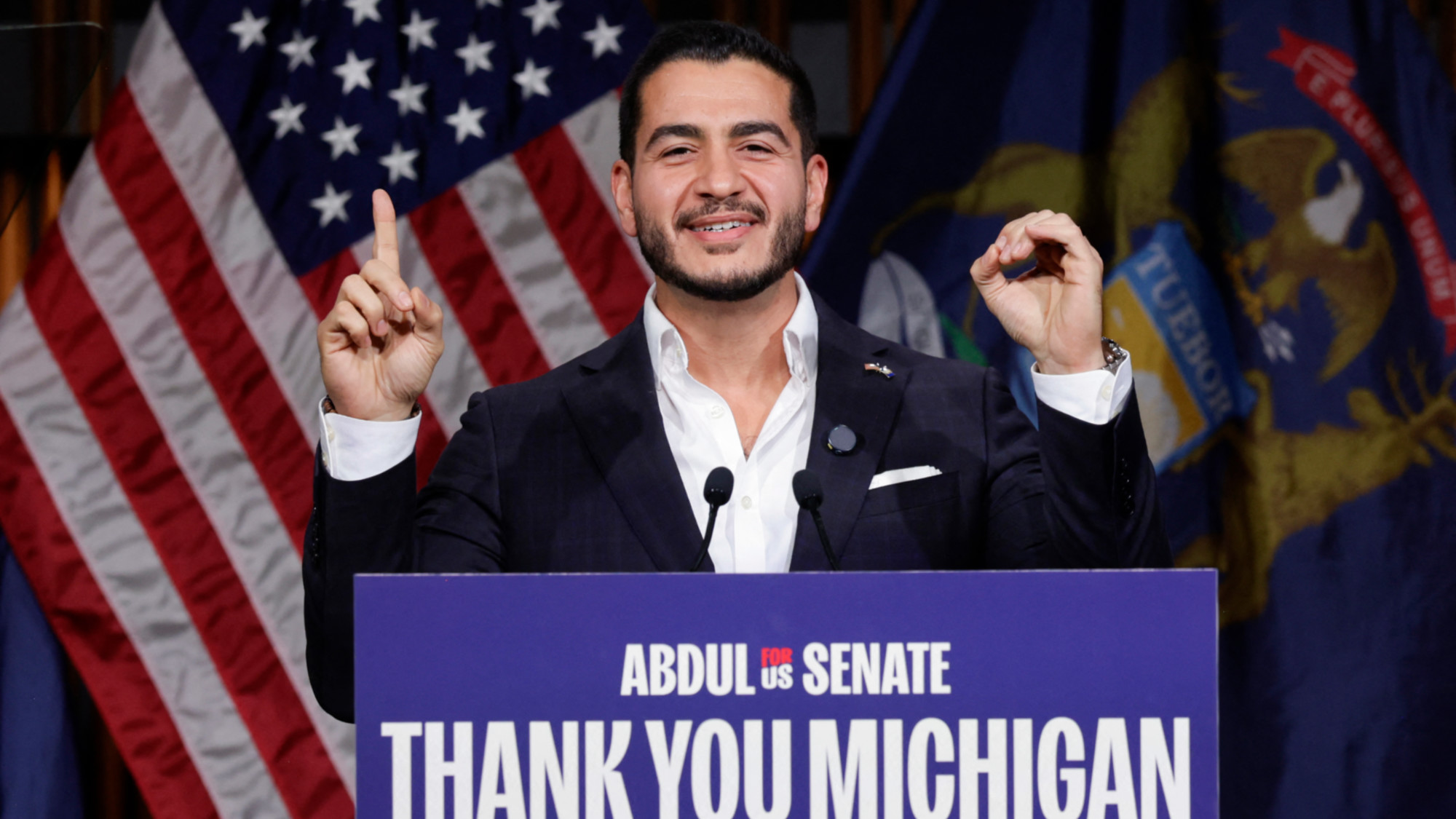
In a landmark electoral milestone that reshapes the trajectory of U.S. congressional representation, Egyptian-American progressive Democrat Abdulrahman Mohammed El-Sayed secured a decisive win in Michigan’s high-stakes U.S. Senate race on Wednesday, cementing his status as the first Muslim lawmaker to join the U.S. Senate when the 119th Congress convenes in January. As 80% of precincts reported results, the Associated Press formally projected El-Sayed’s victory at 2:27 a.m. EST (7:27 GMT), with the 42-year-old holding a commanding 51.8% share of the vote compared to his Republican rival, former Congressman Mike Rogers, who trailed at 46.2%.
Addressing a jubilant crowd of supporters in his victory speech, a visibly energized El-Sayed framed his win as a rebuke of months of targeted Islamophobic attacks launched directly by sitting U.S. President Donald Trump and Vice President JD Vance. “I am so proud and honored to stand here as your senator-elect,” he told roaring attendees, before directing a pointed, good-humored jab at the two top Republican officials who had spent months demonizing his identity. “JD, habibi, there is this delicious irony in the fact that you’re constitutionally obligated to swear me in in January,” he said, drawing thunderous cheers. Turning his attention to Trump, who had repeatedly refused to use El-Sayed’s full name and instead referred to him exclusively as “Mohammed” as a deliberate slur, he added: “Donald, I know you struggle with my name, so after JD swears me in in January, you can just go on and call me Senator.”
El-Sayed dedicated a portion of his address to marginalized families across the country who had watched the presidential administration mock his Arab and Muslim identity for months. “To all the parents who struggled to explain to their kids why the president openly mocked someone for their name or how they pray, let them know tomorrow that the bad guys lost,” he said. “They want an America that is too small for some of us. We know that America is big enough for all of us.”
The historic general election victory capped a grueling primary fight that defied every expectation set by Democratic Party insiders and deep-pocketed special interest groups. Back in August, El-Sayed pulled off a narrow upset over Haley Stevens, a centrist incumbent backed by the powerful American Israel Public Affairs Committee (AIPAC), which poured tens of millions of dollars into efforts to defeat him across both the primary and general election cycles. El-Sayed, who earned an early endorsement from progressive Senate leader Bernie Sanders, later secured the backing of former President Barack Obama to shore up support among the Democratic Party’s centrist base in the critical swing state. He openly called out AIPAC for its unprecedented $42 million spending spree against his campaign during his victory address, telling the pro-Israel lobbying group: “Thank you for giving me the opportunity to beat you twice.”
A core pillar of El-Sayed’s campaign platform centered on reorienting U.S. foreign policy away from unconditioned military aid to Israel, framing that funding as enabling apartheid and what he described as a genocidal campaign against Palestinian civilians. “They try to call you hateful if you believe that Palestinian kids should get to grow up in the land of their forefathers without being murdered by our tax dollars,” he told supporters. “If you believe in equal rights for peace, dignity and self-determination that’s not hate, it’s love. We want our taxes spent here…we don’t want our money sent to do apartheid or genocidal war.” Michigan Democratic Party Chair Curtis Hertel noted that the unprecedented intensity of the primary race drove a 500,000-vote surge in Democratic turnout compared to typical low-participation midterm primaries, a wave of energy that carried through to the general election.
A Michigan native with a long track record in public service, El-Sayed graduated from the University of Michigan, where he delivered the 2007 commencement address and drew public praise for his oratory skills from then-keynote speaker former President Bill Clinton. He went on to earn a medical degree from Columbia University, and previously led public health departments for Detroit and Wayne County. His 2018 long-shot bid for Michigan’s governorship laid the groundwork for his signature Medicare-for-All policy proposal, a national single-payer health insurance plan that has grown increasingly popular across both partisan lines as private U.S. insurance premiums have skyrocketed in recent years. Unlike his fellow progressive New York politician Zohran Mamdani, El-Sayed did not seek an endorsement from the Democratic Socialists of America, a strategic choice to court centrist Democratic voters in Michigan’s politically volatile swing electorate. He rejected all corporate campaign donations, raising every dollar of his campaign war chest from individual grassroots supporters, and made a deliberate push to appear across every major television network, podcast and social media platform to reach voters across the full political spectrum.
His Republican opponent Rogers, by contrast, ran a far lower-profile campaign and received a last-minute endorsement from Trump at a point when the sitting president’s approval ratings were hovering at historic lows. For months, Trump and national Republican surrogates launched a relentless series of smear attacks against El-Sayed, labeling him “a Communist loser who hates Jews and Israel” and pushing unsubstantiated claims that he had secret ties to the Muslim Brotherhood, a group for which no verifiable evidence linking El-Sayed has ever been produced. The Muslim Brotherhood was only designated a terrorist organization by the U.S. after Trump sanctioned three of its political branches the prior year. El-Sayed repeatedly dismissed those identity-focused attacks as a sign of Republican political bankruptcy, noting: “My name is not raising your gas prices. My name is not taking us to war. My name is not the reason you can’t afford your groceries.”
El-Sayed, who is married to an Indian-American physician and shares two young daughters with her, will make history when he takes his Senate seat in January, breaking decades of precedent for Muslim representation in the U.S. upper legislative chamber.