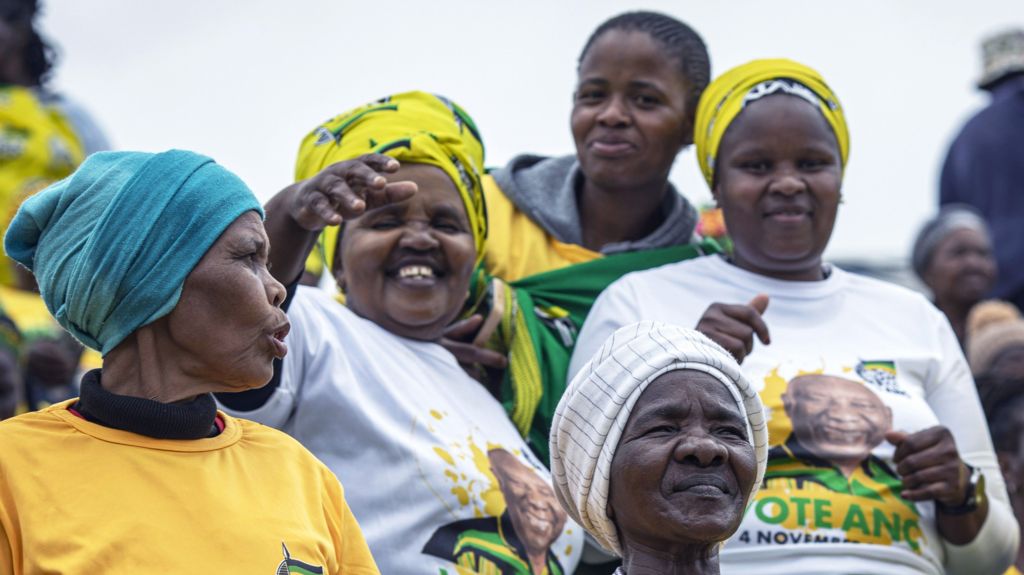
Millions of South Africans headed to polling stations across the nation to cast ballots in fiercely contested municipal elections, where the long-dominant African National Congress (ANC) braces for a potentially historic erosion of voter backing after three decades of leading post-apartheid governance. The vote determines leadership for nearly 300 local municipalities, the government bodies directly responsible for delivering core public services including piped water, reliable electricity, waste collection and road maintenance to communities nationwide.
The 2025 electoral campaign season unfolded with unorthodox, highly publicized outreach efforts from party leaders: candidates were filmed riding through massive, cratersized potholes to highlight infrastructure neglect, joining elderly residents in knitting circles, and even staging stunts with modified vehicles to grab public attention. For the ANC, which governed South Africa as the undisputed leading party in the immediate post-1994 apartheid era, this election represents a make-or-break opportunity to restore public trust after a devastating performance in the 2024 national general election, where it lost its long-held parliamentary majority for the first time in democratic history.
The party’s support has plummeted steadily in recent years, fueled by widespread public fury over rampant official corruption, chronically high unemployment that impacts millions of working-age South Africans, and soaring violent crime rates. At its 2004 peak, the ANC secured 70% of the national vote; by 2024, that share had collapsed to just 40%. While independent polling firms and political analysts have uniformly projected further steep losses for the party in this local ballot, President Cyril Ramaphosa pushed back against narratives of a political downward spiral during the ANC’s final weekend rally, telling cheering supporters: “What I am witnessing on the ground is the ANC surging higher and higher, and on November 4, we will prove all the naysayers wrong.”
In the historic Johannesburg township of Alexandra, a longstanding ANC stronghold located just kilometers from Sandton, Africa’s wealthiest commercial district, years of mismanagement have eroded the party’s traditional loyal base, driving widespread voter apathy. A BBC reporting team visiting the community a week before election day spoke to a cross-section of residents, capturing the sharp divide among young voters. Eighteen-year-old first-time voter Sanele Ntombela expressed cautious optimism that his ballot could push local leaders to address the neighborhood’s visible crises: uncollected garbage piled beneath streetlamps plastered with campaign posters, raw sewage trickling through gaping potholes, and frequent interruptions to water and electricity access. By contrast, most of Ntombela’s peers stated they had not registered to vote, arguing no party had delivered tangible improvements to their lives. Elsewhere in Alexandra, 33-year-old registered voter Zandile Mncube said she would skip the polls entirely, noting that years of successive local governments had only made living conditions worse, and that casting a ballot would make no measurable difference.
The stark contrast between adjacent Sandton, with its gleaming skyscrapers, well-paved roads and upscale retail outlets, and Alexandra’s overcrowded homes, uncollected waste and pervasive stench of sewage is replicated across most townships in Gauteng province, including Soweto, where 45-year-old lifelong resident Mduduzi Makhubo explained that his community now routinely loses access to running water every Monday after 2 p.m. Makhubo said he planned to cast his ballot to push back against the arrogant, unresponsive attitude of local officials and disrupt the long-standing broken status quo.
These on-the-ground accounts align with years of damning findings from South Africa’s Auditor-General, whose latest 2024-2025 audit awarded a top-tier clean financial audit to just 39 of the country’s 257 municipalities. None of Gauteng’s three major metro cities — Johannesburg, Tshwane and Ekurhuleni — made that list, with Johannesburg explicitly flagged as requiring urgent, sustained intervention to reverse its slide into effective bankruptcy, marked by crumbling infrastructure and collapsing service delivery.
With more than 500 registered political parties contesting the nationwide local polls, analysts are closely watching outcomes across South Africa’s eight major metropolitan municipalities, only three of which currently operate under single-party rule. All three Gauteng metros are currently run by fragile coalition governments where the ANC holds the largest share of seats, a dynamic that most experts agree is likely to shift after votes are counted. Veteran political analyst Melanie Verwoerd, a former ANC member of parliament and ex-South African ambassador to Ireland, described the election as a public verdict on the ANC’s decades of governance, noting that pre-election surveys point to the party recording its worst ever electoral performance. An Ipsos poll released ahead of voting put projected ANC national support at just 30%, down sharply from the 46% share it secured in the 2021 local elections. The same polling shows the main opposition Democratic Alliance (DA) making modest gains, with projected support rising from 22% in 2021 to 25% in this cycle, particularly in Johannesburg, where party leader Helen Zille ran a viral, unorthodox campaign that included swimming in massive potholes, ziplining over sinkholes, and arriving at her final rally in a beloved vintage local BMW model nicknamed the “Gusheshe”. Zille has repeatedly argued that municipalities run by the DA consistently deliver far better public services to residents.
Verwoerd predicted that coalition governance will remain the standard across Gauteng’s metros, noting that past local coalition arrangements have often been unstable, with frequent leadership collapses caused by infighting between allied parties that have further undermined public service delivery. She added that the most functional local governing models would likely mirror the current national unity power-sharing agreement between the historic rival ANC and DA, while noting that the DA is almost certain to retain control of Cape Town, widely recognized as South Africa’s best-performing metro. In the coastal eThekwini municipality, which includes the major port city of Durban in KwaZulu-Natal province, the newly formed uMkhonto weSizwe (MK) Party, founded by former president Jacob Zuma, is projected to make strong inroads, but no polls show it securing an outright majority. Verwoerd noted that the MK Party’s refusal to enter governing partnerships with either the ANC or DA would make forming a functional local administration extremely messy, even as Zuma vowed to his supporters on Sunday that his party would seize control of multiple municipalities after results are released.
Fellow political analyst Dr Levy Ndou echoed Verwoerd’s projections, noting that a cross-party ANC-DA coalition appears unavoidable in most major metros, and that it remains unclear whether the existing national unity government framework will trickle down to shape local governance arrangements. Both experts also highlighted the steady, years-long decline in voter turnout, particularly among young South Africans, despite more than 29 million citizens being registered to vote. Ndou attributed this trend to the low quality of many local election candidates, and the fact that most ward councillors, the officials directly responsible for neighborhood-level services, remain largely invisible to constituents throughout campaign season. South Africa’s Independent Electoral Commission has seven days to release final official results, while newly elected parties have a 14-day window to negotiate and form functioning local governing structures.
ANC under pressure to reverse South Africa decline