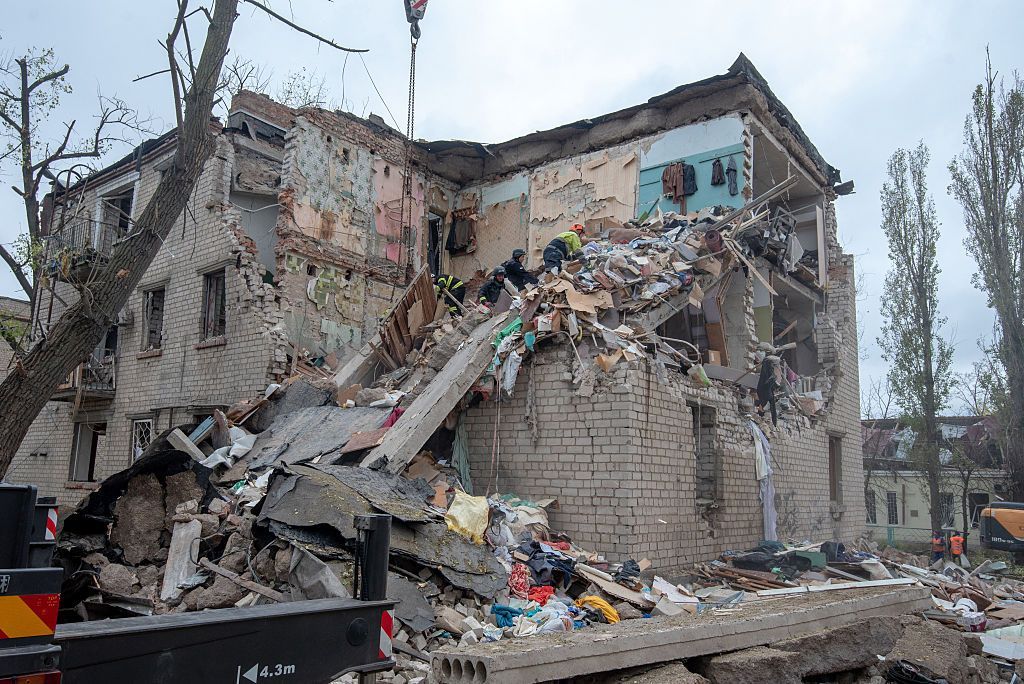
Over a brutal 24-hour period, coordinated Russian aerial assaults across multiple Ukrainian regions have claimed the lives of no fewer than 38 civilians and left hundreds more with life-altering injuries, targeting humanitarian aid distribution points, medical facilities, and critical civilian energy infrastructure. The deadliest single incident unfolded late Monday night in the village of Komyshuvakha, in the southeastern Zaporizhzhia region, where nine 3,000-kilogram glide bombs detonated as local residents gathered at a public school to collect urgently needed humanitarian aid. When the first blasts hit, dozens of civilians sought shelter in the building’s underground basement, but the force of the subsequent explosions collapsed the shelter’s roof, trapping scores of people beneath tons of concrete and debris. As of initial official tallies, 33 civilians have been confirmed dead in the Komyshuvakha strike, with regional governor Mykhailo Semikin noting that the full scale of the tragedy is still being uncovered, as rescue teams continue to sift through rubble for more than 50 people still listed as missing. Ukrainian President Volodymyr Zelensky publicly denounced the attack as one of the deadliest single mass civilian atrocities perpetrated by Russian forces since the full-scale invasion began, revealing that the strike came as a deliberate retaliation for Kyiv’s proposal to extend and expand a temporary local ceasefire brokered just days earlier in the Kherson region, which had allowed for safe civilian evacuations from the Russian-occupied frontline village of Oleshky. Moscow’s Ministry of Defence released a statement claiming the Komyshuvakha strike targeted Ukrainian military positions and killed 25 service members, but independent reporting from BBC News Russian defence correspondent Ilya Abishev confirmed there is no verifiable evidence of any military presence or major military-industrial sites in the small residential village, even as it sits on a key local transport route supporting Ukrainian defensive lines near Zaporizhzhia city. The United Nations Human Rights Monitoring Mission in Ukraine further emphasized that the public, widely advertised nature of the school’s humanitarian aid distribution means the strike almost certainly violated core tenets of international humanitarian law. The wave of violence extended well beyond Zaporizhzhia: in the central city of Dnipro, a Russian missile levelled a local hospice housing nearly 50 terminally ill residents, the oldest of whom was 90 years old. Dnipro Mayor Boris Filatov shared graphic photos on Telegram showing elderly, bedridden patients surrounded by shattered glass and collapsed ceiling debris, writing that he was intentionally sharing the distressing imagery to push global political leaders and diplomats to confront the reality of attacks on non-combatants. Two additional civilians were killed and 18 wounded in a separate concurrent strike in Dnipro, while five more people lost their lives to drone and aerial bomb assaults in the eastern Donetsk region. In the northeastern city of Kharkiv, a direct hit on a civilian hospital left 73 people injured, the vast majority of whom were elderly inpatients. Beyond direct attacks on populated areas, Russian forces launched coordinated strikes on energy infrastructure across nine Ukrainian regions, triggering cascading disruptions to heating, water, and power access for millions. Kyiv’s primary water utility Kyivvodokanal announced that the capital’s entire municipal water supply had been fully cut off due to critical damage to energy infrastructure, forcing the complete suspension of the city’s metro public transit system, with Kyiv Mayor Vitali Klitschko warning that the city’s power grid is facing an increasingly dire, unstable operating situation. This latest surge in civilian carnage comes even as diplomatic efforts to de-escalate the long-running conflict appear to be slowly advancing: the Kremlin confirmed it will send representatives to a US-brokered three-way peace negotiation in Abu Dhabi scheduled for November 10–11, marking the first formal trilateral meeting between Russia, Ukraine, and the United States since February of this year. The White House also announced that First Lady Melania Trump, who was widely credited with mediating last week’s temporary ceasefire to enable evacuations from Oleshky, will host separate bilateral meetings with Russian and Ukrainian envoys at the White House the following Thursday, though no further details on participating delegates or meeting agendas have been released. Speaking to reporters during an official visit to Berlin, President Zelensky stated that he has not yet seen any credible signals that Russia is prepared to engage in good faith on permanent ceasefire terms and a just peaceful settlement, noting that prior rounds of late 2024 ceasefire negotiations collapsed after Russian officials refused to back down from maximalist demands that would effectively force Ukraine to surrender large swathes of its sovereign territory. Zelensky also highlighted Ukraine’s growing, life-threatening air defence shortfalls, caused by delayed Western weapons deliveries and critical shortages of US-made Patriot interceptor missiles, which have left the country’s civilian population far more exposed to the recent surge in mass Russian missile and drone attacks. The UN previously warned last month that civilian casualty rates across Ukraine had hit an all-time record high, as stalled Russian ground advances on the front lines have led Moscow to shift its operational strategy to widespread, systematic long-range bombardment of civilian population centres and critical utility infrastructure.
Death toll rises in Ukraine after Russia attacks aid centre, hospice and hospital