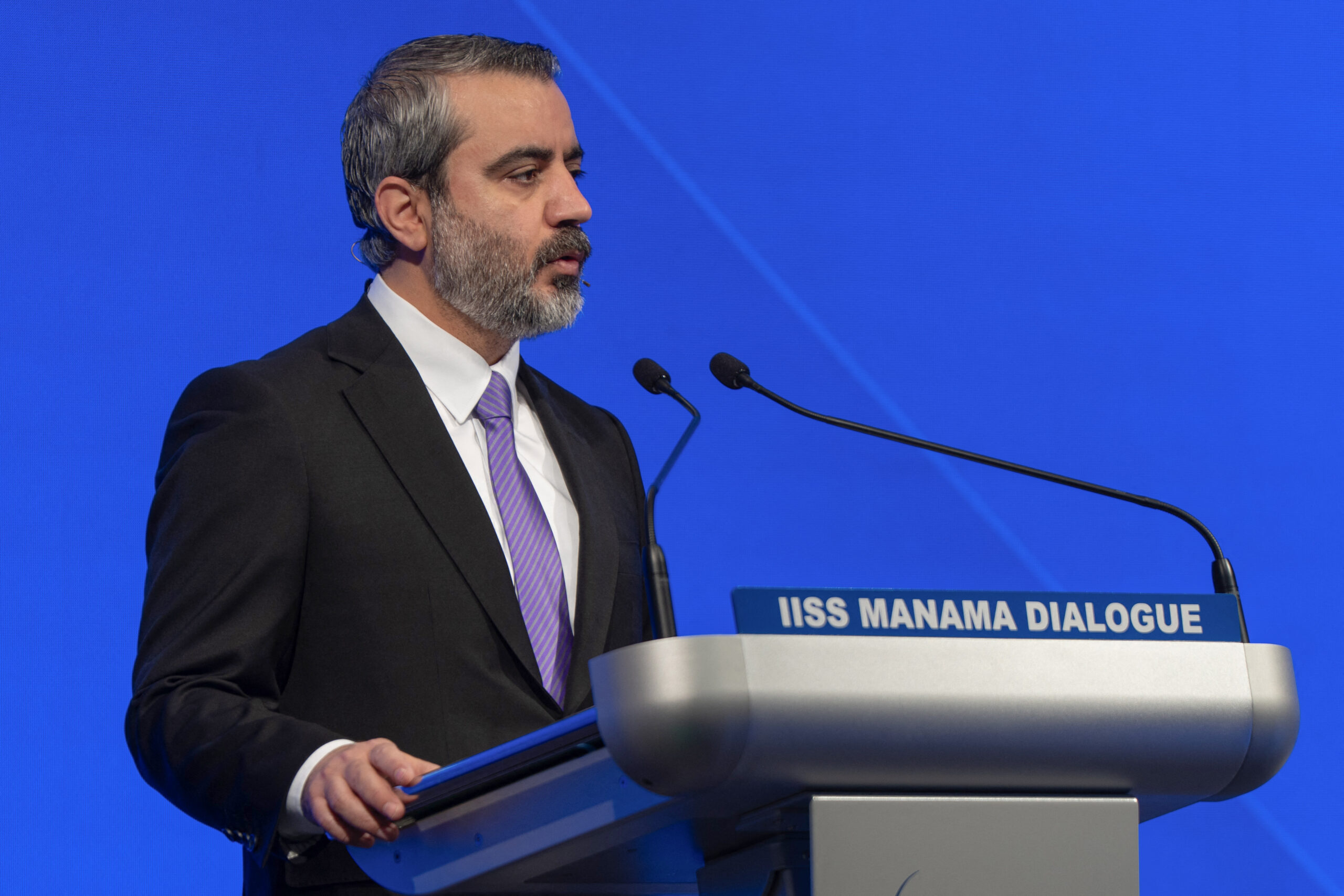
During a regional security session at the 2026 Manama Dialogue in Bahrain on Saturday, Syrian Foreign Minister Asaad al-Shaibani publicly confirmed that Damascus has launched formal internal and cross-regional assessments of potential membership in the Mecca Joint Defence Agreement, the landmark mutual defence framework signed by Saudi Arabia, Turkey and Pakistan in Mecca on August 7 earlier that year.
Al-Shaibani framed Syria as an irreplaceable pillar of regional collective security, noting that Damascus would endorse any multilateral mechanism designed to uphold cross-border stability, and emphasized that the broader Middle East is currently in greater need than ever of coordinated joint deterrence and integrated shared defence architectures. The announcement marks the first official public signal of planned expansion for the three-nation pact, which operates on a core principle identical to NATO’s collective security clause: any armed attack against a single signatory will be treated as an assault on all member states, triggering coordinated collective response from the full alliance.
Alongside the membership deliberation, al-Shaibani used his Manama platform to reaffirm Damascus’s unwavering support for Yemen’s internationally recognized government in its efforts to restore full national sovereignty and territorial stability, while calling on all regional actors to strictly respect the unity and sovereign integrity of every national state, and explicitly warning against unilateral actions that risk eroding fragile regional security balances.
Independent regional political analyst Samy Akil, a senior advisor at Syria Report, confirmed to Middle East Eye that negotiations over Syria’s accession remain in very early preliminary stages, and Damascus is highly unlikely to formalize status as the pact’s fourth full member in the immediate short term. “We are still squarely in the exploratory, speculation phase, no binding decisions have been finalized at all,” Akil explained. “To a large degree, this announcement represents calculated sabre-rattling from Syrian leadership. The intent is clearly there, but the proposal is still being field-tested, and the final outcome will hinge entirely on the detailed, negotiated fine print of any accession terms.”
The public disclosure of Syria’s membership talks unfolds against a backdrop of rapidly escalating security tensions across the Arabian Peninsula, as Saudi Arabia faces a sustained wave of attacks from Iran-aligned Houthi forces operating out of Yemen, who have repeatedly targeted Saudi civilian airports, military installations and critical energy infrastructure. Just one day before al-Shaibani’s Manama remarks, the Saudi-led military coalition active in Yemen announced it had intercepted a swarm of Houthi-launched drones over the sacred Mecca and Medina regions, a claim the Houthi movement later formally denied. Akil stressed that the timing of the Syrian foreign minister’s announcement was a deliberate strategic choice calibrated to the current crisis trajectory. “This is directly tied to the looming broader regional conflict that we expect to see a new round of major escalation in within days,” he noted. “This is deliberate strategic balancing behaviour from Damascus.”
In recent weeks, Riyadh has been rallying widespread regional and international backing to respond to the Houthi threat, bringing the long-dormant military provisions of the Mecca pact to the forefront of regional security discussions. Both Pakistan and Turkey have publicly pledged full military support to Saudi Arabia under the terms of the existing agreement, though neither has announced plans to launch active military operations against Houthi forces in Yemen. Turkish officials have explicitly ruled out deploying ground combat troops to Yemeni territory, even as the Turkish parliament’s foreign affairs committee has formally approved legislation to fully ratify the original three-nation defence pact.
Since the ouster of Bashar al-Assad in December 2024, Saudi Arabia has emerged as one of the most critical strategic regional partners for Syria’s new transitional government. Syrian President Ahmed al-Sharaa traveled to Riyadh on October 6 for a high-profile meeting with Saudi Crown Prince Mohammed bin Salman, where the two leaders negotiated frameworks for expanded bilateral diplomatic ties, post-conflict Syrian reconstruction, cross-border investment and coordinated alignment on shared regional security priorities. In the aftermath of that summit, Damascus issued multiple formal denials of unsubstantiated media reports claiming Saudi Arabia had requested Syria deploy ground combat troops to Yemeni territory to counter Houthi forces. Ahmad Zaidan, a senior media advisor to President al-Sharaa, posted on social platform X that the reports were “completely fabricated and entirely baseless”, while the Syrian foreign ministry’s communications department reaffirmed that Damascus’s entire regional policy agenda is anchored in advancing stability, peaceful dialogue and cooperative security, not opening unneeded new military fronts.
Akil noted that while Syrian armed forces could potentially be drawn into regional conflict scenarios, deploying frontline combat troops to Yemen would be strategically unwise, as the asymmetric, desert and mountain warfare environment in Yemen is fundamentally different from the counterinsurgency operations Syrian forces have decades of experience conducting. “My assessment is that Syria’s final contribution under the pact, if it joins, will likely mirror the role it played during Operation Desert Storm: a small, limited military contingent focused almost entirely on logistical support for Saudi forces, rather than frontline shock combat deployments,” he explained. Even with limited operational commitments, accession to the Mecca pact would represent a historic milestone in deepening formal security cooperation between Damascus and Riyadh.
Al-Shaibani also used his Manama address to strongly condemn ongoing Israeli military operations on Syrian territory, noting that Israeli forces have carried out more than 1,000 separate attacks on Syrian soil in less than two years, killing dozens of Syrian civilians and military personnel. “How can international demands for border security and full state control over national arsenals possibly be justified, when Syrian national sovereignty is being violated and targeted on a near-daily basis?” he challenged. Akil pointed out that Syria’s push to join the Mecca pact is also motivated by a clear strategic goal of strengthening its negotiating leverage in future talks with Israel. With Israeli forces still maintaining permanent occupying positions in southern Syrian territory, Damascus views formal security alignment with major regional powers Saudi Arabia, Turkey and Pakistan as a valuable bargaining chip, especially since a full Israeli withdrawal from southern Syria is not expected in the short or medium term. Full membership would grant Syria the legal right to activate the mutual defence clause of the pact in the event of large-scale Israeli attacks on its territory. Al-Shaibani also formally renewed Syria’s longstanding demand for Israeli forces to withdraw fully to their pre-December 8 2024 positions, and for the 1974 Syria-Israel disengagement agreement to be fully enforced by all parties.
While accession to the Mecca Joint Defence Agreement offers Syria a clear pathway to formalize deeper security partnerships with three major regional powers, significant unanswered questions remain about what concrete military commitments Damascus would be expected to make as a member, and what formal operational role Syria would take on within the alliance’s collective defence architecture.
Why is Syria considering joining the Saudi-Turkey-Pakistan defence pact?