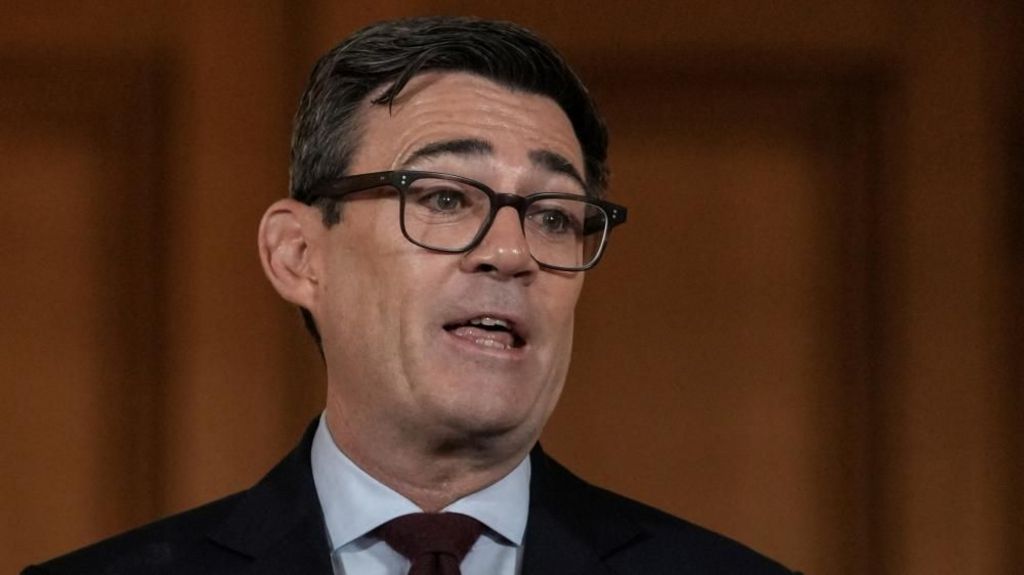
Just days before the highly anticipated 2024 Commonwealth Heads of Government Meeting (CHOGM) kicking off November 1 in Antigua, UK Prime Minister Andy Burnham has laid out a nuanced new official position on Britain’s centuries-long role in the transatlantic slave trade, signaling openness to a formal, unreserved state apology while categorically ruling out direct financial reparations to affected communities and nations.
The landmark policy shift, outlined in a Guardian op-ed and subsequent public remarks, breaks from successive previous UK administrations’ longstanding refusal to entertain any formal state apology for the brutal trafficking of millions of African people to the Americas between the 16th and 19th centuries. Burnham described the transatlantic slave trade as an unforgivable “brutal and barbaric violation of basic human dignity” that Britain can no longer avoid confronting head-on, noting that Commonwealth member states have spent decades calling for a transparent, honest dialogue about the colonial era’s harms. “I do not believe ordinary British citizens today can be held legally or morally liable for heinous historical wrongs that unfolded in a completely different era, under entirely separate legal frameworks, in which they played no personal part whatsoever,” Burnham wrote, explaining his rejection of financial reparations. “That said, I am fully open to calls for a formal state apology, as a core part of a structured, respectful dialogue with communities and nations directly impacted by this historic injustice.”
Chancellor John Healey echoed the prime minister’s stance in a broadcast interview with BBC’s Laura Kuenssberg, framing the proposed apology as a long-overdue, appropriate gesture ahead of CHOGM, where King Charles III will formally open the summit as part of his ongoing regional tour of Caribbean Commonwealth nations. The king’s current regional visit has already included stops in the Bahamas, where he made explicit reference to the “unimaginable suffering of the past” tied to colonial exploitation, and Guyana, where he paid his respects at the historic site of a major uprising by enslaved people against British colonial authorities.
Reaction to Burnham’s announcement has been mixed across political, civil society, and global Commonwealth circles. Bell Ribeiro-Addy, Member of Parliament for Clapham and Brixton Hill and chair of the All-Party Parliamentary Group (APPG) for Afrikan Reparations, welcomed the government’s willingness to discuss a formal apology as a meaningful incremental step, but emphasized that the proposal still falls far short of full accountability. “Acknowledgement of past harm is not the same as genuine understanding, and a formal apology costs nothing to deliver,” she told BBC Radio 4’s Today programme. “Until the UK issues that unreserved apology, the Commonwealth can never truly call itself a family of equal nations. I want to be clear: to date, no formal financial reparations invoice has ever been submitted to the UK government, so the public fixation on financial payments is a misplaced distraction from the broader, more holistic framework of reparative justice that affected communities are advocating for.” Barbados Prime Minister Mia Mottley, a longstanding advocate for reparative justice measures, also offered cautious praise for Burnham’s statement, noting she would engage in good faith during upcoming CHOGM discussions while continuing to push for full, comprehensive redress for colonial harms.
Cross-party political responses have been sharply divided. Conservative Party leader Kemi Badenoch took to X to criticize the position, arguing that British taxpayers alive today have no obligation to cover costs for events that unfolded generations before they were born, and claiming the ruling Labour government was already overspending on domestic welfare programs without adding new “global welfare” commitments. Liberal Democrat leader Ed Davey by contrast praised Burnham’s openness to an apology, stating that taking responsibility for historical harms and offering a sincere public apology is always a morally correct step.
Not all civil society groups have reacted positively. Denis O’Brien, founder of advocacy group The Repair Campaign, described Burnham’s announcement as deeply disappointing and insufficient, calling on the UK government to end decades of obfuscation and deliver a full, unqualified formal state apology immediately as a critical first symbolic step toward meaningful reparative justice.
The announcement arrives at a moment of intense geopolitical competition, as Downing Street officials have explicitly framed strengthening ties across the 56-nation Commonwealth as a core UK national priority to counter growing Russian and Chinese influence across the Global South, a dynamic underscored by Russian President Vladimir Putin’s recent high-profile Russia-Africa Summit hosted in Moscow earlier this week. The new policy also puts Burnham in partial contrast with his recent predecessors: former Prime Minister Tony Blair expressed “deep sorrow and regret” over the slave trade in 2007, but stopped short of a formal state apology; David Cameron explicitly ruled out reparations and urged Caribbean nations to “move on” from the history during a 2015 Jamaica visit; Rishi Sunak rejected both an apology and reparations outright in 2023, while former Labour leader Keir Starmer ruled out compensation payments for historical slavery in 2024, focusing instead on future Commonwealth cooperation. Notably, the 1833 Slavery Abolition Act that ended chattel slavery across most of the British Empire included massive taxpayer-funded compensation payments to wealthy British plantation owners for the loss of their enslaved human property – a debt the UK only finished paying off entirely in 2015.
Burnham ‘open’ to calls for slavery apology but not reparations