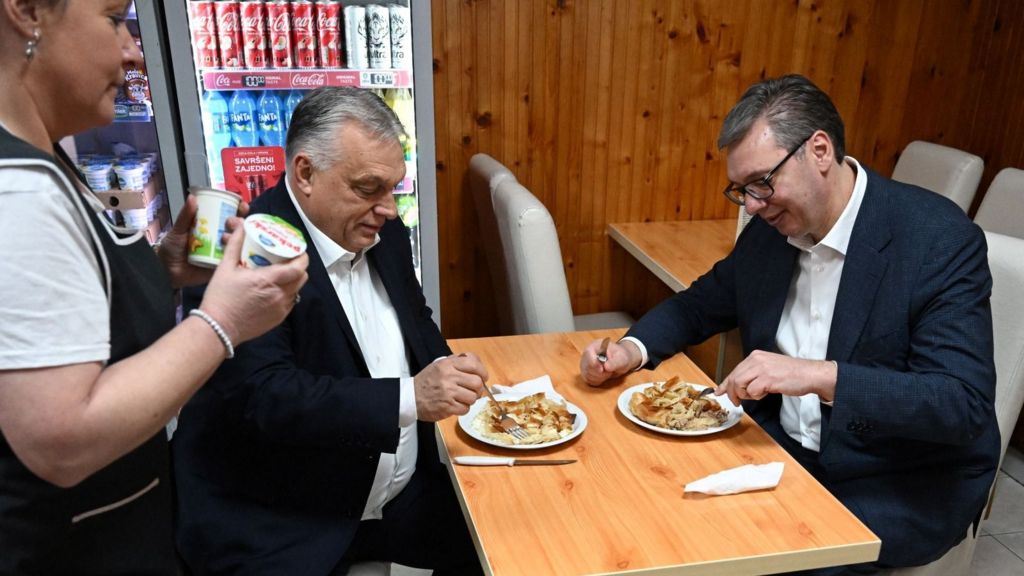
Last November, Hungarian Prime Minister Viktor Orbán and Serbian President Aleksandar Vučić sat down for a casual lunch of traditional Balkan burek pastries at a bustling downtown bakery in Subotica, northern Serbia – Orbán opting for a cheese-filled pastry, Vučić choosing a meat variant. The two nationalist leaders, who had held power for 16 and 14 years respectively, then traveled to a nearby winery to hash out cross-border business deals, including Hungary’s planned acquisition of Serbia’s Nis oil refinery, and discuss shared diplomatic priorities: their close alliances with Russian President Vladimir Putin and Chinese President Xi Jinping, and staunch support for Bosnian Serb separatist leader Milorad Dodik. The pair had spent years consolidating control over state institutions, building intertwined cross-border business empires, and overseeing landmark infrastructure projects such as the Chinese-funded, Chinese-engineered high-speed railway linking Belgrade and Budapest. At that November 2024 meeting, neither leader could have predicted they would both be ousted from office within 12 months.
Orbán fell first in April 2025, defeated by Péter Magyar’s centrist Tisza party in a landslide upset that defied nearly all pre-election forecasts. Just days later, a grassroots Serbian student movement, formed less than two years prior, secured a historic parliamentary election victory, marking the end of Vučić’s decades-long grip on power. The two victorious movements appear structurally distinct on the surface: Tisza is a personality-driven political organization centered on the energy and public profile of its leader Magyar, while Serbia’s Student List operates on a decentralized, leaderless model that rejects hierarchical governance.
Yet the two campaigns shared a defining, unprecedented strength: a cohort of tech-savvy young voters who mobilized at record turnouts of 79% in Hungary and 69% in Serbia, leveraging artificial intelligence tools to analyze electoral data, flag high-risk polling locations, and coordinate tens of thousands of civilian election monitors to counter long-documented patterns of voter intimidation and systemic electoral fraud deployed by the ruling parties. Hungarian civic action group DE played a direct, hands-on role in supporting the Serbian student campaign, sending 70 trained election observers to Serbia ahead of polling day, and hosting months of workshops even before the Serbian election was officially called to share tactics honed during Hungary’s earlier electoral fight.
One of the most effective shared strategies was the pre-emptive identification of “infected” polling districts: locations where abnormally high vote shares for incumbent parties in previous cycles strongly indicated widespread chain voting, voter coercion, or ballot tampering. On Serbian election day, student activists stationed both fixed teams at high-risk sites and roving mobile units across the northern Vojvodina province, filming all interactions with suspected ruling party operatives. Péter Klemm, a student activist based in Subotica, noted that masked pro-Vučić vigilantes began gathering near polling stations as early as 4 p.m. on election day, but the 20 to 30 civilian monitors posted at each threatened location acted as a powerful deterrent, blocking nearly all planned intimidation and fraud attempts.
The parallels between the two ousters extend far beyond campaign tactics. Vučić delivered his formal concession speech at exactly 9:30 p.m. on Serbian election night, matching the exact timestamp of Orbán’s concession announcement after his April defeat, a moment that shocked most international observers who had predicted both leaders would refuse to cede power peacefully. Unconfirmed widespread local reports indicate Vučić spoke to Orbán twice over the course of election night: once before his public concession, and again at 11:15 p.m., with multiple sources claiming Orbán convinced his long-time ally to avoid deploying state security forces to cling to power. Vučić has denied speaking to Orbán before his public announcement, though he acknowledged a later post-concession call, while Orbán has declined all requests for comment on the conversations. Strikingly, the two victorious parties also won nearly identical proportional representation seat shares: the Tisza party secured 140 seats in Hungary’s 199-seat national parliament, while Serbia’s Student List claimed exactly 140 seats in the 250-seat Serbian national assembly. Péter Magyar was the first European head of government to call the Serbian student leadership directly to congratulate them on their win, noting that the Hungarian movement’s success had clearly served as a source of inspiration for the Serbian youth campaign.
Both former incumbents now face the prospect of prosecution for long-rumored corruption and abuse of power, with newly empowered special anti-crime prosecution bodies in both countries – Serbia’s JTOK organized crime task force and Hungary’s newly established NVVH special prosecution service – holding overlapping investigative powers that legal experts say will allow for coordinated cross-border probes. The catalyst that sparked Serbia’s student movement, the November 2024 collapse of the Novi Sad railway station canopy – a disaster widely attributed to systemic corruption and negligent oversight that killed 16 people – also implicated Orbán-linked Hungarian firms that had been contracted for the station’s renovation work.
Áron Timar, founder of Hungary’s DE civic action group, noted that for years European political analysts operated under the assumption that Orbán and Vučić’s regimes would grow more entrenched and unassailable the longer they held office. “In reality, they grew steadily weaker the longer they clung to power,” Timar explained. “Once the public found its collective voice and rose up, there was no force left that could stop the shift.”