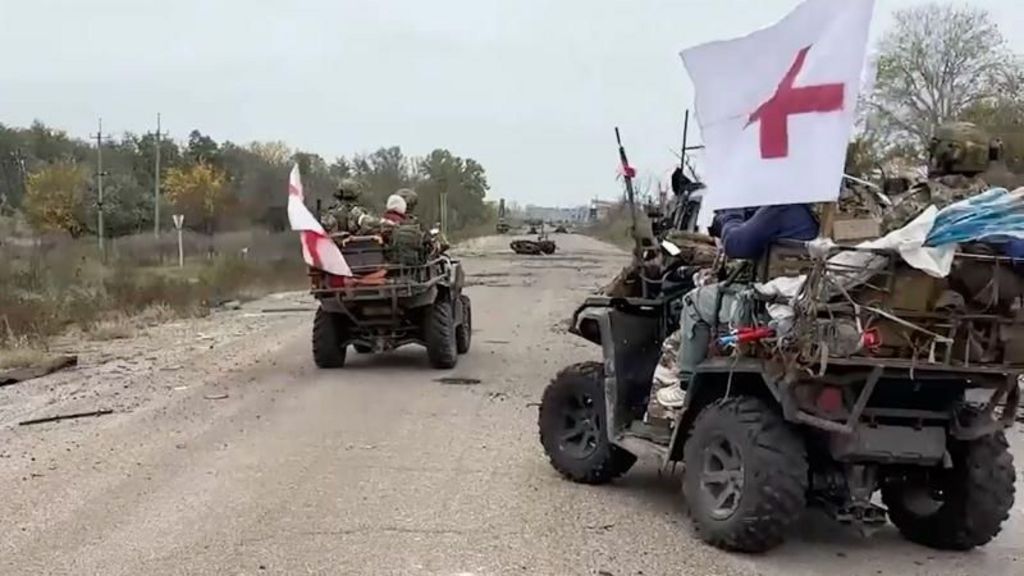
A landmark civilian evacuation initiative is currently unfolding in the Russian-occupied southern Ukrainian city of Oleshky, with confirmation from both Ukrainian and Russian governing authorities, marking a rare coordinated humanitarian milestone across active front lines. The operation was made possible by a region-wide ceasefire across the entire Kherson frontline, mediated by U.S. First Lady Melania Trump, which took effect on Tuesday, allowing demining teams – Russian sappers among them – to systematically clear the only egress route out of the war-torn settlement. Under the structured evacuation framework, residents opting to depart are granted a strict four-hour safe travel window, with a fleet of 25 buses deployed to transport up to 750 people before 14:00 local time (12:00 GMT). Dedicated ambulances are also on site to accommodate people with reduced mobility, ensuring vulnerable groups are not excluded from the safe passage scheme. Even amid widespread structural devastation, and a total collapse of basic public services including natural gas, grid electricity, and piped running water, several hundred Oleshky residents have voluntarily chosen to remain in the town, according to on-ground assessments. Ukraine’s Human Rights Ombudsman Dmytro Lubinets emphasized the non-coercive nature of the operation, stating, “Every resident who wishes to leave Oleshky will be guaranteed a fully safe passage out, no exceptions. At the same time, those who make the independent decision to stay will not be displaced against their will, and will receive full access to all necessary humanitarian support.” Notably, the evacuation route does not lead directly to nearby Ukrainian-held territory, which sits just 5 kilometers (3.1 miles) from Oleshky’s city limits. Instead, evacuees seeking to reach Ukrainian-controlled areas must first traverse Russian-occupied territory to the southern Russian coastal city of Anapa, board a Russian government-chartered flight bound for Gomel in Belarus, then travel overland across the Belarus-Ukraine border into Ukraine’s northern Chernihiv region. A subset of departing residents has also elected to settle permanently in Russian-controlled territories rather than complete the full circuit back to Ukrainian-held land. Lubinets and his Russian counterpart, Human Rights Ombudsman Yana Lantratova, made a joint visit to Oleshky on Friday to oversee the operation. Lantratova later shared on social media that on-ground teams have divided departing residents into two separate groups based on their stated destination preference: those heading for Russian-held areas, and those transiting back to Ukraine. Footage posted to Lubinets’ official social media channels shows him interacting with tearful local residents, noting in recorded remarks that a large share of the population has opted to stay, a choice he confirmed was fully voluntary, with authorities prioritizing unimpeded delivery of humanitarian supplies to those remaining. Russian officials announced on Thursday that they have pre-positioned dozens of tonnes of emergency aid for residents staying in Oleshky, including shelf-stable food stocks, critical medical supplies, hygiene kits, and fuel for portable electric generators. For many residents, the choice to stay is deeply personal: one Oleshky resident told the BBC she refused to evacuate because no provisions were made to transport her household pets. Olena, a displaced Oleshky native now residing in Kyiv, shared that her elderly grandmother and most extended family members have chosen to remain in the city, noting the older generation’s deep attachment to their lifelong hometown. She added that she only succeeded in convincing her own father to evacuate after she gave birth to a new baby, as he faced no other way to see his grandchild. Olena also shared harrowing accounts of daily life in occupied Oleshky, recalling that her grandmother’s sister died last winter after stepping on a snow-covered landmine that cost her her legs; with no functional emergency medical transport available, local residents carried her to the hospital in a garden wheelbarrow, a makeshift method that is now standard for moving both wounded people and the deceased to medical facilities and the town morgue. The unprecedented Kherson ceasefire is scheduled to remain in effect through the end of Sunday, November 1, marking the first multi-day stretch of sustained peace across the frontline region since Russia launched its full-scale invasion of Ukraine in February 2022.