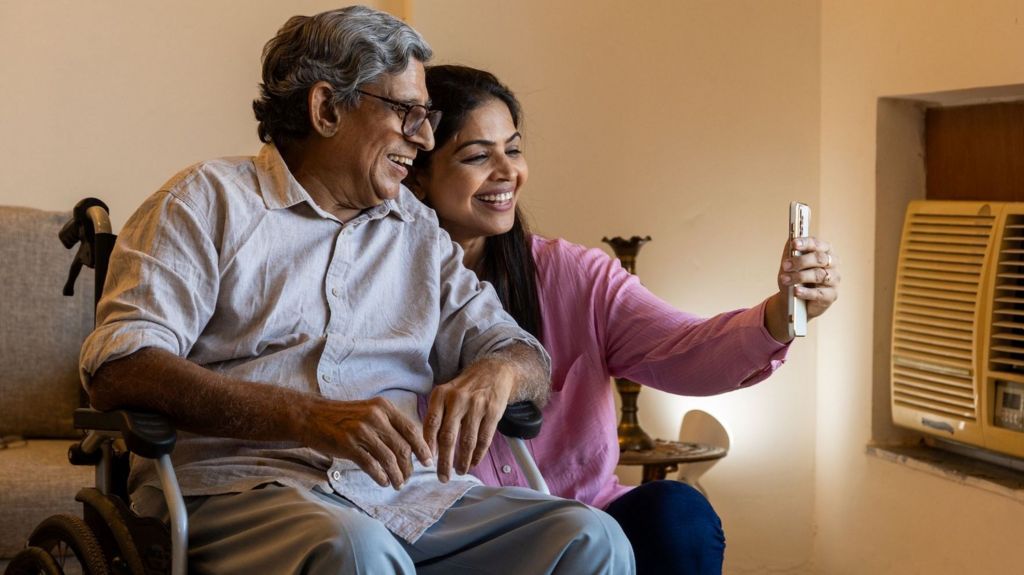
A 2024 health scare for the elderly father of Jakarta-based advertising executive Arindam Bhattacharyya laid bare a growing, nation-wide dilemma in India: as more young professionals relocate for work, millions of adult children face the impossible choice of balancing international careers with the responsibility of caring for ageing parents back home. Bhattacharyya now relies on two specialized senior care startups to coordinate remote health monitoring and emergency medical support, though he still maintains close, daily oversight of his parents’ wellbeing in Kolkata. This personal anecdote is a microcosm of a sweeping demographic shift documented by the United Nations Population Fund (UNFPA): between 2020 and 2050, the global population of people aged 60 and over will double to 2.1 billion, and India is on track to match this trend, with 21% of its total population, or one in every five residents, set to be 60 or older by mid-century. For generations, Indian cultural norms have placed the full burden of elderly care on extended joint families, with almost no public discourse around formal senior support systems. However, the steady dissolution of traditional multi-generational households, combined with mass youth outmigration to urban centers and foreign job markets, has created a rapidly widening gap between care needs and available informal support, a gap that underfunded public social infrastructure has failed to fill. Rather than framing this demographic shift as a crisis, government think-tank NITI Aayog has positioned India’s emerging senior care industry as a high-growth economic opportunity, currently valued at an estimated $7 billion and projected to expand exponentially in the coming decades. A wave of new startups and established real estate players have rushed into the space to address unmet needs across three core segments: purpose-built senior living communities, at-home care services, and tech-enabled remote monitoring tools. These ventures primarily cater not just to elderly end-users, but to their geographically distant adult children who are willing to pay for peace of mind. The organized senior living segment has seen particularly explosive growth, driven by rising disposable incomes and shifting family structures, though supply lags far behind demand: global real estate firm Colliers International estimates India currently requires 2 to 2.2 million dedicated senior housing units, while only 25,000 such units are operational nationwide. Firms including Manasum Senior Living, Primus Senior Living, Ananta Living, and Vedaanta Senior Living are racing to expand their portfolios, alongside growing interest from mainstream residential real estate developers. Anantharam Varayur, a former tech executive who co-founded Manasum, noted that the industry has overcome significant cultural stigma: when he first promoted his senior living concept at a 2015 Indian community event in the U.S., almost no attendees approached his stall, as the idea of moving a family member to a so-called “old age home” was widely seen as a shameful abandonment of filial duty. Today, Manasum operates 900 units across Bengaluru and Goa, with plans to scale to 10,000 units by 2030, and receives enquiries from a diverse base of clients: elderly people whose children live overseas, couples with adult children who have special needs, single senior citizens, and even younger adults proactively planning for their own future care. For the large share of elderly Indians who wish to age in their own family homes, a new generation of end-to-end home care platforms including Emoha Elder Care, Care24, and KITES Senior Care have displaced the old fragmented, hyperlocal network of small, unregulated caregiver agencies, using digital platforms to streamline service delivery. The sector faces significant structural hurdles, however: ratings agency CareEdge warns that insufficient standardized training for care staff will lead to a crippling skilled workforce shortage as demand surges. Caregivers also require rigorous background vetting and specialized training to protect a highly vulnerable elderly demographic at high risk of financial scams, abuse, and exploitation, prompting NITI Aayog to call for a unified national caregiving policy to build a professional, inclusive care ecosystem. Many innovative startups are also addressing the non-medical, emotional needs of senior citizens: 2022 saw high-profile investment from former Tata Group chairman Ratan Tata in Goodfellows, a service that pairs elderly clients with empathetic young companions to provide social connection and support with digital tasks, with a tagline promising “Everything Grandkids Do!” rather than positioning its services as a replacement for family. Other ventures leverage cutting-edge AI: Bengaluru-based firms Kubo Care and NoBlink.ai deploy wall-mounted radar sensors that track movement in senior homes, automatically alerting emergency services if a user suffers a fall or loses consciousness, with NoBlink.ai pricing its hardware at roughly one tenth the cost of comparable Western products to keep services accessible for middle-class households. Affordability remains the most persistent systemic barrier, however: a one-bedroom unit in a premium senior living community can cost 6 million rupees, plus additional recurring fees for meals and maintenance, a price point far out of reach for the vast majority of India’s elderly population. NITI Aayog data shows 78% of Indian seniors have no pension coverage, and households with at least one elderly member have a 13% lower average monthly per capita income than households with no older residents. Industry experts emphasize that private startups alone cannot resolve India’s looming ageing care crisis, pointing to successful models in peer nations: Japan has built a robust multi-layered system combining universal long-term care insurance, public nursing facilities, community social programs, and neighborhood support networks, while China has implemented targeted policy reforms to address its own rapidly ageing population. Indian states are already taking first steps: Kerala recently became the first state to pass landmark senior citizens legislation enshrining rights to affordable care, free legal aid, digital access, and age-friendly public infrastructure. While India still has a narrow window to prepare before its 2050 demographic milestone, building a coordinated, inclusive ecosystem that combines private sector innovation, public policy support, and community resources will be critical to ensuring the country’s 300 million future elderly residents can age with dignity.