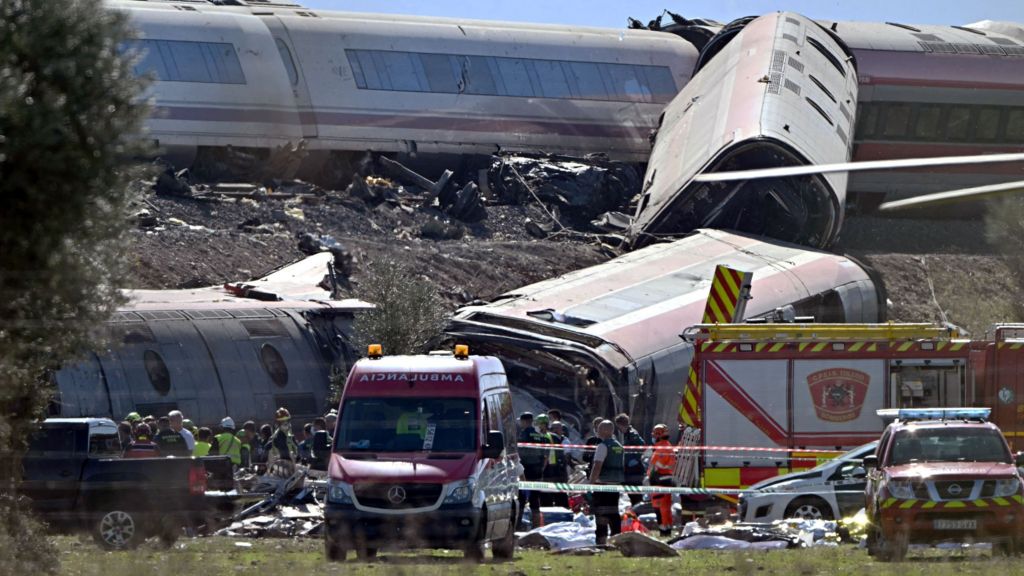
A catastrophic high-speed rail collision unfolded on a Wednesday morning just 140 kilometers south of Madrid, claiming at least 68 lives and leaving dozens of people with severe injuries, marking one of the deadliest rail disasters in modern European history and Spain’s worst fatal train crash in 13 years. The incident took place shortly after 9 a.m. local time (8 a.m. GMT) on a major intercity route connecting Madrid to Seville, when a state-owned Renfe-operated high-speed train carrying 397 passengers traveling southward slammed into a stationary Iryo private rail service that had halted on the tracks due to an earlier computer system failure. The sheer force of the impact sent multiple train carriages careening off the rails and tumbling down a steep embankment, with photographic evidence showing a section of exposed railway track piercing straight through one carriage, and at least one other vehicle catching fire in the immediate aftermath.
Spain’s Transport Minister Óscar Puente confirmed at a press briefing that the sequence of disaster was triggered first by a technical computer malfunction aboard the Iryo train, which carried 147 passengers at the time of the crash. Standard safety protocols dictate that when such a system outage occurs, a 24-hour central traffic control hub based in Madrid is supposed to oversee all affected operations, but the centre made an “inexplicable, reckless” decision to clear all trains in the area to resume movement without imposing any mandatory speed restrictions, directly setting the stage for the high-speed Renfe service to strike the halted Iryo train from behind.
Survivors from both carriages recounted harrowing, life-altering scenes of chaos and devastation in the moments after impact. Many passengers described being thrown violently into the air for several seconds, flying suitcases and debris cascading across cabins, and dozens of people trapped under twisted metal and overturned seats. Multiple survivors smashed through carriage windows to escape filling smoke and spreading flames, while others recalled witnessing fellow travelers with severed limbs, grievous head wounds, and fatal injuries. 22-year-old Tangui Binier, a passenger on the Iryo service, told BBC reporters that he watched his carriage flip completely upside down, and that his father had to carry a teenage girl with a broken hip out of the wreckage; he noted that the traumatic sights of deceased victims left him uncertain if he would ever fully recover. Renfe passenger Salvador Arriza, 62, described the collision force as “brutal,” while El Pais journalist Antonio Jiménez Barca, who was walking to the Renfe train’s cafeteria when the crash hit, recalled being thrown to the floor, suffering a severe head laceration, and being pinned under other injured passengers.
First responders deployed dozens of ambulances to the remote crash site, while medical helicopters airlifted the most critically injured victims to nearby specialized hospitals. Spain’s Civil Guard announced that it would be collecting DNA samples from family members of missing passengers to formally identify many of the badly disfigured victims trapped in the wreckage. The tragedy has plunged the entire nation into mourning: Prime Minister Pedro Sánchez traveled to the crash site to meet with survivors and first responders, noting that the crash had shattered countless lives and torn families apart with unfathomable pain. The disaster comes just months after a separate high-speed rail crash on the same Madrid-Seville line near Córdoba in January that killed 46 people, and is the deadliest Spanish rail incident since the 2013 Santiago de Compostela derailment that left 80 people dead. Opposition leader Alberto Núñez Feijóo of the People’s Party demanded full transparency into the systemic safety lapses, stating that Spanish citizens have an absolute right to understand the failures plaguing the national rail infrastructure. Public sector trade union CSIF has called for Transport Minister Puente to resign, accusing him of unfairly scapegoating low-level control room staff for the disaster rather than accepting ministerial oversight responsibility. Sánchez and all major national political figures immediately canceled all upcoming public events, including planned campaign rallies for the forthcoming parliamentary elections scheduled for the following month. The prime minister emphasized that two major fatal rail crashes within a single year was completely unacceptable, and pledged a full, independent investigation to uncover all instances of negligence, with strict, firm measures to correct any identified gaps in rail safety protocols.
High-speed train crash kills at least 68 people in Spain