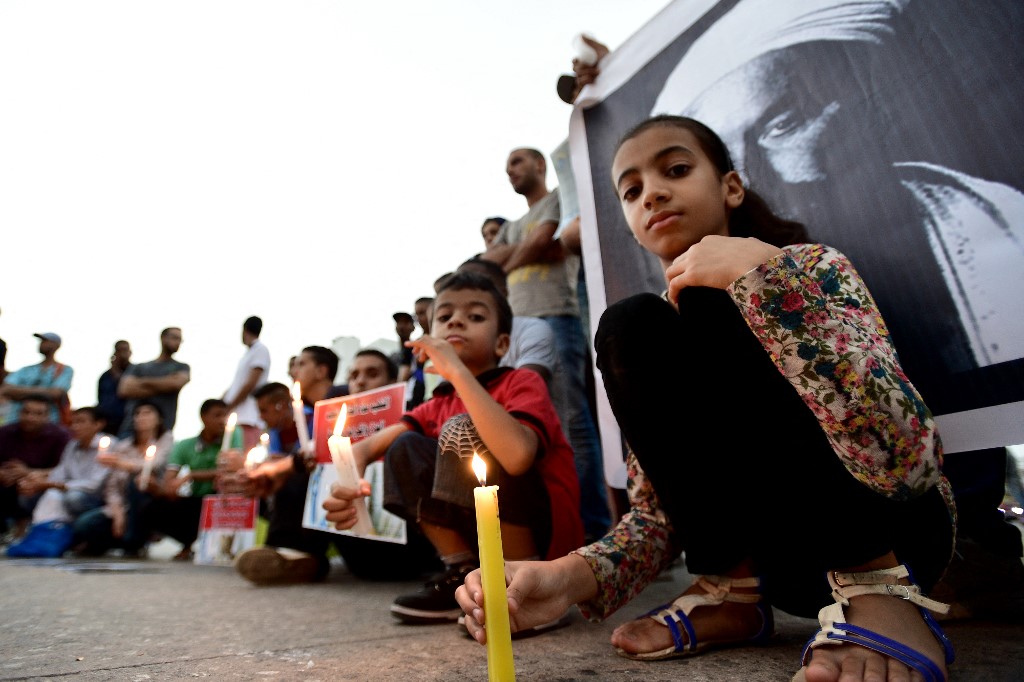
For Mohamed Ahamjik, the legacy of Morocco’s 2016–2017 Rif protest movement is etched into every facet of his family’s daily struggle. Since his younger brother Nabil, a key grassroots activist in the uprising, was handed a 20-year prison sentence in 2017, Mohamed has dedicated himself to advocating for Nabil’s release and amplifying the movement’s unmet demands, even as his mother’s health has steadily declined amid years of relentless stress. “This has always been a duty towards my mother, my brother Nabil and our family,” he shared in an interview with Middle East Eye, on the eve of the 10th anniversary of the protests that first erupted across Morocco’s northern Rif mountains.
The 2016–2017 Hirak (movement) was ignited by a devastating, widely publicised tragedy: on 28 October 2016, 31-year-old local fishmonger Mouhcine Fikri was crushed to death inside a municipal rubbish truck in Al Hoceima, as he attempted to retrieve a haul of seafood that authorities had seized and ordered destroyed. What began as small, local demonstrations over Fikri’s killing quickly swelled into a region-wide mass movement demanding an end to decades of systemic poverty, state neglect, political marginalisation and the pervasive “hogra” – a local term for state-sponsored humiliation and arbitrary oppression – that Rif residents had endured for generations.
For several months, Moroccan authorities allowed the largely peaceful, grassroots protests to proceed without major intervention. But as demonstrations spread beyond Al Hoceima and its surrounding province to draw solidarity from communities across the country, officials shifted to a harsh, coordinated crackdown. The state attempted to discredit the movement by branding it a separatist plot – a label that leading Moroccan historian Maati Monjib dismisses as a deliberate fabrication. “Although a tiny fringe of activists shared separatist views in isolated Facebook groups, none of the prominent, now-imprisoned leaders of the movement ever advocated for breaking away from Morocco,” Monjib explained to MEE, noting that the false accusations were deployed solely to delegitimise the protesters’ core demands for equitable development and political representation.
The crackdown reached a violent turning point on 20 July 2017, when riot police deployed tear gas and batons to break up a peaceful demonstration in central Al Hoceima. In the clashes, 22-year-old protester Imad el-Attabi sustained severe injuries that resulted in his death the following month. The incident sparked a wave of national solidarity protests across Morocco throughout the rest of that summer, but the state’s mass arrest campaign continued unabated, detaining hundreds of activists, journalists, and bystanders. Ten years on, six of the Hirak’s most prominent leaders remain behind bars, including movement figurehead Nasser Zefzafi, who was handed a 20-year prison sentence alongside Nabil Ahamjik. Transferred between multiple correctional facilities across the country in the years since his arrest, Nabil is currently held in a prison near Tangier, where he has defied the hardships of incarceration to pursue advanced academic study: he completed a master’s thesis examining the Rif’s fraught historical relationship with the Moroccan state through Mohammed I University in Oujda, earning a top mark of 18 out of 20 and an official recommendation for academic publication. Now enrolled as a PhD candidate, he staged a 10-day hunger strike last month after prison administrators refused to provide him with adequate space or resources to continue his doctoral research.
The ripple effects of the 2017 crackdown extended far beyond the borders of Morocco, targeting Rif activists living in the diaspora as well. Said El Amrani, a Belgian-based digital creator, former journalist and human rights advocate who was born in Al Hoceima, left Morocco for higher education in the 1990s, and has not been able to return to his homeland since his final visit to the Rif in late 2016, just two months before the Fikri killing. “Since the beginning of the Rif movement, at least 11 activists have been arrested when arriving in Morocco. Two of them were sentenced to prison, one of them is still in jail,” El Amrani told MEE. He and other exiled Rif advocates have also faced sustained, targeted harassment online: malicious actors stole personal photos from his private social media accounts, including images of his underage daughter, manipulated them to create explicit sexualised fake content, and circulated the doctored material across public Facebook groups. He has also been repeatedly smeared by a media outlet widely documented to have close ties to Morocco’s domestic intelligence services. Today, El Amrani notes, the Rif region remains under heavy, visible security presence, with at least five new police stations constructed across the area in the decade since the protests.
This pattern of state repression in the Rif is not a new phenomenon, but the latest chapter in a century-long history of resistance and violent state suppression that local residents pass down through generations. Jamal El Khattabi, a 1960s-born Al Hoceima native now living in exile in the Netherlands, grew up hearing stories of the 1921–1926 Rif War, when Berber tribal fighters led by iconic anti-colonial leader Abdelkrim El Khattabi (no direct relation, though a distant tribal connection) united the region to fight invading Spanish, and later French, colonial forces, and proclaimed a short-lived independent Rif Republic. Jamal’s father was one of the young fighters who joined Abdelkrim’s uprising, and his maternal grandfather was among the thousands of Rif residents killed when Spanish colonial forces deployed chemical weapons to crush the resistance, suffocating to death after exposure to toxic gas. After Morocco gained full independence from French and Spanish colonial rule in 1956, the region’s suffering did not end: the Moroccan royal army under then-Crown Prince Hassan, who would later rule as King Hassan II, launched a brutal crackdown on Rif communities to suppress remaining local autonomy movements. Jamal, who joined student activist groups while at university, was arrested twice under Hassan II’s notoriously authoritarian regime: during his 1989 detention, interrogators beat him with a thick wooden stick and threw him from a building rooftop, leaving him with permanent, life-altering back injuries. He was also held in the infamous Derb Moulay Cherif detention centre in Casablanca, where he endured blindfolding, repeated severe beatings, threats of violence via attack dogs, and days of continuous exposure to blinding bright lights as part of systematic state torture. “I could no longer stand without them having to ‘help’ me,” he recalled. After his second period of detention, he fled Morocco for Spain before eventually settling permanently in the Netherlands.
When King Mohammed VI ascended the throne in 1999 following his father’s death, many Moroccans held out hope that the decades of iron-fisted rule, political persecution, torture and enforced disappearances would end, ushering in a new era of open governance and reform. The 2011 Arab Spring protests led to a revised national constitution that formally placed limited checks on the monarchy’s powers, but public optimism for sweeping, lasting political reform quickly faded. State repression intensified steadily in the years that followed, accelerating dramatically after the 2017 Rif crackdown. Over the past decade, multiple independent human rights reports have documented how the Moroccan monarchy has increasingly relied on cutting-edge surveillance tools – including the notorious Israeli-made Pegasus spyware – coordinated online defamation campaigns, and systematically unfair trials to crush all forms of political dissent. This playbook was deployed most recently during last year’s nationwide Gen Z protests, where young Moroccans demonstrated against rampant government corruption, skyrocketing unemployment and collapsing public services, even as the state poured billions of dollars into new stadiums and prestige infrastructure for the upcoming 2030 FIFA World Cup. Unlike the Rif protests, which authorities tolerated for several months, the 2023 Gen Z demonstrations were crushed within weeks: Moroccan security forces arrested an estimated 6,000 people, the vast majority in the first 72 hours of unrest. According to data from the Moroccan Association for Human Rights (AMDH), roughly 700 of those detainees remain in prison today, including dozens of minors.
Against this turbulent backdrop, the 10th anniversary of the Rif uprising has taken on renewed, urgent relevance for Moroccans across the country. The kingdom has posted impressive headline economic growth in recent years, and made global headlines last month with the appointment of its first ever female prime minister, but deep structural social and economic grievances remain unaddressed. National youth unemployment currently sits at a staggering 37%, and soaring cost of living pressures have pushed millions of working-class families into precarity. These frictions were thrown into sharp relief earlier this summer, when tens of thousands of Moroccan youths – a large share of them from the long-neglected Rif region – attempted to breach the border fence into Ceuta, a small Spanish autonomous enclave on Morocco’s northern coast, in a mass bid to escape their lack of local prospects.
The stark two-tier economic divide across Morocco is impossible to ignore: coastal investment hubs such as Casablanca, Rabat and Tangier, as well as tourist hotspots like Marrakech, have attracted tens of billions of dollars in foreign direct investment, gleaming new transport infrastructure, high-tech industrial zones and export-focused job creation. The Tanger Med port complex, for example, has grown into one of the busiest trade hubs on the African continent, driving record national export figures. But the Rif, and other impoverished inland regions such as the remote Atlas Mountains, have been almost entirely excluded from this prosperity. The Rif has the highest recorded rate of cancer diagnoses anywhere in Morocco, a public health crisis widely linked to residual chemical contaminants left behind by the Spanish colonial military’s 1920s chemical weapons campaigns. Yet the specialised oncology hospitals and life-saving treatment equipment that local residents need are located hours away, across regional borders. While the state has rolled out a handful of small concessions to address the 2017 protesters’ demands – including a new university faculty affiliated with the University of Tetouan – local activists say these measures are largely performative and under-resourced. “A new hospital was recently built, but there is not enough medical staff to operate it properly,” El Amrani explained. For young people across the region, formal employment opportunities are almost non-existent: thousands have left the Rif clandestinely to make dangerous sea crossings to Europe, while others have migrated to larger northern Moroccan cities such as Tangier and Tetouan in search of work. For generations, many Rif border communities relied on informal cross-border trade with the Spanish enclaves of Ceuta and Melilla to make a living, but recent years have seen Moroccan authorities dramatically tighten border controls, shutting down that informal economy entirely and pushing even more families into poverty. “They have nothing to lose,” El Amrani said of the region’s disaffected youth. “Many are out of school, without work and without access to healthcare. They feel they have no future. For them, the only solution is to leave.”
Monjib, who himself spent three months in prison for his pro-democracy activism and remains a regular target of state harassment, notes that while heavy state repression has largely paralysed the formal organisational structure of the 2017 Hirak movement, shifting its public focus to campaigns demanding the release of all remaining political prisoners, its core foundational demand for equal dignity has never faded. “There continues to be a deep desire for dignity and equal recognition – where a Moroccan, in the Rif or elsewhere, should be the equal of every other Moroccan, regardless of status or background,” he said.
*This report is produced as part of Middle East Eye’s independent, award-winning coverage of North Africa and the Middle East.*