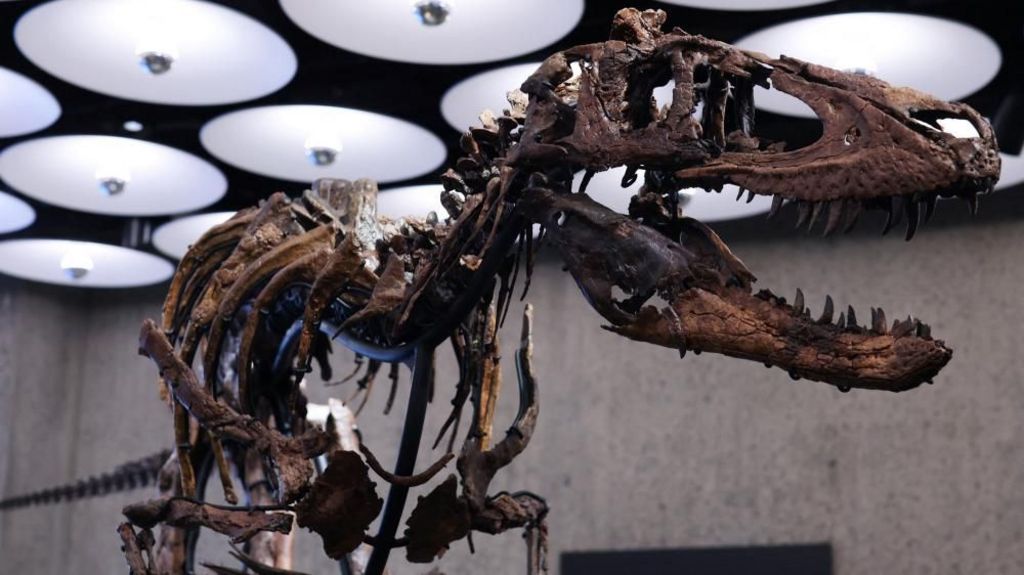
A one-of-a-kind dinosaur skeleton, once misclassified as a juvenile Tyrannosaurus rex, has shattered pre-auction estimates to sell for a staggering $47.3 million at a Sotheby’s New York auction on Tuesday. Nicknamed “Jodi”, the 10-foot-tall mounted specimen belongs to the newly validated genus Nanotyrannus, a slender, blade-toothed Late Cretaceous carnivore that roamed prehistoric North America alongside T. rex roughly 67 million years ago.
The auction far outstripped pre-sale projections of a $9 million minimum bid, unfolding over a dramatic 12-minute bidding war between six competing parties, whose final winner has chosen to remain anonymous. The sale comes just 12 months after a landmark peer-reviewed research paper formally confirmed Nanotyrannus as a distinct genus, ending decades of paleontological debate over whether small tyrannosaur fossils were merely adolescent T. rex individuals. Jodi is only the third nearly complete Nanotyrannus skeleton known to global science, and the very first specimen of the newly recognized genus ever to be offered on the public market.
Composed of 191 well-preserved fossil elements including a virtually intact, exquisitely preserved skull, the skeleton was first unearthed in Montana’s famous Hell Creek Formation by local rancher Jodi Pierson, for whom the fossil is named, before being fully excavated by veteran commercial paleontologist Clayton Phipps – the same researcher who discovered the iconic “Dueling Dinosaurs” specimen just 8 miles away in 2006. That fossil, which captures a Nanotyrannus and Triceratops locked in apparent combat, formed the core of the 2023 research led by paleontologists Lindsay Zanno and James Napoli that formally separated Nanotyrannus from the T. rex lineage. Prior to the genus’s official classification, Jodi was even displayed publicly at London’s 2023 Frieze Masters art fair, marketed at the time as a young T. rex.
The record-breaking sale follows Sotheby’s $50.1 million auction of a full T. rex skeleton nicknamed “Gus” last July, a transaction that ignited fierce ongoing debate within the global paleontology community about the ethics of high-value private fossil sales. Leading researchers including University of Edinburgh paleontologist and Jurassic Park scientific consultant Professor Steve Brusatte have sharply criticized the trend, warning that skyrocketing price tags place world-class scientifically critical specimens far out of the budget range of nearly all public museums and academic institutions. Brusatte compared the scenario to the Mona Lisa being locked away in a private collector’s vault, noting that losing access to such rare specimens would deal severe harm to both public science education and ongoing paleontological research, calling Jodi’s sale “harrowing” due to the risk the specimen could disappear from public view entirely.
Not all paleontologists share this unreservedly critical stance, however. University of Portsmouth researcher Megan Jenkins, speaking to BBC Radio 4’s Today programme, acknowledged the immense labor, time, and significant financial investment required to locate, excavate, and prepare high-quality dinosaur specimens, and noted that the vast majority of high-value auctioned fossils eventually end up in public museum collections over time, rather than being permanently sequestered in private storage. The heated debate comes as a new wave of ultra-high-net-worth collector interest in rare paleontological artifacts drives auction values to unprecedented heights, reshaping the longstanding norms of fossil access and curation for the scientific community.
Nanotyrannus skeleton auctioned for $47.3m in New York