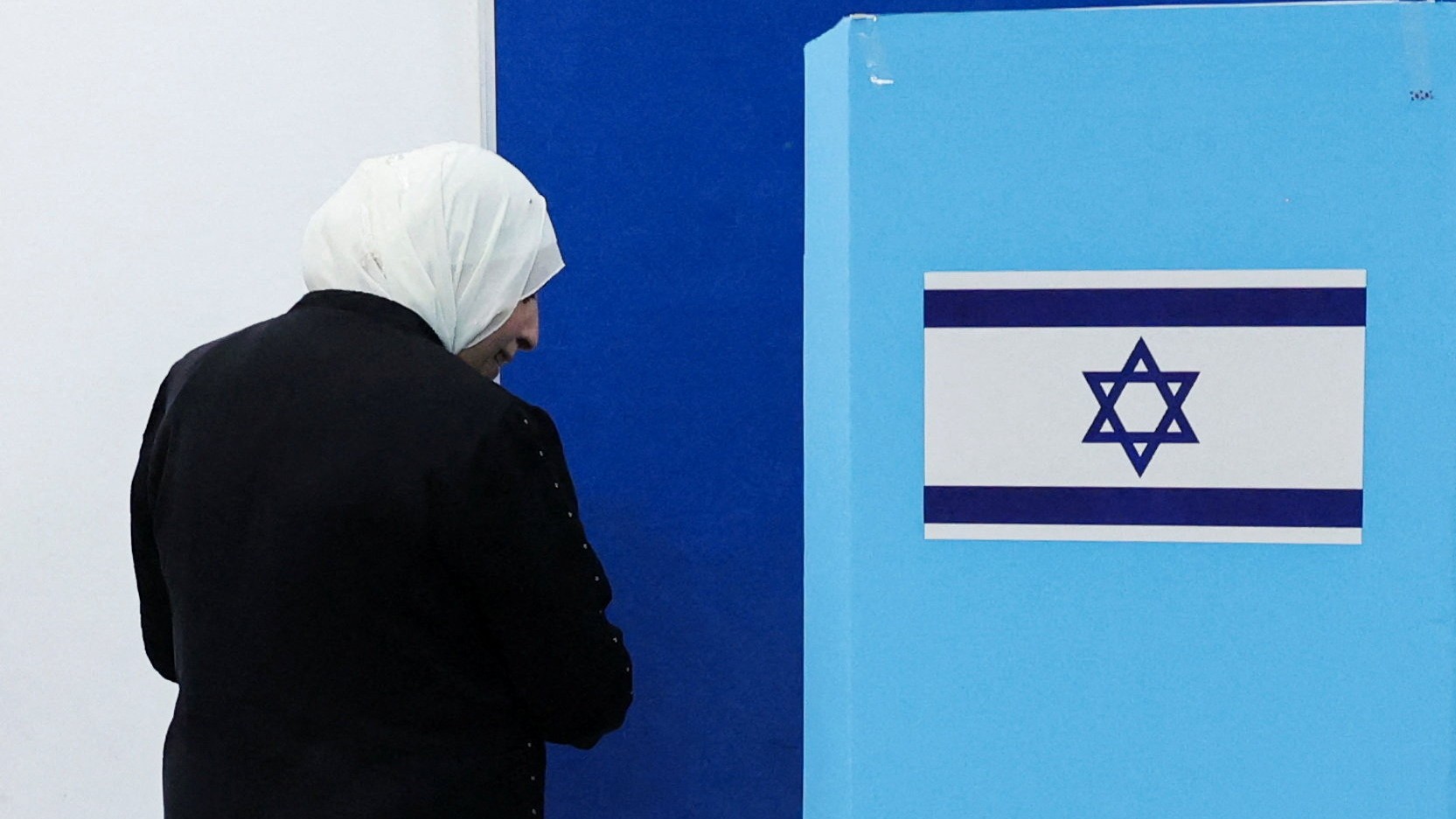
For 44 years after casting his first and only ballot in 1980, 70-year-old Ibrahim Said refused to participate in Israeli national elections. Over decades, successive political factions had approached him with pledges to advance his community’s interests, even promising to help reclaim land in al-Birwa, the ancestral village his family was forced to flee during the 1948 Nakba. Yet no tangible progress ever materialized for Palestinian citizens of Israel, leading Said to conclude the country’s democratic system offered no meaningful support for him or his community. That long-held stance has now shifted dramatically, as Said told reporters from Middle East Eye from his Galilee garage: “Without a doubt, we must vote this time. We are living in fear.”
Scheduled for Tuesday, the upcoming polls come four years after the 2022 elections returned Benjamin Netanyahu to power and empowered his far-right, Jewish supremacist allies Bezalel Smotrich and Itamar Ben Gvir. In the intervening years, Israel has launched a devastating military campaign in Gaza, while life in the occupied West Bank has been crippled by widespread shutdowns, economic strangulation, and surging, routine settler violence. For Palestinian communities inside Israel’s pre-1967 borders, systemic neglect from state authorities has allowed organized crime to spiral out of control, and overt, violent discrimination against Palestinian citizens has reached unprecedented levels. Even expressing basic solidarity with Palestinians in Gaza or the West Bank can lead to arrest, dismissal, or targeted, virulent hate campaigns in mainstream Israeli media and online spaces. Three major political parties have explicitly centered policies of deportation and forced displacement of Palestinians as core electoral pledges: Smotrich’s Religious Zionism party, for example, has vowed to fully “Judaise” the Galilee and Negev regions, which are home to hundreds of thousands of Palestinian residents. For Palestinian citizens of Israel, the stakes of this election are higher than they have ever been in the country’s history. “We do not feel safe. A sense of security has completely vanished — and I mean security on every level,” Said emphasized. “I feel not just like a second-class citizen, but like a twentieth-class one.”
In the 2022 Israeli elections, voter turnout among Palestinian citizens stood at just 54%. Leading analysts and recent polling now project that figure could surge to 68% or even higher on Tuesday, which would allow the two dominant Palestinian representative parties, the Joint List and Raam, to secure roughly 15 of the Knesset’s 120 parliamentary seats, matching the community’s historic high water mark set in 2020. “I believe turnout could reach 72 percent or 73 percent. God willing, perhaps even higher. Election day may bring many surprises,” noted Ameer Fakhoury, a senior analyst at Israel’s Vanleer Institute think tank, in an interview with Middle East Eye.
Fakhoury explained that this historic mobilization is not driven by narrow, incremental policy demands such as repealing the 2018 Nation-State Law that codifies Jewish supremacy in Israeli law, or securing minor budget increases for Palestinian communities. “We are voting to prevent displacement and protect the most basic conditions of our existence,” Fakhoury stated. He noted that in most democratic contexts, high minority voter turnout reflects public confidence in state institutions, but this moment represents the exact opposite dynamic for Palestinian citizens of Israel: “a lack of confidence in state institutions and an attempt to cling to the political forces or government arrangements that might offer some protection. Today, survival has become the dominant motivation.” He added, “When Palestinians inside Israel say they are voting to prevent what happened in Gaza or the West Bank from happening to them, consider what that actually means. They are saying they want to prevent ethnic cleansing or genocide. And from whom? From their own state. From the state of which they are supposedly citizens.”
Even prominent Palestinian figures who have long advocated for full election boycotts are now re-evaluating their positions, including Jowan Safadi, a renowned musician with a large following across the Arab world. For decades, Safadi refused to cast a ballot on the principle that Israel’s electoral system is a hollow performance of democracy. He points out that roughly equal numbers of Jewish and Palestinian people live under full Israeli control between the Jordan River and the Mediterranean Sea, yet only the 2.1 million Palestinian citizens of Israel — who make up just 20% of the country’s officially counted population — are permitted to participate in Knesset elections, and even his own wife is excluded from that group. “The entire arrangement is unfair from the outset. You are given a very narrow space in which to exercise political influence, but you can never genuinely reach a position where you can meaningfully influence Israeli policy,” Safadi explained. “The electoral process merely provides a democratic facade, allowing Israel to claim that it is a democracy. That has always been the principal reason for my refusal to participate.”
But the extreme, rising extremism that has overtaken Israel’s ruling coalition and broader society has pushed Safadi to reconsider, as voting represents one of the very few remaining levers available to Palestinian citizens to push back against existential threats. “My only hope is that changing the people in power might bring someone who is slightly less barbaric and sadistic. We are essentially talking about moving from something terrible to something marginally less terrible,” he said, though he remains deeply apprehensive that even a change in leadership could bring worse outcomes. The internal debate over abandoning longstanding boycott positions has been deeply divisive across Palestinian communities in Israel; Safadi said he struggled to sleep for days after posting on social media that he was considering voting, questioning his own choices and wondering if boycotting might still yield better long-term outcomes. He added that he would not be voting out of enthusiasm for the existing Palestinian political factions, whose campaign strategies he believes are disconnected from the current crisis: he argues that Arab political leadership has failed to adjust its messaging to match the scale of the ongoing genocide in Gaza, continuing to campaign as normal while the community faces existential risk. “The Israeli right has done more to persuade me to vote than the Arab parties themselves,” Safadi noted. “Ben Gvir and Smotrich have effectively done the campaigning for the Arab electoral lists.”
This grassroots momentum has even reduced campaign spending for the Joint List and Raam, as a source within the Joint List confirmed that voters are already driven to the polls by the terrifying, openly anti-Palestinian rhetoric from Smotrich’s Religious Zionism, Ben Gvir’s Jewish Power, and the newly formed far-right party Amcha Yisrael, founded by a notoriously hardline former Israeli general. Hostility toward Palestinian citizens is not limited to the far-right, either: Adham, a northern Israeli mechanic who only shared his first name, recently attended a campaign event for Naftali Bennett, leader of the mainstream opposition party Together, where audience members repeatedly demanded assurances that Bennett would never form a governing coalition with any Palestinian political party. A former Mossad official speaking at the event explicitly promised the crowd that no such coalition would ever be considered. Adham, a father of three, says his wife has been ostracized at the Israeli public school where she works since the 7 October 2023 outbreak of the Gaza war, and that rampant unpunished organized crime in Palestinian communities leaves him terrified for his adult sons, who he will not allow to return home later than 10 p.m. He plans to vote for Mansour Abbas’s Raam party, a socially conservative faction that has pledged to deliver tangible public safety and economic benefits to Palestinian communities by building pragmatic alliances with mainstream Zionist parties. Notably, Yoav Segalovich, a former Jewish Israeli police major-general widely recognized for his work addressing violent crime in Palestinian communities, is running as a candidate on Raam’s 2026 electoral list.
For countless Palestinian citizens, the fundamental right to live safely in their own homes is the core issue on the ballot. In 2025 alone, 252 homicides were recorded in Palestinian communities across Israel, and 147 more were documented in the first six months of 2026, with Israeli police solving just 12% of these killings this year. The sense of pervasive insecurity extends far beyond violent crime, however: Maha Mohammed, a hijab-wearing teacher based in the majority-Palestinian northern town of Umm al-Fahm, says she feels fear even visiting Jaffa, her own birthplace. “Even there, you find yourself walking around in fear. You worry about getting on a bus or walking through an area where Arabs and Jews are together,” she explained. “As a woman who wears the hijab, whose clothing visibly reflects her religious identity, you feel anxious and cannot be entirely yourself. You also sense that the people around you may be afraid of you or uncomfortable with your presence.” Mohammed notes that for the vast majority of women in Umm al-Fahm, safety for themselves, their children, and their broader community is the single most pressing priority driving their decision to vote. “We are voting to affirm that we exist, that we are here, and that our presence in this country matters.”