On the cusp of a major Communist Party plenum that has removed 45 of the 376 full voting members from its ranks, Beijing is grappling with a defining existential question: does its current governing and development model align with the unique historical phase the nation now occupies?
There is no easy consensus within Chinese leadership circles. Domestically, a stack of unaddressed structural challenges mounts, while traditional global reference points no longer offer clear, reassuring blueprints. Once the United States stood as a potential positive paradigm for Beijing to adapt, but the MAGA-era Washington of today, which prioritizes Pentagon hard power and recently designated China’s long-running Confucius Institute cultural exchange programs as national security threats, no longer serves as a usable, aspirational model for Chinese policymakers.
This uncertainty echoes two earlier pivotal moments in modern Chinese political history: in the wake of the 1978 Xidan Democracy Wall protests in the early 1980s, and after the 1989 Tiananmen pro-democracy demonstrations, when the current generation of senior leaders first cut their teeth in political life. Back then, the core strategic fear driving Communist Party thinking was the concept of *heping yanbian*, or “peaceful evolution”: the gradual, non-violent transformation of a communist state into a liberal capitalist democracy, advanced not through military invasion or revolution, but through cross-border trade, cultural exchange, and the spread of Western ideas.
For decades of veteran Chinese officials, this was framed as an existential peril that could collapse the entire communist system — yet paradoxically, it was also recognized as an unavoidable global force. The only viable path forward, leadership concluded at the time, was to embrace targeted market reforms that mirrored elements of that “peaceful evolution” to avoid total stagnation.
Today, Beijing observes a very different iteration of that same “peaceful evolution” unfolding across the Pacific: the United States itself is undergoing an unrecognizable, turbulent transformation. The central open question for Chinese analysts now is whether this turmoil marks the terminal decline of the U.S. system, or simply a messy new stage of its long-term development.
This lack of definable clarity across Western societies stands in stark contrast to the unshakable ideological certainty of 40 years prior, during the final stretch of the Cold War and immediately after the collapse of the Soviet Union. At that time, the U.S. held unrivaled cultural hegemony over both China and the global stage, projecting unassailable confidence in its liberal democratic model. Today, that aura of unchallenged superiority has evaporated.
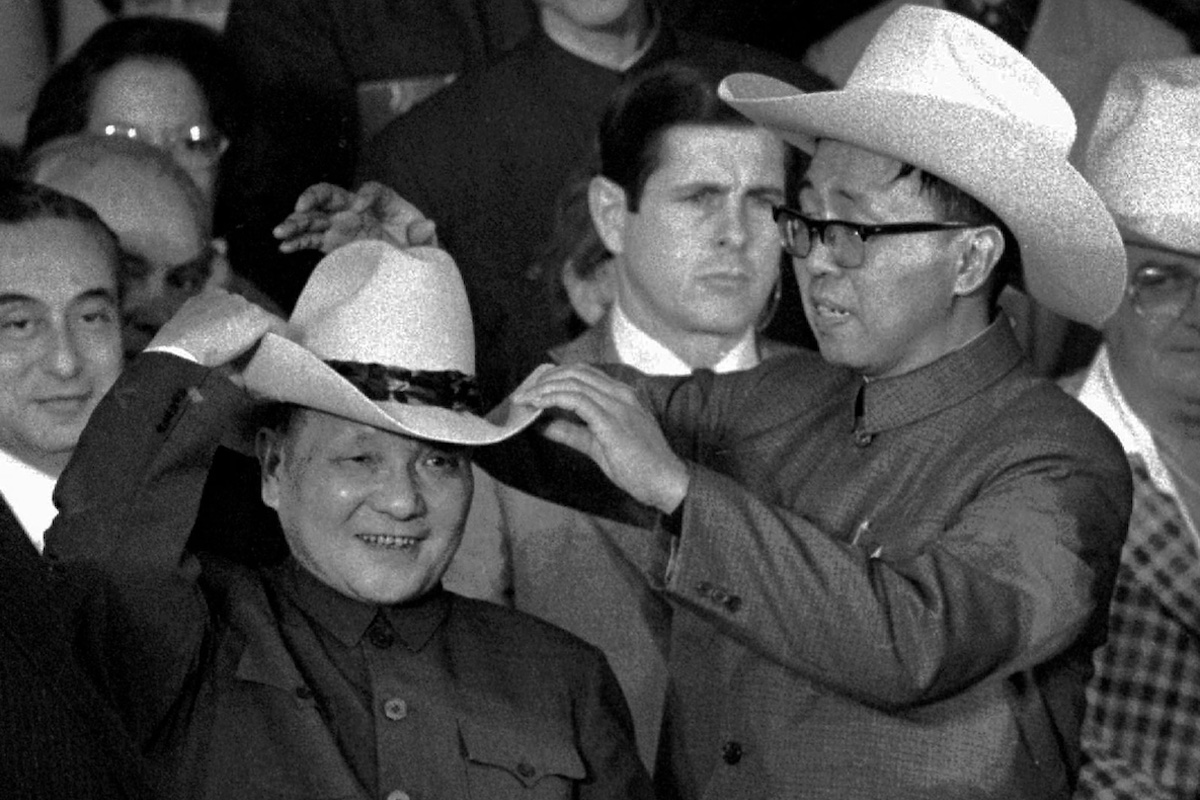
Chinese political culture has long been rooted in pragmatic, empirical problem-solving, famously summed up by Deng Xiaoping’s iconic adage: “It doesn’t matter if a cat is black or white, as long as it catches mice.” In the 1980s, Deng himself concluded that the U.S. model was the “cat” that delivered proven results. For decades, the U.S. stood as an explicit aspirational benchmark for China, whose stated goal was to first match, then surpass, American levels of prosperity and global influence. That widespread Chinese admiration for the U.S. was an unspoken, powerful diplomatic lever Washington wielded, intentionally or otherwise, to shape bilateral relations.
But now that China no longer views the U.S. as a model worth emulating, that entire historic channel of U.S. leverage disappears. Beijing is now fully committed to advancing its interests on the global stage using its own self-defined governing framework, under the conviction that its path is the correct one. The core unresolved question hanging over the country today is whether that “Chinese cat” actually delivers the tangible results it promises: widespread domestic frictions cast doubt on that assumption, but the visible chaos unfolding across the U.S. seems to validate Beijing’s rejection of the Western model.
This centuries-old Chinese preoccupation with selecting a viable external governing framework stretches back more than 100 years. In the interwar 1920s, in the aftermath of the Qing Dynasty’s total collapse, the nation faced an almost identical dilemma: which competing Western ideological system would best secure China’s survival and prosperity? The options on the table were Soviet communism, Italian and German fascism, and the liberal democratic model from Western Europe and the United States, each of which had vocal, organized supporters within Chinese intellectual and political circles. At that time, China was crippled by military defeat, cultural disorientation, and economic collapse, and its leadership concluded it had no choice but to adopt a proven foreign system, eventually aligning fully with the Soviet Union. Half a century later, post-Mao leaders concluded the Soviet model had failed to lift living standards meaningfully, and turned to selectively adapt elements of the U.S. system, which was then seen as the undisputed global victor of the Cold War that delivered widespread wealth to its population.
Today, for the first time in two centuries, Chinese leaders negotiate with the U.S. as formal equals, and many in Beijing openly argue their system is outperforming the American one. Donald Trump’s administration, which first took office vowing to erase China’s trade surplus and revitalize U.S. domestic industry, has after two years dragged the country into a new full-scale Middle East conflict with Iran, triggering the worst global oil crisis in 50 years and sending global financial markets into turmoil. For Beijing, there is little left to admire in the U.S. system: the American “cat” no longer appears to be working even for its own citizens, so there is no reason for China to attempt to adapt it to its own context. This fundamental shift upends 50 years of established U.S.-China bilateral dynamics.
Chinese analysts frame the current U.S. crisis through the lens of their own 19th century national trauma. They draw a direct parallel between the mass opium addiction that crippled the late Qing Dynasty and today’s widespread fentanyl and prescription opioid epidemic tearing through American working-class communities, and between the fanatical Taiping Rebellion pseudo-Christian movement that triggered a devastating 19th century civil war and modern U.S. social media platforms like TikTok that erode all shared boundaries between fact and fiction. Chinese observers note that U.S. regulators enforce strict quality controls for food and pharmaceutical products, but impose almost no oversight on social media platforms, which they argue systematically erode public critical thinking and educational outcomes for young people. Beijing frames its own strict drug prohibition regime and tightly controlled, party-curated domestic internet ecosystem as a deliberate protective “cultural bubble” designed to shield the nation from what it sees as a self-destructive Western cycle of substance abuse and information chaos, under the belief that its system will grow stronger as the U.S. decays.
Beyond these surface-level symptoms, Chinese analysts argue the U.S. foundational liberal *res publica* — the shared commitment to a common public good that binds its citizens together — is actively fragmenting. Two core fault lines drive this erosion: first, a new class of unaccountable American billionaires who prioritize personal, narrow agendas over collective national interests, with no unifying shared national purpose comparable to the anti-communist consensus of the Cold War era. Second, the growing spread of parallel sharia legal norms in parts of Western Europe, which they argue erodes the centuries-old liberal principle of equal citizenship under a single unified secular legal system, creating a patchwork of competing legal standards that undermines the foundation of liberal democracy. These observations lead many in Beijing to conclude that the entire Western liberal democratic model is no longer functional.
While the U.S. spent the years immediately after the 9/11 attacks prioritizing counter-terrorism and sidelining the China challenge, it has now spent more than a decade debating whether China, or domestic social divisions, or immigration, represents its primary national threat. This internal disorientation leads many Chinese policymakers to conclude the U.S. is too distracted and in decline to pose a meaningful challenge to China’s global ambitions. But this calculation carries significant risks: Washington is increasingly aligning with European and Indo-Pacific allies who now share a common wariness of China’s geopolitical ambitions, trade practices, and military support for Russia and Iran. If the U.S. successfully resets its priorities to focus on China, Beijing’s entire set of assumptions about Western decline could be proven wrong, creating a volatile new geopolitical landscape where miscalculation could trigger unintended, large-scale conflict across Asia’s many regional flashpoints. The recent U.S. decision to formally designate remaining Confucius Institutes as national security threats and accelerate their closure marks the latest step in Washington’s ongoing campaign to push back against Chinese influence operations on American soil, with no clear path yet for how the two powers will resolve their deepening ideological and strategic rivalry.