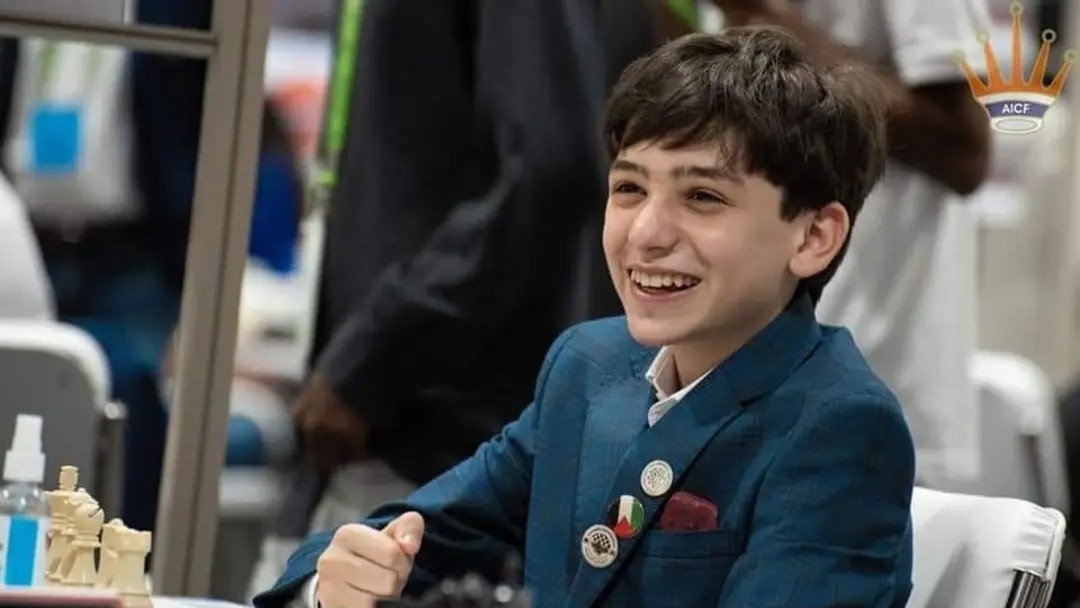
Raised in the occupied West Bank city of Hebron, Mohammed Seder first discovered his love for chess at just 5 years old, spending his after-school hours working through chess puzzles at home. His early aptitude for the game caught the eye of his father Naji Sider, a former Palestinian national chess champion, who quickly recognized the family’s inherited chess talent and began formal training for his son. By age 10, Seder was competing in official chess tournaments, and today at 17, he stands as Palestine’s highest-ranked chess player, holding a FIDE (International Chess Federation) rating of 2235 that earns him the grand master title. His 12-year-old sister Randa Seder has also made a name for herself in the sport, recently claiming the 2026 Palestine Women’s Classical Chess Championship title, and previously making history as the youngest ever participant at the 2022 FIDE Chess Olympiad in Mamallapuram, India.
Seder has already secured two Palestinian National Chess Championship titles, and has claimed Arab chess championship wins in the under-8, under-10 and under-14 age categories, representing Palestine at dozens of international events and chess olympiads across more than 20 countries. Speaking to Middle East Eye, the teen champion shared that his local fame precedes him even at school, where teachers often know his reputation before their first class with him, and his tournament wins for the school are celebrated as major community achievements. For Seder, every international appearance carries dual weight: immense pride in flying the Palestinian flag, and a deep sense of responsibility to showcase the world the depth of talent and intelligence among Palestinian people.
A meticulous competitor, Seder prepares for every match by researching his opponent’s full profile, including their signature playing styles, preferred opening moves, and common problem-solving patterns, before working with his coaches to craft targeted game plans. He also swears by non-strategic preparation steps: prioritizing sufficient sleep, and eating carb-heavy but light meals before matches, a lesson he learned the hard way after overeating at a Turkish restaurant in Dusseldorf, Germany, and losing a key match when heavy food made him drowsy. When he cannot travel for in-person tournaments, he keeps his skills sharp by playing daily on open online chess platforms including Lichess and Chess.com.
Currently in his final year of secondary school, Seder is preparing to sit for the Palestinian Tawjihi general secondary exam, a high-stakes assessment in a society that values academic excellence deeply, with a 99 percent youth literacy rate across Palestine. He is aiming for top marks to secure a full scholarship to study computer science or engineering at a U.S. or European university, with his top pick being Saint Louis University in Missouri, renowned for its world-class collegiate chess program. Even as he seeks educational and competitive opportunities abroad, Seder emphasizes that his connection to his homeland outweighs all his chess ambitions: “My land is much more important to me than chess. If I leave Palestine for some years, I will come back for sure.”
Despite his extraordinary talent, Seder’s path to advancing his chess career is blocked by systemic barriers facing Palestinians in the occupied West Bank. The network of Israeli military checkpoints across the territory turns short 60-kilometer trips between Hebron and cities like Ramallah, Nablus or Jenin into grueling, dangerous journeys that can stretch 5 to 12 hours. In recent years, settler violence and Israeli military raids in Hebron have escalated sharply; just days before the interview, the Israeli military demolished an entire Hebron neighborhood and forcibly displaced more than 2,670 Palestinian residents as collective punishment following an attack on a nearby military checkpoint. Seder has faced repeated arbitrary detentions during travel, including being held at a border crossing en route to a Kuwait tournament, and once being forced out of his car by Israeli soldiers and made to wait by the roadside for two hours with no stated reason. Two months prior to the interview, Israeli soldiers raided the Seder family home at night and arrested his father, who was released only after several hours in custody.
Palestine’s domestic chess scene also suffers from a near-total lack of corporate sponsorship and public funding, severely limiting access to high-level competitive events. Seder’s next career milestone is reaching a FIDE rating of 2400 to earn the International Master title, a goal that requires competing in 3 to 4 high-level tournaments per month against existing International Master ranked players. In 2026 alone, he has only been able to participate in one official tournament, leading him to warn that if he remains in Palestine long-term, his promising chess career will stagnate and end prematurely.