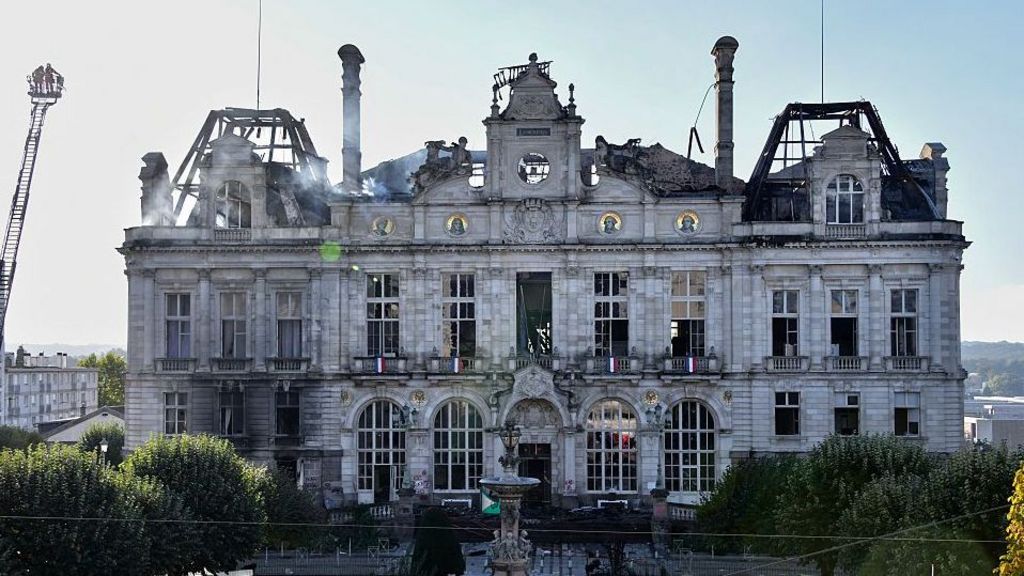
Exactly seven days after violent unrest during France’s nationwide wave of demonstrations left Limoges’ iconic 19th-century town hall reduced to a charred, fire-ravaged shell, the tight-knit porcelain-making city is caught in a moment of collective grief and fierce political division. For Guillaume Guérin, the conservative mayor who only took office six months ago, the past week has been the most searing of his young tenure: standing beside the blackened, still structurally fragile stone facade of the once-grand municipal building, he recalls breaking down in tears when he first witnessed the full scale of the damage, as the building’s beloved wooden clock spire crumbled into roaring live flames in front of onlookers last Saturday. The viral footage of the spire’s collapse sparked immediate national outrage, a reaction Guérin describes as entirely legitimate and understandable, calling the incident not just a local loss for Limoges but a “historical tragedy for all of France.”
Two men, aged 66 and 34, have been taken into police custody in connection with the arson, with regional prosecutors confirming both suspects have documented ties to radical left-wing activist networks. Guérin has publicly noted that while he received a personal message of solidarity from U.S. Vice President JD Vance, he has not heard any direct outreach from Emmanuel Macron, France’s sitting outgoing president. The mayor warns that the destruction of the landmark municipal building will leave a tangible mark on the country’s upcoming presidential election, scheduled in six months’ time, arguing “this country is not doing well at all.”
The fire that destroyed the city’s most recognizable architectural symbol is the most explosive flashpoint yet of weeks of rolling, youth-led national protests that began as narrow demonstrations over dilapidated high school infrastructure, but quickly snowballed into a broader mass outcry over skyrocketing living costs, stagnant wages and widespread public frustration with a paralyzed centrist national government. The administration, led by Prime Minister Sébastien Lecornu, holds no stable working majority in the National Assembly, is grappling with one of the largest fiscal deficits in the European Union, and has offered few actionable policy solutions to address public discontent ahead of the election. Lecornu traveled to Limoges on Friday evening to survey the damage, as national authorities moved to ban public demonstrations in multiple urban centers, deploy additional riot police across high-risk areas, and impose strict local restrictions in Limoges including an overnight curfew and a ban on public gatherings larger than 10 people in the city center.
Public opinion across Limoges remains sharply split on the fire and the legitimacy of the broader protest movement. At a popular student pub in the city center, 24-year-old Alexander, wearing the traditional colorful French student faluche beret, argues that widespread systemic poverty poses a far greater crisis than the loss of a historic municipal building. His view is echoed by 19-year-old medical student Jade, who says she survives on just €300 a month for living expenses and feels her generation is completely disrespected by governing elites, noting that while the town hall fire is tragic, it is far from the most distressing outcome of the current wave of unrest. Both acknowledge that acts of random vandalism are unacceptable, but say the anger driving the protests is fully justified.
Across the city at Limoges’ landmark Eiffel-engineered covered market, however, long-time local residents express overwhelming grief and frustration at the destruction. 63-year-old fishmonger Jean Roger Faucher, whose family has run their market stall for more than a century, married at the town hall decades earlier and says the fire left him completely stunned, adding that while he sympathizes with the protesters’ economic grievances, any demonstration that endangers local residents’ lives cannot be tolerated. 59-year-old butcher Pascale Vuylsteke, who works 100 hours a week to support her business, says she recognizes that living costs have become unmanageable for many, but struggles to accept that mass vandalism is a reasonable response.
Limoges, a historic cradle of the 19th-century French labor movement that grew alongside its world-famous porcelain industry, now finds itself once again at the epicenter of a national political rupture. Many local residents hold out hope that the shock of losing the town hall will push the protest movement away from violent destruction and back toward constructive, peaceful debate — but with further demonstrations already scheduled and national political polarization continuing to deepen, that outcome remains far from guaranteed.