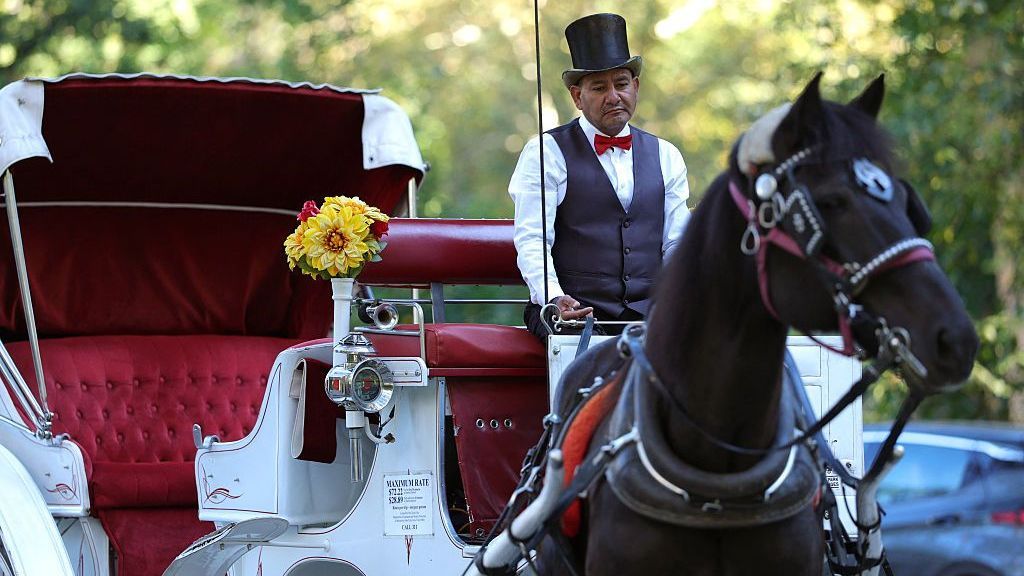
For more than 160 years, clip-clopping horse hooves on Central Park’s paved paths have been a defining New York City tourist tradition. But that iconic practice is poised to come to an end by 2028, after a years-long battle that has pitted animal welfare advocates and public safety campaigners against hundreds of carriage drivers whose livelihoods and lives are tied to the industry.
Alexus Lawson’s connection to the trade began when she was just five years old, after a chance encounter with a Central Park carriage horse that left her captivated. Today, at 28, the sixth-generation driver owns six horses, and has worked guiding rides through the park for six years. When news broke of the upcoming city council vote to outlaw the industry, her first thought was not just for her job, but for the animal she works alongside every day. “What am I supposed to do with my horse?” Lawson questioned. “You’re going to tell me I can’t work with her anymore? How am I supposed to ensure her health?”
Lawson is one of roughly 200 licensed carriage drivers in Central Park, a group that has pushed back fiercely against claims that the horses are mistreated or that the rides pose an unacceptable public risk. Medet Fidan, a driver with 12 years of experience, calls the mistreatment allegations absurd. “I spend more time with my horses than my wife and my kids,” he said. “They’re telling me I’m abusing my horse? No way.” Fidan says he is angry that city leaders are moving forward with the ban without meaningful input from the people who make their living in the industry, warning the decision will destroy his family’s livelihood.
City officials and ban supporters, however, argue the change is long overdue, pointing to decades of documented incidents that have harmed both horses and humans. Official data from the Manhattan Borough President’s office shows 40 horses working in Central Park have died since 1982, with causes ranging from overheating to collisions with vehicles and other carriages. The push for a ban gained urgent new momentum this summer following the death of 18-year-old Indian tourist Romanch Mahajan, who fell from a carriage after the horse bolted and later died from his injuries. The proposed legislation, dubbed Romanch’s Law, was also spurred by the death of carriage horse Deniz, who died after ingesting a toxic plant in the park earlier this year.
Since that fatal incident, ban supporters have highlighted a string of other recent accidents: the Central Park Conservancy, the non-profit that manages the park and backs the ban, recorded seven horse-related incidents in just 13 months leading up to the vote. These include a collision that tipped a carriage and sent a driver to the hospital in May, and an incident in January where a spooked horse ran into nearby city traffic, causing a multi-car crash.
Previous attempts to ban the industry in past decades were derailed by pushback from city council members and the Transport Workers Union, which represents the drivers. This year, however, the proposal has the backing of Mayor Zohran Mamdani, who has proposed an industry transition framework to support affected workers. The plan includes promises of potential job placement, vocational training, career counseling, and financial compensation for drivers and other workers in the sector, with the mayor’s office confirming it is actively working to connect drivers to new roles. Drivers in the industry report earning between $60,000 and $70,000 annually.
The union, however, says the proposal offers no binding guarantees for compensation or new jobs, arguing the ban will leave workers “economically wiped out.” It also raised urgent concerns about what will happen to the hundreds of horses currently working in the industry, noting that thousands of unwanted horses are sent to slaughter auctions across the U.S. every year. The proposed legislation does prohibit selling carriage horses for slaughter or reassigning them to other similar heavy work, but the union says there is no dedicated funding to support shelters or rescues that take in the animals.
For animal rights activists, the ban marks a decades-in-the-making victory that addresses longstanding abuses. The movement to end New York’s horse-drawn carriage industry actually predates the modern animal rights movement: the American Society for the Prevention of Cruelty to Animals (ASPCA) was founded in 1866, after activist Henry Bergh witnessed a carriage horse being brutally beaten in the city. Today, groups including PETA and a broad coalition of animal welfare organizations continue to back the ban, arguing that horses are not suited to stand for hours in noisy, crowded urban parks pulling passengers. Current rules allow horses to work up to nine hours a day, waiting for hire at designated park entrances, with rides costing a minimum of $72.22 for 20 minutes.
Public opinion on the ban is deeply divided, even among tourists and visitors. German tourist Vanessa Stolle, who keeps horses at her family’s home back in Europe, said the animals do not belong in Central Park’s busy environment. “To stand the whole day here – it’s loud for them and they can’t go to the countryside,” she explained. But other visitors say the carriages are a core part of New York’s cultural identity. German tourist Christian Bauers, who first saw the horses during a visit 20 years ago, said: “It’s part of the culture of New York. Let them stay. It’s cute.”
Many visitors who support the ban say they sympathize with the drivers facing job loss, but argue the safety risks are too high to keep the industry running. Jeanne Collopy, an animal lover from Colorado who grew up around wild horses, said: “I know there’s a union and I hate to have people out of work, but it’s a little bit confining for the horses.” Her husband Chris Koenigs added that while the horses are pleasant to observe, the death of 18-year-old Mahajan was an unacceptably high cost for preserving the tradition. “The park is magnificent,” he said. “I can’t help but think, it would be a magnificent park with or without the carriages.”
Drivers, meanwhile, push back that New York’s carriage industry is the most heavily regulated in the country, and that many horses thrive on the daily work and stimulation of the job. “They look at an animal in harness and they see a trap,” Lawson said of city officials pushing the ban. “They see a job as something that’s terrible. Horses are working animals.” For Lawson and her fellow drivers, the ban is not just a policy change – it is the end of a lifelong passion and a livelihood they have built with the horses they love.