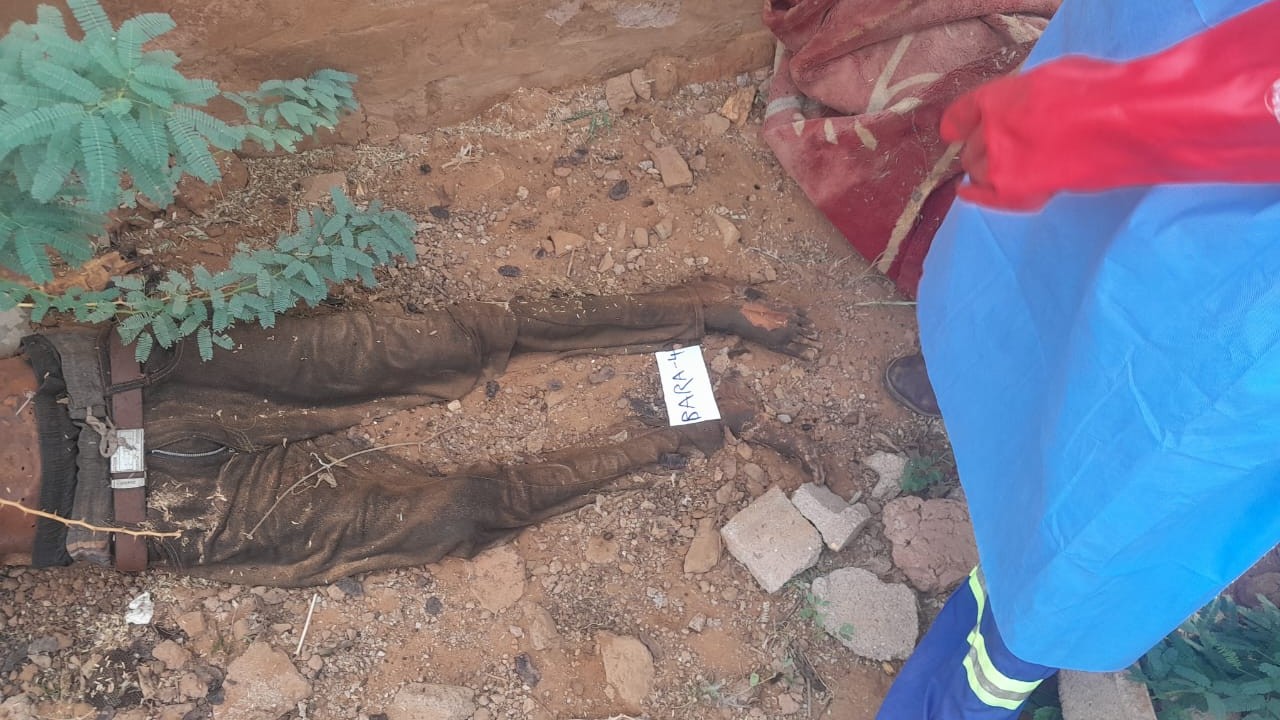
More than 18 months into Sudan’s brutal civil war between the Sudanese Armed Forces (SAF) and the Rapid Support Forces (RSF), a grim discovery has unfolded in the North Kordofan state town of Bara, revealing the full scale of alleged mass atrocities committed by the paramilitary group. After the SAF recaptured Bara from RSF control during intense fighting in July 2025, local volunteers have recovered and buried more than 600 corpses scattered across the town’s streets, residential homes, public squares, surrounding villages, and the key highway connecting Bara to el-Obeid, the strategic state capital. Local activists and volunteers confirm hundreds more bodies remain uncollected, rotting in open areas across the region. Eyewitnesses and local sources allege the vast majority of the recovered dead are unarmed civilians killed in deliberate revenge attacks carried out by the RSF after the group seized control of the area, with the remaining bodies belonging to fighters from both warring factions.
Exclusive photos and video footage obtained by Middle East Eye document the horrific conditions volunteers have faced. Bodies were left exposed to Sudan’s sweltering heat for months, with many decomposing completely into skeletons in just a few weeks, while others remain partially preserved. Remains have been found of all ages, including children and elderly civilians, alongside the fresher bodies of combatants. The scale of unburied dead has turned Bara, once a populated community, into a deserted wasteland. The ground is contaminated by decomposition, overrun by swarms of insects and roaming scorpions, and littered with additional dead animals and birds. This toxic environment has already sparked the rapid spread of unidentified, unexplained diseases across the area, putting the volunteers working to bury the dead at extreme risk.
To date, 50 volunteers have led the entire recovery and burial effort, funded largely by local community groups, Bara residents, and members of the Sudanese diaspora, particularly those based in Gulf countries and neighboring el-Obeid. One volunteer revealed the team has opened 200 mass graves to inter the remains, burying 400 additional bodies in separate sites. The Sudanese Ministry of Health, Sudanese Red Crescent, and small local initiatives have only provided basic supplies including mortuary bags and body containers. Volunteers report they have received no direct support from national authorities or major international non-governmental organizations, and are still in desperate need of critical logistical aid: fuel for transport, protective gloves, face masks, hand sanitizer, additional body bags, and other sanitation materials.
Abdul Rahman, a leading figure of the Bara resistance committee, told Middle East Eye that recovery operations remain ongoing, as teams believe the final death toll will far exceed current field estimates. Hundreds of bodies are still stranded in hard-to-reach outlying communities including Geraigikh, Jabrat al-Sheikh, and Umm Syala. Sudan’s Ministry of Information has confirmed that RSF abuses have impacted more than 100 villages across the Bara region, forcing the entire local population to flee their homes. Following a meeting between Bara local leaders and Information Minister Khalid Ismail Ahmed Ali el-Aisir, the ministry announced the federal government would provide support to victims through medical care and future reconstruction efforts, though no funding or timeline has been released.
Activist groups including the independent Emergency Response Rooms and popular resistance volunteers operating under SAF coordination have formally accused the RSF of carrying out systematic massacres across the Bara area in October 2024. The RSF, a paramilitary force that grew out of the former Janjaweed militia in Darfur, has already been formally designated as committing genocide by the United Nations and United States across multiple regions of western Sudan. The group is widely documented to receive military and financial sponsorship from the United Arab Emirates, a claim Abu Dhabi continues to deny despite mounting evidence from UN fact-finding missions and independent investigators.
Sudan’s conflict erupted in April 2023 over a power struggle between SAF commander Abdel Fattah al-Burhan and RSF leader Mohamed Hamdan Dagalo. It has since spiraled into the world’s largest active humanitarian crisis, with more than 11 million people forcibly displaced from their homes and at least 150,000 people killed, according to UN estimates. Both the SAF and RSF have been credibly accused of war crimes, including deliberate attacks on civilian infrastructure, sexual violence, and extrajudicial killings. The SAF receives military backing from Egypt and Turkey, while Egypt recently drew international condemnation for an airstrike on a gold mining camp near the Sudan-Egypt border that killed at least 114 civilian miners.
Recent weeks have seen a major territorial advance by the SAF across North Kordofan, with the army retaking control of key towns including Sodar, Um Badir, and al-Mazroub, returning most of the state to government control. Military sources tell Middle East Eye the SAF is planning its next push into neighboring West Kordofan, targeting the major gum arabic-producing cities of Al-Nuhud and Al-Khuwayyi. The region historically produces more than 80 percent of the global supply of gum arabic, a critical additive used by multinational food giants including Coca-Cola and PepsiCo, as well as in pharmaceutical and cosmetic products. For its part, the RSF has responded by expanding cross-country drone strikes, targeting population centers including el-Obeid, Kosti in White Nile state, Atbara in northern Sudan, and the capital Khartoum and its twin city Omdurman.
The conflict’s international dimensions were thrown into sharp relief recently when Israeli Prime Minister Benjamin Netanyahu publicly presented a map dividing Sudan into spheres of influence: RSF-held western Sudan was labeled as friendly to Israel and the UAE, while SAF-controlled territory was marked as aligned with Turkey, Saudi Arabia, Egypt, and Pakistan. To date, years of international diplomatic efforts to broker a ceasefire and end the war have failed to produce any meaningful progress, leaving civilians across Sudan trapped in ongoing violence and humanitarian catastrophe.