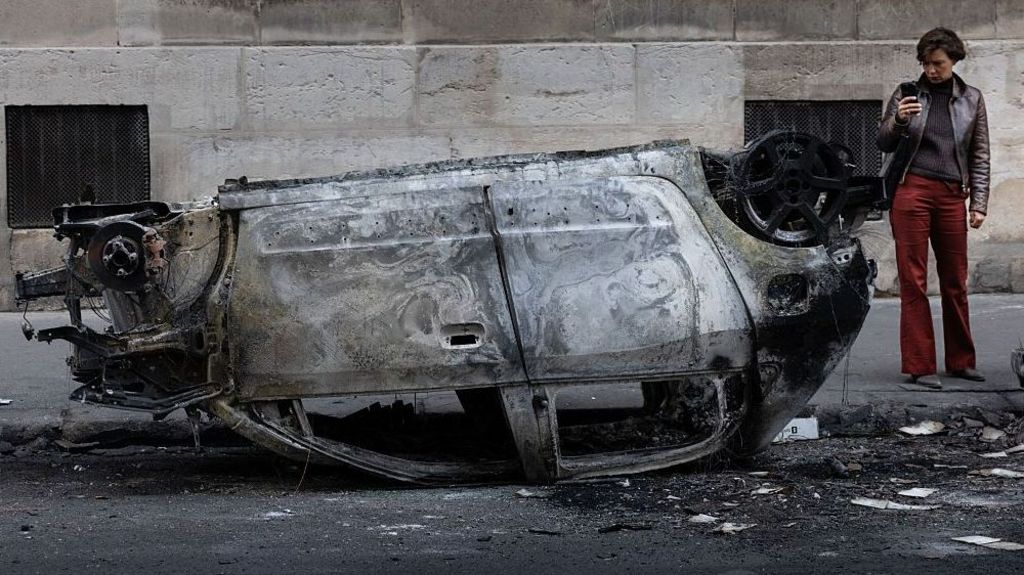
In the tree-lined streets of central Paris, shattered glass from smashed storefronts still crunches underfoot, and walls are scrawled with red graffiti insulting French police, dated to the October 17 riot. For local resident Elisabeth, the chaos that unfolded that Saturday does not represent the country she loves. Speaking through tears amid the wreckage, she pushed back against widespread media focus on the violence, insisting it does not reflect the values of most French people. “This is not the face of France,” she stressed, rejecting her friend’s comparison to an impending civil war. But her uncertainty over who orchestrated the unrest, and why it erupted after weeks of peaceful student protests, mirrors the confusion and division rippling across the nation days after the violence. What began as a mass demonstration over public education reforms has devolved into widespread arson, looting of more than 3,000 businesses, and coordinated attacks on law enforcement, leaving French political leaders scrambling to assign blame — and turning the chaos into early political fodder for the 2027 presidential election, just six months away.
French top officials have been unified in pointing fingers at radical far-left factions as the main architects of the violence. Prime Minister Sébastien Lecornu has repeatedly stated that small far-left and ultra-left groups planned the insurrection, accusing these factions of weaponizing legitimate student demonstrations for political gain. Interior Minister Laurent Nunez echoed this claim, saying these groups “poured oil onto the fire” of existing public frustration. A declassified French intelligence report dated September 29, published by Le Figaro, goes further, alleging that radical-left aligned student unions and political movements have been deliberately manipulating peaceful student protests. The report specifically names Jean-Luc Mélenchon’s left-wing populist party La France Insoumise (LFI), claiming the group is embracing violence as an electoral strategy to build support ahead of 2027. French intelligence had already warned government leaders earlier this month that anarchist left-wing groups were embedded in the student movement, and their symbolic circled capital “A” was found spray-painted on damaged buildings across the country over the weekend. Footage repeatedly aired by French media shows groups of masked young men in black clothing attacking police vans with large hammers and machetes, adding credence to claims that at least some of the violence was pre-planned, even as most looting appears to have been opportunistic.
Belgian officials have drawn similar connections, with Interior Minister Bernard Quintin warning this week of the “TikTokisation of violence,” where riot footage shared widely on social media radicalizes impressionable young people. Quintin also blamed “known far left groups” for violent unrest that has erupted in Brussels and Liège in recent days. Back in France, the conservative mayor of Limoges Guillaume Guérin has publicly blamed LFI for the chaos in his city, where the historic town hall was set ablaze — an accusation the party has forcefully rejected.
Mélenchon, who participated in Saturday’s originally planned peaceful protest and is currently polling in second place for the 2027 race, has vehemently denied all claims of involvement in the violence. He has flipped the blame back to Lecornu and centrist President Emmanuel Macron’s government, arguing the administration is either incompetent or intentionally allowed the violence to unfold to position itself as the “party of order” and distract from its failed management of France’s spiraling public debt and borrowing costs. Student organizers echo this rejection, calling the claims of political manipulation insulting. Lisa Cordat, a representative of the FSE student union in the Paris suburb of Saint-Denis, where the original education protests began a month ago, says students have organized their own demonstrations via independent social media and student-led groups. “Student anger comes from the ground up,” she emphasized, rejecting any claim that politicians are calling the shots.
For many ordinary French residents, however, the flurry of cross-partisan blame-shifting only highlights how political leaders are exploiting the violence for their own gain, rather than addressing the root causes of public anger. “Politicians are hunting for scapegoats but don’t ask why it all happened,” said 25-year-old Lina, echoing a sentiment shared by many interviewees. Teacher Mar put it more bluntly: “Saturday’s violence suits politicians’ purpose. It distracts from weeks of legitimate protests for better public services. Politicians aren’t listening to what the students need, or what teachers need or what the French people want. They’re using the violence to election-campaign to become president and to try to make their opponents look bad.”
Of all the presidential contenders, far-right National Rally leader Marine Le Pen appears to be the biggest political beneficiary of the unrest, which comes as she already holds a significant lead in early polling for 2027. Le Pen released a formal presidential-style video address to the nation Sunday, standing behind a desk in front of the French flag and specifically naming Mélenchon, blaming his associates for seeking to “throw the country into chaos.” She also attacked Macron’s government as “running out of steam,” claiming France is “taken hostage between violence and powerlessness,” and closed by reminding voters they will soon have the chance to “choose a different path” in six months. Like former U.S. President Donald Trump, Le Pen has also blamed migrants for the chaos, doubling down on her party’s signature law-and-order and closed-border platform.
The unrest has also exposed critical gaps in France’s domestic security apparatus. President Macron has already demanded explanations for intelligence and policing failures after the violence, with Interior Minister Nunez admitting there were not enough officers deployed to the streets despite advance public notice of the nationwide protests. After facing accusations of heavy-handed policing at earlier demonstrations, law enforcement was left badly outmatched by the scale of coordinated violence Saturday. Online platforms have pledged to work with authorities to track down looters, many of whom openly posted stolen goods — including designer sneakers — for sale online shortly after the looting, with many not even bothering to hide their identities. Former Prime Minister Gabriel Attal, another 2027 presidential hopeful, has called for targeted social media blackouts to prevent further unrest, after evidence showed social media posts encouraged participation in the violence.
Beyond the immediate political blame game, the French riots are part of a broader wave of youth-led unrest spreading across Europe, with similar protests erupting over the past weekend in Italy, Portugal, and Albania alongside France and Belgium. A growing body of polling and on-the-ground interviews shows this unrest stems from deep, long-simmering disillusionment with mainstream politics and deteriorating living conditions across the continent. Young people in particular face a cascade of crises: skyrocketing housing costs, growing social inequality, the accelerating threat of climate change, and fears that artificial intelligence will displace them from the workforce. Many people also report feeling powerless over global events that drive up everyday costs, such as ongoing wars in Ukraine and the Middle East that have pushed energy prices sharply higher.
2024 Pew Research polling bears out this widespread discontent: 69% of people in France report being dissatisfied with how democracy is working in their country, compared to 68% in Spain, 62% in Italy, and 69% in the United States. Most people on the ground in France are quick to draw a clear line between the thousands of peaceful protesters who marched to demand better public education, and the small faction of rioters who engaged in violence and looting. But the question now hanging over France and the rest of Europe is whether this wave of unrest is the product of simple political manipulation by extreme factions — or a boiling over of decades of ignored public frustration, where growing numbers of people have come to feel there is little left to lose.