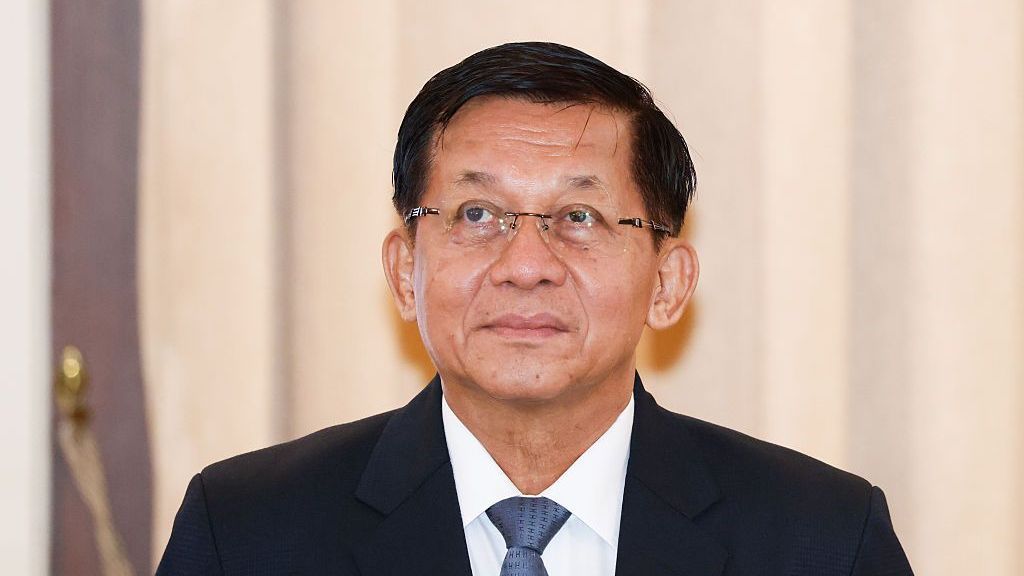
For nearly three years following the 2021 military coup that ousted Myanmar’s democratically elected government and detained iconic leader Aung San Suu Kyi, Washington maintained a strict policy of diplomatic isolation, paired with targeted sanctions against figures tied to the junta led by Min Aung Hlaing. That long-standing posture now appears to be shifting, after the revelation that a senior Trump administration official held a historic face-to-face meeting with Min Aung Hlaing in Nay Pyi Taw last September, paired with recent adjustments to U.S. sanctions that have removed some junta-linked business figures from the restricted list.
The September 15-16 meeting marked the first encounter between a senior U.S. official and Min Aung Hlaing since the general seized power. The participating official, Assistant Secretary of State for Intelligence and Research Michael Vance, framed the discussion as primarily focused on securing the release of U.S. citizen Adam Castillo, who was detained in June amid a local dispute with the American Chamber of Commerce. But diplomatic analysts widely agree that the meeting covered far more than the Castillo case, as Vance’s status as the most senior U.S. official to meet the junta leader in three years carries major symbolic and strategic weight. It is also worth noting that Vance has a recent history of diplomatic engagement related to Myanmar: he met Burmese officials in Tokyo this June and again this month, and has also held talks with representatives of Myanmar’s anti-junta opposition movement.
This apparent policy shift did not emerge overnight. Tracing its origins back to July of last year, at the peak of the Trump administration’s trade tariff war with China, President Trump sent a personal letter to Min Aung Hlaing that signaled a break from previous diplomatic protocol. In the letter, Trump notified the junta leader that Myanmar would face 40% tariffs on its exports to the U.S. – a move that sent shockwaves through many regional governments that had long aligned themselves with Washington. But Min Aung Hlaing responded not with condemnation, but with effusive flattery, mirroring Trump’s distinctive rhetorical style and thanking the president for the opportunity to continue accessing the world’s largest U.S. market.
For Min Aung Hlaing, this acknowledgment from the U.S. president was a major diplomatic win. Since seizing power, the junta leader has been widely shunned by the international community, branded a war criminal with pending cases at both the International Criminal Court and International Court of Justice, and recognized by only a handful of countries including Russia and China. Trump’s decision to address him as “Your Excellency” without any mention of the coup’s devastating human cost, the dissolution of Myanmar’s democracy, or the continued detention of Aung San Suu Kyi represented a significant break from the global consensus.
That same month, the junta took steps to strengthen its ties to Washington, signing a $3 million contract with DCI, a long-standing Washington lobbying firm that previously worked for a past Burmese military regime in 2002 to improve its international image. Since that deal was struck, the military government has also hired controversial Trump confidant and lobbyist Roger Stone for a $50,000 monthly retainer to advance its interests in Washington. Adam Castillo, the detained U.S. citizen whose release was the stated purpose of Vance’s meeting, had himself been working to encourage re-engagement before his arrest: a former U.S. Marine and Trump supporter who recently stepped down as head of the Yangon American Chamber of Commerce, Castillo had traveled to Washington to argue that Washington’s decades-long sanctions strategy had failed, and that re-engagement could advance U.S. strategic interests by loosening China’s grip on Myanmar’s vast critical mineral reserves.
Castillo’s arguments found a receptive audience in the Trump administration, which had been scrambling to find alternative sources of rare earth minerals after China blocked rare earth exports to the U.S. in retaliation for Trump’s tariffs earlier that year. Myanmar is home to substantial rare earth reserves that are currently entirely controlled and exploited by Chinese firms, making them a highly attractive target for U.S. policymakers seeking to reduce dependence on Beijing.
This shift in approach has also been reflected in U.S. guidance on international elections. The U.S. State Department recently issued new instructions to U.S. embassies worldwide barring them from publicly commenting on the fairness, integrity, or legitimacy of foreign electoral processes or the democratic credentials of host governments. When Myanmar held a widely criticized general election late last year that allowed Min Aung Hlaing to rebrand himself as a civilian president, most Western governments condemned the vote as neither free nor fair – but the U.S. remained silent, breaking with decades of precedent where Washington regularly issued judgments on the democratic status of foreign elections.
The recent removal of some junta-linked individuals from the U.S. sanctions list has only reinforced perceptions that a major policy shift is underway. DCI, the lobbying firm working for the junta, recently noted in a newsletter that “For years, the U.S. approach to Myanmar has been defined by isolation, sanctions, and distance. That era is over… thankfully, President Trump has the courage to try something different.”
Yet analysts argue that the change is more rhetorical and procedural than substantive. Richard Horsey, Myanmar adviser for the International Crisis Group, notes that Min Aung Hlaing himself remains under U.S. sanctions, and that “In practice less has changed than the headlines suggest. What is new is the level of contact and the location. Senior U.S. officials have now been to Nay Pyi Taw, which is exactly what Min Aung Hlaing wanted. What he wants next is sanctions relief, and that will be harder.”
Other Trump administration policy changes have had far more tangible impacts on people in Myanmar and the U.S. Last year, the administration dismantled much of USAID’s programming in the country, cutting aid to opposition groups, independent dissident media, and displaced refugees by more than half. It also revoked Temporary Protected Status for 4,000 Burmese refugees who had settled in the U.S., a decision decried by human rights groups that leaves these refugees at risk of deportation back to Myanmar, where many would face imprisonment or even death.
As for the prospect of the U.S. gaining access to Myanmar’s rare earth reserves, most experts are skeptical. The majority of these deposits lie in territory contested by ethnic insurgent groups, and are currently extracted by Chinese firms with decades of experience operating in Myanmar’s ungoverned border regions, before being transported to China for processing. There is currently no clear path for U.S. firms to gain meaningful access to these reserves.
Skepticism also extends to the prospects of U.S.-Myanmar cooperation on cracking down on the country’s booming billion-dollar scam industry. While the junta has launched a few highly publicized raids on major scam compounds, analysts note that the criminal syndicates running these operations simply relocate to smaller, more remote sites, and many of these groups operate with the explicit backing of militia groups allied to the Myanmar military.
Regional policy experts note that diplomatic engagement with Nay Pyi Taw is not inherently problematic, but that Washington must prioritize key issues in these talks. “Talking to Nay Pyi Taw is not wrong in itself,” says Hunter Marston, Southeast Asia director at the Lowy Institute. “The question is what Washington asks for and what it gives away. It should use the channel for the things that matter most: humanitarian access, an end to airstrikes on civilians. It should keep talking to the opposition and the ethnic armed groups, who hold much of the country. And on scams, the most effective thing the US can do is to co-ordinate with other governments in the region, including China, to go after the money.”
The biggest open question remains whether the Trump administration, currently distracted by domestic political battles and other geopolitical priorities including tensions with Iran, has the bandwidth to maintain sustained focus on Myanmar, let alone challenge China’s long-standing dominant influence in the country.