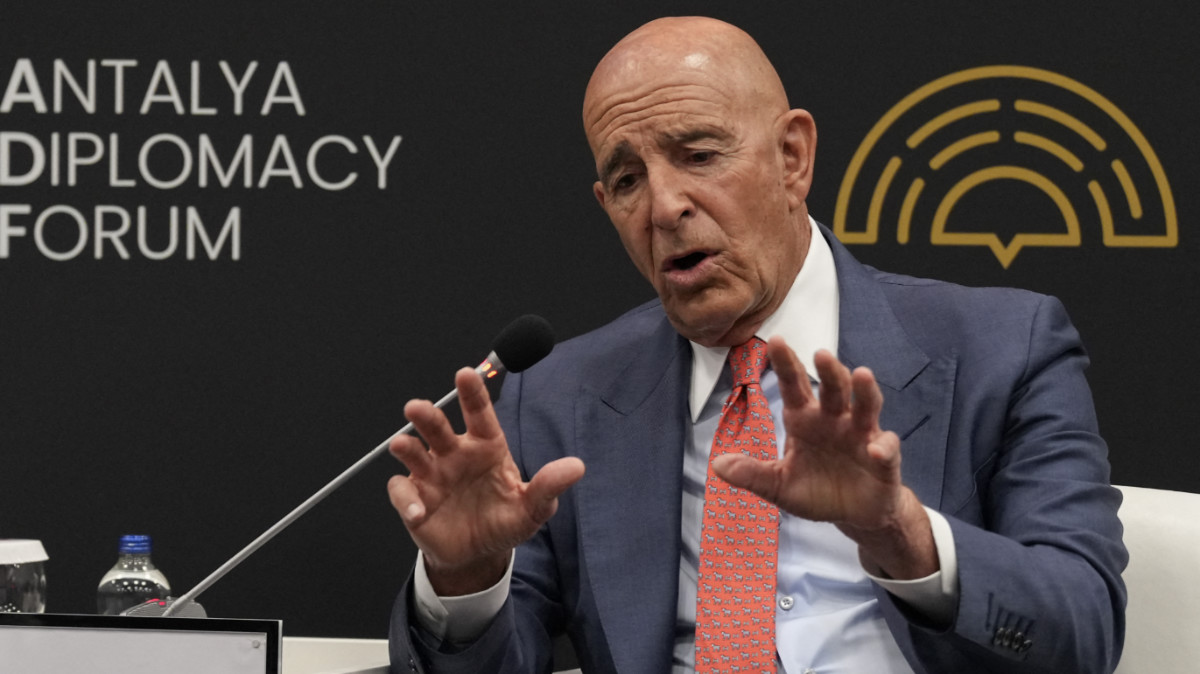
A top senior advisor to former US President Donald Trump has announced a historic reorientation of Washington’s approach to the Arabian Gulf, bringing an end to an 80-year-old foundational arrangement that traded US security guarantees for access to Gulf oil supplies. Speaking Tuesday at the Doha-based Global Security Forum, Tom Barrack — the current US ambassador to Turkey and special envoy for Syria and Iraq — made clear that the long-standing global order where the United States served as the sole security guarantor across the Middle East is now a thing of the past.
Barrack, a figure long known for his critical views of colonial-era divide-and-rule policies in the Middle East and his vocal praise for the Ottoman Empire’s governance of the region, argued that Western powers for decades intentionally benefited from regional instability. “Conflict and controversy was actually to the western favour,” he explained. “The more off-base the region was, the more [the West] could manipulate fossil fuels for its own benefit. That’s not in existence anymore.” He emphasized the core new direction of US policy: Washington no longer seeks to exercise direct ownership or control over the Gulf region.
The policy shift comes in the aftermath of a tense diplomatic rift earlier this year, when Gulf states lobbied the US to reject plans for a joint US-Israeli attack on Iran, only to see their appeals ignored by Washington. Following the February 28 strike, Iran launched retaliatory waves of drone and missile attacks targeting the UAE, Saudi Arabia, Kuwait, and Bahrain, leaving the region to grapple with the fallout of the aggression.
When pressed on whether Gulf states could continue to depend on the post-WWII US security umbrella that has anchored regional security for generations, Barrack gave a blunt answer: no. “In the region, everybody is saying if we have America and we are selling oil and gas in dollars and we buy weapons in dollars and we have bases of Americans… we are going to have free seas, and we are going to have a security guaranty. All of a sudden, that doesn’t happen,” he noted. Barrack traced this dramatic reassessment of US commitments directly to the fallout of the joint US-Israeli campaign against Iran.
Crucially, Barrack stressed that the policy shift does not amount to a full US withdrawal from the region. “The bargain is not to own, not to control, but not to leave. We’re not leaving,” he clarified. Describing the transition to a new regional framework as a awkward, challenging process, he compared it to raising a teenager: “What’s happening in this administration is not an abandonment. It’s a message for realignment. And that message is like raising a teenager. It’s not easy.”
Under the new approach, Washington will back regional efforts to build local security architectures to replace the old US-led framework, including the Mecca Pact. Barrack pointed to Saudi Arabia’s activation of joint defence pacts with Pakistan and Turkey to counter Houthi aggression as an example of the new, region-led order taking shape. “Everybody’s got to be on their own regional alliances, which is what’s happening,” he said.
Barrack’s landmark remarks arrive as the entire Middle East braces for the possibility of a new, full-scale war against Iran. In recent weeks, leaders from Qatar and Egypt have issued repeated warnings that the region is on the brink of a major new conflict. While large-scale kinetic attacks have calmed in recent weeks, with Iran continuing targeted strikes on commercial shipping in the strategic Strait of Hormuz and the US maintaining its strict economic blockade of the country, tensions have been reignited by former President Trump’s recent escalation.
Ahead of Israel’s upcoming general elections this month, Trump openly endorsed Israeli Prime Minister Benjamin Netanyahu and raised the stakes for new military action. In comments Sunday, Trump said he wanted Netanyahu to remain in office to help “finish the job” against Iran unless the Iranian government quickly alters its policy trajectory.
The center of current regional hostilities has shifted to Yemen, where the Iran-aligned Houthi movement has carried out crippling attacks on Saudi civilian airports and critical energy infrastructure. Saudi Arabia backs Yemen’s internationally recognized government, but deep internal divisions within the administration have prevented any successful large-scale counter-offensive against Houthi positions. Though Riyadh and its Yemeni allies have repeatedly pledged to retake all occupied territory from the group, Barrack cast serious doubt on the likelihood of a military victory.
“These kinetic reactions have never worked. It doesn’t work. It’s probably not likely that it’s going to work,” he said when asked about Saudi prospects for defeating the Houthis militarily. He added that while Trump remains committed to providing logistical support to Saudi Arabia, the US will not commit ground troops to another Middle Eastern conflict: “The president has been clear that he supports Saudi Arabia, and the backing they need logistically he will supply, but America getting involved in a ground kinetic battle somewhere else sounds fruitless.”
Barrack is the second high-profile Western leader to publicly rule out a military solution to the Houthi conflict. Earlier this week at the same Doha forum, former MI6 director John Sawers made similar remarks, stating plainly that “the Houthis are here to stay.”