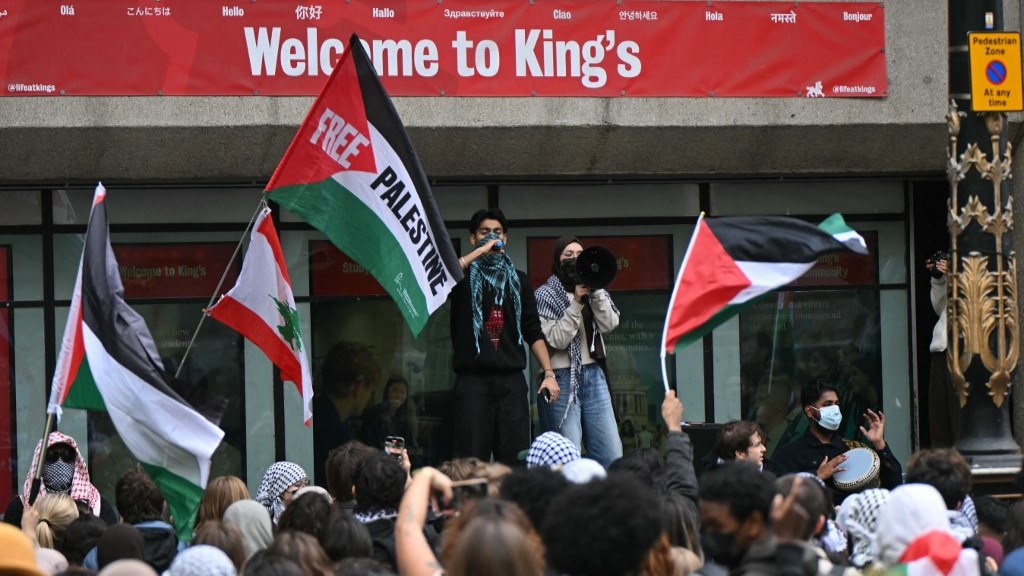
A bombshell new investigation from Amnesty International has pulled back the curtain on a widespread, coordinated campaign by British higher education institutions to stifle pro-Palestine student protests against university partnerships with Israel amid its ongoing military campaign in Gaza.
Released this Tuesday, Amnesty’s *Silencing Dissent* report draws on thousands of pages of documents obtained through Freedom of Information (FOI) requests to dismantle the narrative that universities have acted independently in their responses to Palestine solidarity demonstrations. The investigation confirms that institutions operated within an interconnected, institutionally supported network that actively pushed for harsh, repressive measures against student activists.
Internal communications obtained through FOI requests reveal that university administrators across the country openly coordinated punitive actions against protesters, from seeking court-ordered injunctions to block demonstrations to referring participating students to the UK’s controversial Prevent counterterrorism program, a scheme designed to root out extremist radicalization that critics have long accused of targeting Muslim and anti-war communities.
One revealing email exchange from the University of Northampton shows senior administrators directly collaborating to share crowd control tactics, with one senior staff member asking peers at other institutions whether they were “locking in” student protesters — a reference to confining demonstrations to specific, limited campus areas to minimize their public impact.
At the center of this cross-institutional coordination is Universities UK (UUK), the national representative body that counts 142 British universities among its member institutions. The report documents that UUK played a foundational role in standardizing the crackdown, hosting weekly strategy calls for vice-chancellors whose campuses hosted pro-Palestine encampments to share tactics and align their responses to demonstrations.
This collaborative effort did not stop at the university sector gate: the coordination extended directly into the UK government. FOI documents from the University of Kent confirm that UUK maintained close, ongoing ties with Whitehall departments and senior government ministers. The organization arranged direct meetings between university leaders and Downing Street officials, while simultaneously communicating official government expectations for protest management to its member institutions.
As protests grew in size and intensity through 2024 and 2025, UUK deepened its partnership with the Department for Education and the Office for Students (OfS), the national regulator for higher education. The group provided targeted guidance to universities on mitigating reputational damage, managing protest actions, and pursuing legal avenues including civil injunctions to shut down demonstrations. As of publication, UUK has not responded to repeated requests for comment on the report’s findings.
Beyond senior administrative coordination, the report also documents that campus security leadership organized its own unified response through the Association of University Chief Security Officers (Aucso), the trade body representing security leaders across UK higher education.
Ahead of planned national student mobilizations, the chair of Aucso’s South West regional division circulated formal strategic briefings to prepare institutions for increased protest activity. In those documents, Aucso advised universities to consult data protection teams and apply FOI exemptions to keep internal security communications about protests hidden from public disclosure. The organization also provided pre-written press release templates that institutions could adapt locally to shape public narratives and deflect scrutiny of their crackdowns.
The investigation further reveals that at least nine UK universities received private threat assessments from commercial intelligence firms, including Horus Security Consultancy Ltd, Mitie Intelligence Hub, and risk specialist Global Situational Awareness (GSA). These private intelligence updates routinely categorized entirely non-violent student protest actions as high-level security threats.
In one notable example, student-led national weeks of action planned for May 2025 were labeled a “high threat” and classified as a coordinated security risk by the Global Security Operations Centre (GSOC), a private firm that markets itself as a 24/7 centralized command hub for monitoring domestic security threats. The firm’s briefings even labeled common peaceful protest slogans, including the widely used “From the river to the sea,” as “escalatory rhetoric,” and advised authorities to monitor the social media accounts of at least 15 university-based Palestine solidarity societies, including prominent groups at SOAS University of London, the University of Leeds, Imperial College London, and the University of Glasgow.