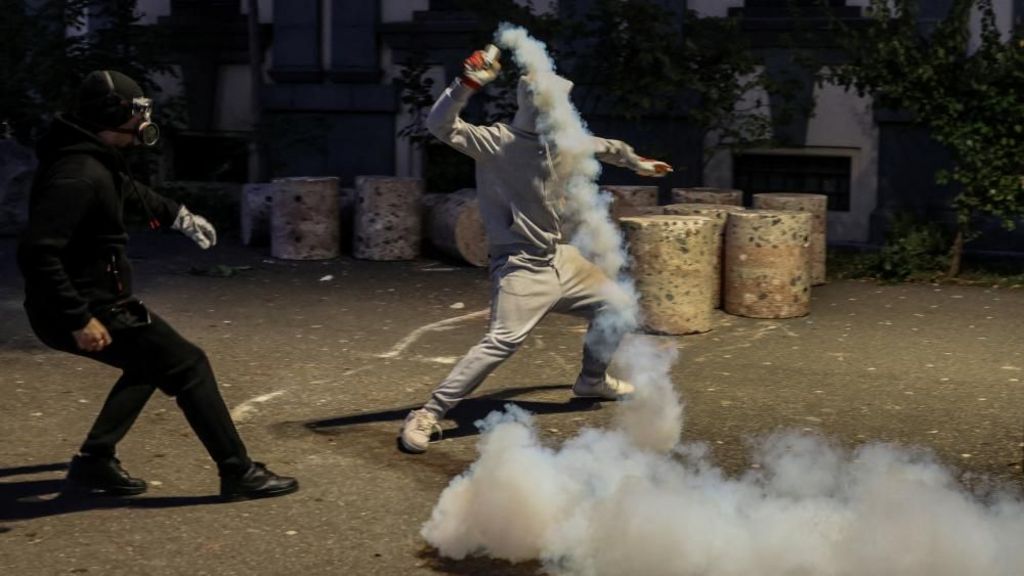
Seven straight days of violent unrest have rocked Albania, as anti-government demonstrations led largely by high school and university students have devolved into open conflict between protesters and riot police in the capital Tirana, with demonstrators demanding the resignation of long-serving Prime Minister Edi Rama.
Pre-counted official data puts the total injury toll at 295 ahead of Monday’s fresh clashes, with 186 of those injured being members of the police force. During a meeting with somber senior police commanders, Rama held up a stone that had been thrown at officers the previous day, stating firmly that if the state chooses to negotiate with the current protest movement, it ceases to function as a sovereign governing body. Since the unrest began, a local police station and multiple central government buildings in Tirana have been targeted by protesters, whose grievances combine demands for improved higher education conditions, widespread anger at systemic government corruption, and repeated calls for Rama to step down after 13 years in power.
Rama has pushed back hard against the movement, claiming the predominantly young protesters have been radicalized by what he called “dark forces” operating from Europe and the United States, framing the unrest as a coordinated, externally backed attack on Albania’s sovereignty.
On-the-ground reporting from Tirana’s Rinia (Youth) Park captured the preparation for conflict under clear October skies: protesters pried loose cobblestones from park pathways to use as ammunition for coming clashes with police, mirroring the stone Rama displayed to police leaders. Within minutes, security forces moved in: an armored police convoy advanced along the city’s main boulevard, with a leading water cannon truck firing tear gas canisters into crowds of fleeing demonstrators. Riot squads pursued the student-heavy crowd through the park, with many protesters taking shelter in a nearby cafe where even waiting staff were left teary-eyed from the lingering gas fumes. Volunteer medics in yellow reflective vests remained stationed under park trees to treat people overwhelmed by tear gas. The on-site reporter witnessed one incident where a police officer fired pepper spray at point-blank range into a young man’s face during a verbal confrontation.
Human rights lawyer Gentian Sejrani, who provides legal representation to more than 100 protesters arrested during the unrest, criticized police conduct as disorganized and unjust. Sejrani noted that police rarely present credible evidence to support arrests in court, citing one client who was detained purely by chance while walking to a bus stop, completely uninvolved in the protests. Conversely, he added, most protesters who throw projectiles at police rarely face arrest, as they are able to outrun security forces.
Mutual anger has fueled the cycle of violence: police are enraged by injuries to their colleagues, while protesters resent what they view as excessive police heavy-handedness, creating a chaotic, volatile standoff. Protesters have organized grassroots mutual aid, bringing saline spray to treat people exposed to tear gas.
Sidorela Vatnikaj, a 27-year-old master’s student and veteran activist with eight years of anti-government protest experience, is one of the de facto prominent voices in the leaderless movement. She described the daily reality of participating in the unrest: coordinating across decentralized protest groups, arranging legal support and first aid supplies, checking on the safety of fellow participants, and spending most of the day moving between protest sites while evading police.
While Vatnikaj says she is uncomfortable with violence targeting state authorities, she blames police for initiating and escalating the conflict. “When I see people throwing stones at the police, I understand their anger. I don’t judge them. I’m not happy, but they have no other way to be listened to,” she explained. She pointed out that many protesters come from families forced to leave Albania over the past decade – a wave of emigration that has seen a million people leave the country – and that young Albanians have been robbed of opportunity, ignored by the government, and now attacked by security forces.
In response to Rama’s rhetorical question asking what would happen if he stepped down, Vatnikaj called for a one-year technocratic interim government to oversee preparations for free, fair democratic elections. She has accused Rama of rigging previous votes and colluding with wealthy foreign investors and organized crime networks. She added that young Albanian protesters draw inspiration and encouragement from fellow Gen Z protest movements across the globe, noting that the dream of a dignified democratic society that drove previous generations has never been realized.
Rama, who has dominated Albanian politics since the early 2000s and held the prime ministership for 13 years, has positioned himself as the only leader capable of delivering Albania’s EU accession by the 2030 target.