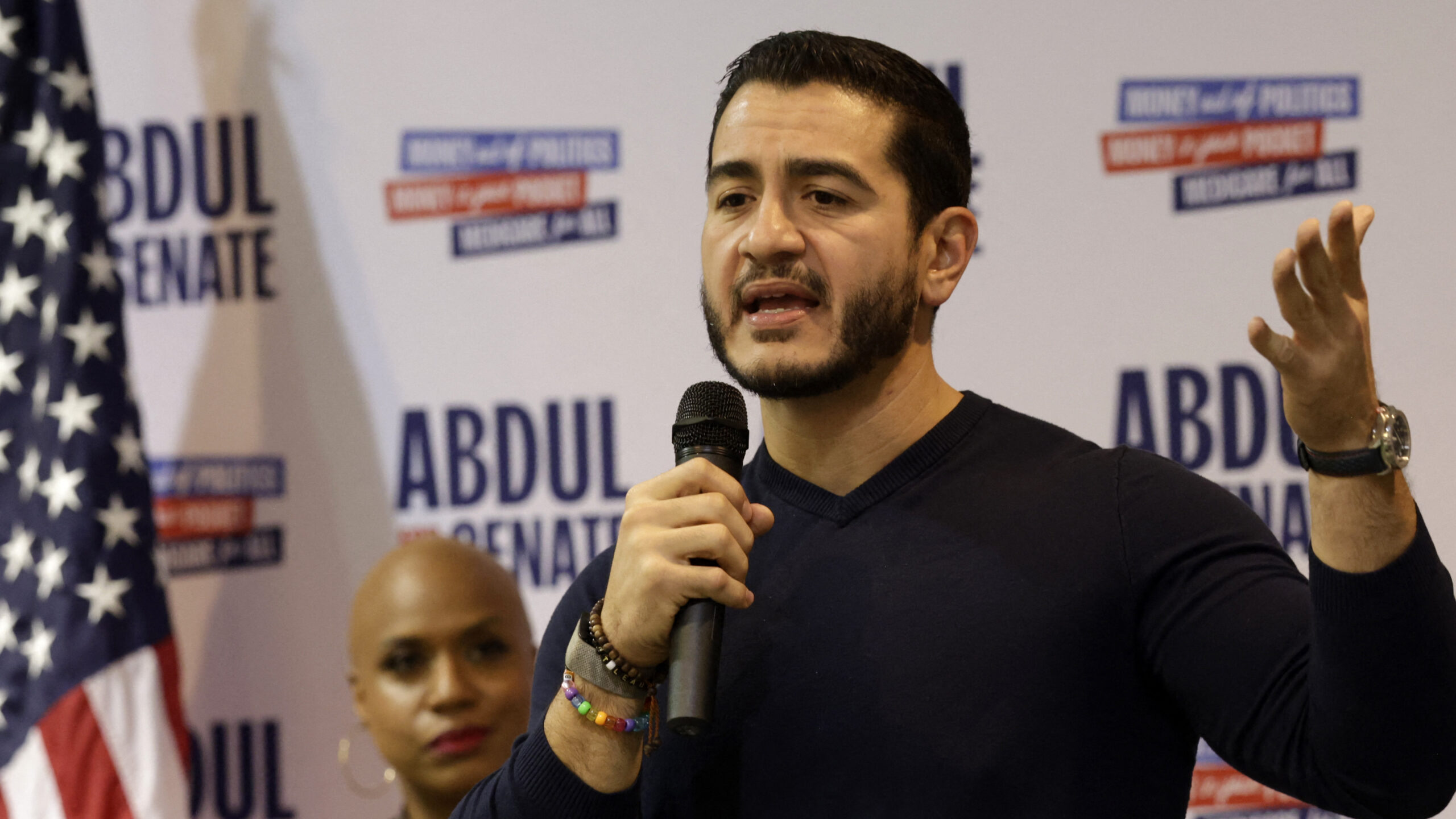
With the 2026 November U.S. midterm elections just weeks away, a tense exchange at a Michigan town hall on Saturday has thrown a spotlight on the growing anti-Muslim rhetoric targeting Democratic Senate candidate Abdul El-Sayed, the son of Egyptian immigrants born and raised in the state. The confrontation, which El-Sayed later shared on his official X (formerly Twitter) account, began when an attendee identifying himself only as Tommy stepped forward to demand that El-Sayed publicly disavow the Muslim Brotherhood.
El-Sayed immediately complied with the request, saying “Sure. Yeah, absolutely,” before pushing back to unpack the underlying implication of the question. He pressed the attendee: “Why would you ask me this? What are you implying?” The heckler, who later described the Muslim Brotherhood as a terrorist organization, pushed back by saying he had never heard El-Sayed make such a disavowal before.
In the aftermath of the event, public records and independent reporting revealed that the heckler is Thomas Teeple, a former Republican congressional aide who previously worked on the staff of Missouri Senator Josh Hawley and served as political director for Philip Sarnecki’s 2022 Kansas gubernatorial campaign. The incident was not an isolated act of individual bias, either: it is the latest in a sustained campaign of religiously tinged attacks targeting El-Sayed, who is Muslim, stretching back months.
El-Sayed drew a historical parallel to the backlash faced by John F. Kennedy, the nation’s first Catholic U.S. president, who faced widespread questioning over whether his religious loyalty would override his duty to the American public. “I am running for the Senate as an American who happens to be Muslim,” El-Sayed emphasized after the confrontation, pushing back against the framing that his faith makes him inherently suspect.
This line of attack did not originate with Teeple. El-Sayed’s general election opponent, former Republican Congressman Mike Rogers, has repeatedly pushed unsubstantiated claims that El-Sayed holds hidden ties to the Muslim Brotherhood. Just weeks before the town hall, a leaked private group chat exposed a coordinated plot to disrupt El-Sayed’s events: a student affiliated with the University of Michigan College Republicans, Iman Dashti, offered students $200 each on behalf of conservative PAC America Next to travel to a Flint town hall and heckle El-Sayed to generate negative press. “Bring your friends. Bring your girlfriend,” Dashti wrote in the GroupMe chat. “Take her out somewhere nice with the $400 you two will make in literally 2.5 hours. All u have to do to get paid is COME AND SHOW OUT AGAINST ABDUL.”
Former president Donald Trump has also amplified the attacks against El-Sayed, mocking his name and spreading the same baseless Brotherhood affiliation claims at recent rallies in Georgia and Tennessee. “He’s a jihadist,” Trump claimed at one event, mispronouncing El-Sayed’s first name as “Mohammed” and joking that he could call the candidate whatever he wanted. He even mocked the name with a drawn-out, mocking string of syllables: “His name is actually Abduladadalalalala.”
El-Sayed has pushed back sharply against these attacks, framing them as a cynical distraction from policy failures by right-wing leaders. On X, the candidate hit back at Trump’s remarks, pointing out the former president’s own close financial ties to Middle Eastern nations: “He says the name just fine when he’s begging the Qataris for a personal jet or the Saudis for funding for his son-in-law’s private equity firm. Wonder what’s changed?”
The incident has sparked widespread backlash online, with many observers and political commentators calling out the question as inherently racist targeting a candidate based on his ethnic and religious background. “This is fucking crazy. Asking a Muslim BORN IN MICHIGAN to disavow some foreign group just bc he’s ethnically Egyptian IS RACIST,” one political commentator wrote on X, sharing the clip of the confrontation. The incident has reignited broader conversations about the normalization of anti-Muslim rhetoric in mainstream American electoral politics, as candidates continue to weaponize faith and ethnicity to sully opponents ahead of competitive elections.