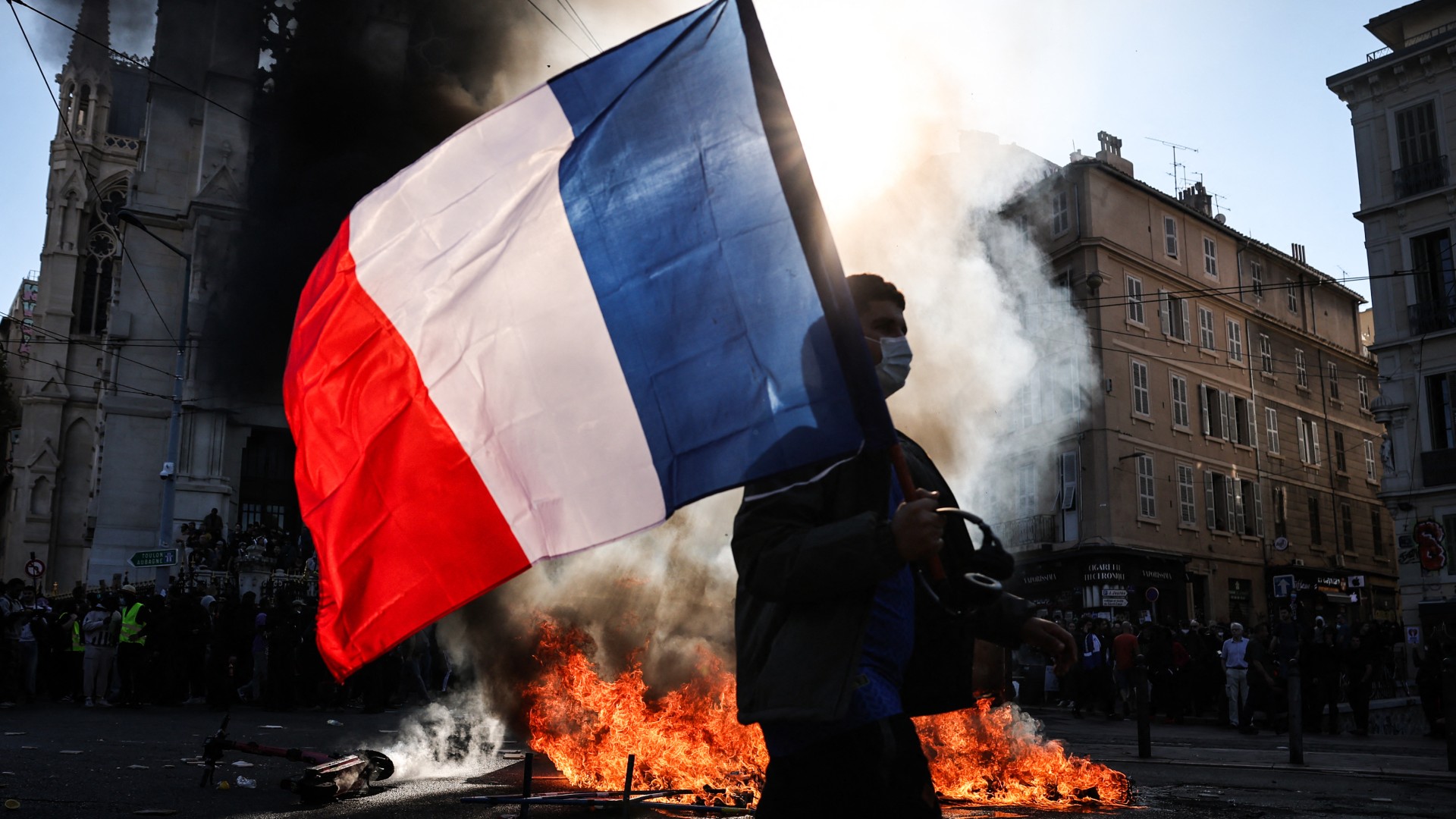
France is facing one of its most severe domestic political crises in modern history after a chaotic, violence-fueled weekend left two civilians dead, thousands injured, and major urban centers resembling war zones, as law enforcement struggled to regain control of public streets. The unrest has cast a deep shadow over the final months of President Emmanuel Macron’s tenure in office.
The scale of the rioting, widely described as the worst period of civil disorder France has seen since the mass student and worker uprisings that pushed the nation to the edge of revolution in May 1968, prompted Prime Minister Sebastien Lecornu to convene an emergency crisis cabinet meeting on Monday to coordinate a government response.
Following the closed-door meeting, Lecornu announced that the government was asking local municipal governments across affected regions to implement targeted partial curfews to stem further violence. The prime minister also confirmed that the administration had not ruled out implementing a nationwide state of emergency if unrest continues to escalate.
Speaking to reporters after the meeting, Lecornu emphasized that the government was “fully resolved to restoring public order” across the country. He noted that if security authorities determined a state of emergency was required to contain the violence, the administration would move forward with the declaration. At this stage of the response, however, Lecornu added that targeted partial curfews appeared to be a more proportional and appropriate measure.
Law enforcement agencies have already taken at least 2,000 protesters into custody across the nation since the unrest erupted, with widespread reports of serious life-altering injuries among demonstrators. Two protesters have had hands completely severed by police stun grenades, and earlier this month, a 15-year-old boy also lost a hand after being hit by a police stun grenade in a separate incident.
In a controversial decision that has drawn sharp criticism from opposition groups, President Macron rejected the resignation offer from Interior Minister Laurent Nunez, even after government authorities acknowledged that “failures in anticipation and intelligence” on the part of security services directly worsened the scale of the crisis. Macron opted to keep Nunez in his post to preserve an uninterrupted chain of command for security operations, as police and national security forces continue to work to contain spreading unrest.
“Those who destroyed must pay,” Macron stated in an address to the nation on Sunday evening. “Those who looted must pay back. Those who sought to bring down the Republic will be held accountable.”
The unrest began on Saturday, when an estimated half a million people marched across the country to protest soaring living costs, long-standing underperformance in the state education system, and steadily deteriorating public services. The initial protests were followed by widespread looting and arson, with independent estimates indicating that rioters damaged or destroyed more than 1,500 independent shops and small businesses across the nation.
The roots of the current movement stretch back to September, when student and teacher strikes began in under-resourced, impoverished suburbs of Paris. The strikers were demanding increased funding and resources for schools that lacked basic equipment and staffing. While government officials ultimately agreed to meet the core demands of the initial strikers, the movement struck a powerful chord across the nation, with millions of French people who had long held frustrations over the education system and stagnating economy joining the protests.
A harsh, heavy-handed crackdown by police, marked by frequent incidents of violence against student protesters, pushed thousands more previously uninvolved citizens onto the streets to join the demonstrations, amplifying the scale of the unrest.
In the southern port city of Marseille, which saw some of the worst weekend violence and looting, local authorities issued an official order banning all public gatherings and demonstrations from midday to 8 p.m. on Monday to prevent further disorder.
By the end of the chaotic weekend, the French capital of Paris had been reduced to what one visiting observer described to Reuters as a “war zone,” with burned-out vehicles, broken storefronts, and debris littering major commercial districts.
“It’s heartbreaking, heartbreaking seeing our city like this,” 59-year-old Marseille resident Farida, who declined to share her last name with Reuters, told reporters. “If every protest ends with all the shop windows smashed and stores trashed, this simply cannot go on – it cannot go on.”
The outbreak of large-scale unrest comes as France, the European Union’s second-largest economy, is already reeling from overlapping fiscal and social crises. The nation narrowly escaped falling into a technical recession in the second quarter of this year, and the sharp spike in global energy prices driven by ongoing geopolitical conflict in the Middle East has hit the country’s energy-dependent economy particularly hard.
Weeks before the current unrest erupted, the Wall Street Journal warned that growing “uncertainty about the country’s political and fiscal future has also contributed to a slowdown in what was once one of Europe’s more reliable growth engines.”
New survey data from Medef, France’s largest national employers’ federation, underscores the deep anxiety French business leaders hold over ongoing political instability. The survey found that 82 percent of responding business leaders expressed pessimism about the current government’s economic policy agenda. Sixty-six percent of respondents added that their companies face a high risk of bankruptcy or increased financial fragility if major changes to national economic policy are not implemented over the next three to five years.