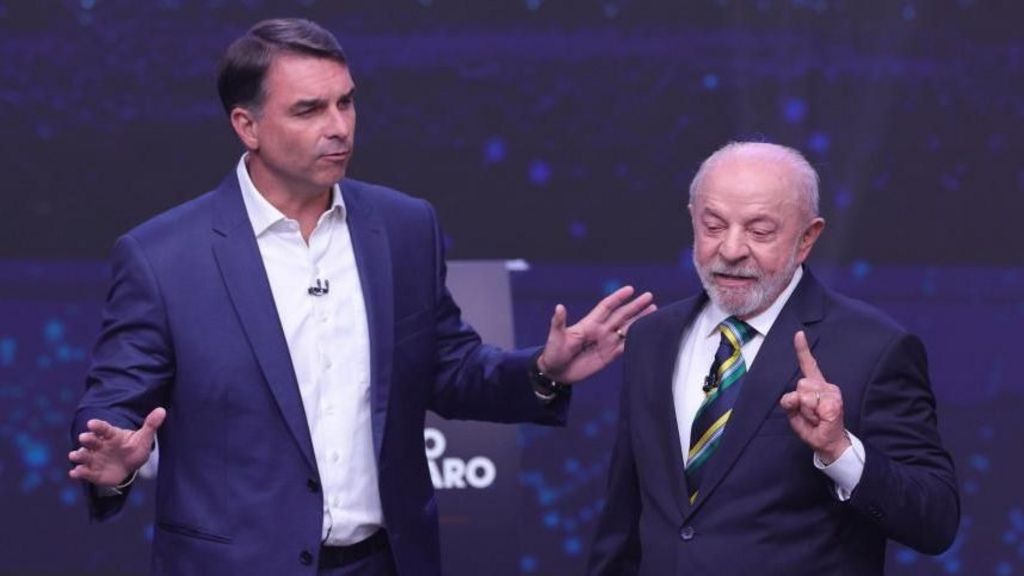
With Brazil’s high-stakes presidential runoff election just seven days away, the nation’s two leading candidates — incumbent left-wing President Luiz Inácio Lula da Silva and right-wing Liberal Party challenger Senator Flávio Bolsonaro — faced off in a chaotic televised debate that has left political analysts warning of growing voter alienation ahead of Sunday’s vote.
Recent polling data has painted the race as virtually tied, making the pre-runoff debate cycle a critical opportunity for both candidates to court the shrinking bloc of undecided voters that will likely decide the outcome. Sunday’s clash marked the first of two scheduled debates before polls open, with a second face-off set for Friday, just 48 hours before voters head to the ballot boxes.
The runoff was triggered after neither candidate hit the 50% valid vote threshold required to win outright in the first round held on October 4. In a surprise upset that defied pre-election polling projections, Flávio Bolsonaro — the son of former president Jair Bolsonaro, who was convicted to over 20 years in prison for plotting a coup to overturn Lula’s 2022 election victory — secured a narrow first-round lead: 47% of the vote to Lula’s 45.2%.
Brazil’s democratic history has set a steep hurdle for Lula to overcome: since the country returned to civilian rule in 1988, no candidate trailing after the first round has ever climbed back to win the runoff. Undaunted, the incumbent has framed his campaign as a second-half comeback, telling supporters he will “win in extra time.”
Instead of focusing on policy proposals to sway undecided voters, however, the first debate quickly devolved into a series of personal jabs and bitter attacks, a dynamic that political analysts say could push already frustrated voters to stay home on election day. Brazil already saw higher-than-average abstention rates in the first round, and experts warn the aggressive, unproductive tone of the debate could drive that number even higher.
Yuri Sanches, an analyst with polling firm AtlasIntel, called the event a policy-free exchange that offered independent voters nothing to endorse. “This was a debate with no discussion of public policy, no rational arguments on either side,” Sanches noted. “Independent voters — those who lean against Bolsonaro at times and against Lula’s Workers’ Party at others — left with an overwhelmingly negative impression.”
Different analysts gave differing assessments of which candidate came out ahead on tactical terms. Lucas Aragão, a researcher with political consultancy Arko Advice, argued that Flávio Bolsonaro managed to get under Lula’s skin by maintaining a calm demeanor while provoking the incumbent. But Rafael Cortez, senior analyst at da Tendências Consultoria, countered that Lula scored a key rhetorical win when he offered to open his own financial records and phone data — as well as those of his immediate family — to full judicial scrutiny, then challenged Bolsonaro to match the pledge before election day.
Many observers also criticized the debate’s loose format, which allowed both candidates to wander the studio while their opponent spoke, leading to frequent interruptions and chaotic, overlapping exchanges. One of the most heated moments came when Bolsonaro called Lula over to his podium to speak face-to-face. Lula, referencing long-standing allegations linking the Bolsonaro family to far-right paramilitary militia groups, rejected the invitation outright. “I don’t want to get close to you,” Lula said. “I want to keep my distance from the Bolsonaro family, and from the militia.”
Bolsonaro, who has repeatedly dismissed the militia links as fabricated fake news, fired back with a sniping personal retort: “On second thought, maybe it’s better I keep my distance too, so my wallet doesn’t get stolen.” He went on to repeatedly accuse Lula’s Workers’ Party of systemic corruption, holding up his palm to display the handwritten word “CORRUPTO” (Portuguese for “corrupt”), pointing out that the middle two letters of the word matched the Portuguese initials for the Workers’ Party, PT.
Running on a platform of tough, iron-fisted anti-crime policy, Bolsonaro also pressed Lula to explain the rise in national crime rates during Lula’s current four-year term, and repeated an unsubstantiated claim that “the majority of prison inmates vote for Lula.” Lula hit back immediately with a direct jab at Bolsonaro’s imprisoned father: “I wish it was 100% of them — even your father.”
With the race still too close to call, all eyes now turn to the second and final pre-election debate on Friday, as both campaigns scramble to lock in undecided support before Sunday’s vote.