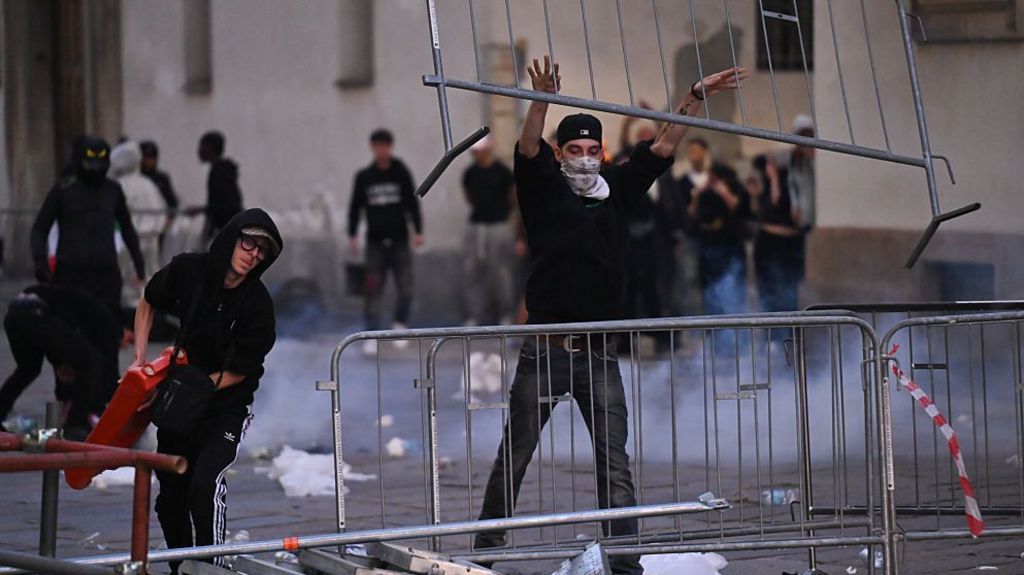
Widespread violent clashes erupted from peaceful cost-of-living protests in Milan over the weekend, leaving a trail of vandalism, injuries and more than 200 detentions across northern Italy, and pushing Prime Minister Giorgia Meloni to convene an urgent national security meeting on Monday.
Organized demonstrations drew more than 5,000 demonstrators to Milan’s streets on Saturday, with tensions escalating quickly when a subset of masked protesters began launching paving stones, discarded bins and street furniture at responding police officers. Law enforcement ultimately deployed crowd control measures including tear gas and water cannons to disperse the unrest, which spilled over into Sunday. Clashes also spread to other major northern Italian cities, triggering pre-emptive security actions in multiple urban centers.
Official Italian local media reports confirm that over 200 people have been taken into custody in connection with the violence, with 80 percent of those detained being minors. Prosecutors in Milan have already requested prison sentences for five adult arrestees charged with multiple offenses including looting, vandalism and resisting arrest. Multiple people, including serving police officers, were treated for injuries sustained during the confrontations. In Turin, authorities detained several individuals found transporting cobblestones and tools specifically intended for breaking windows, while Bologna’s central train station was temporarily closed as a safety precaution amid fears of spreading disorder.
In her first public remarks following the unrest, Meloni drew a clear line between legitimate protest and destructive action. “To demonstrate is a right. To lay our cities to waste is not,” the prime minister stated Saturday, labeling the violent actors as “hooligans” who hijacked the original demonstration to spread widespread chaos. With a national general election scheduled for 2025, Meloni has issued a direct call to political opposition groups to issue unambiguous, unanimous condemnation of the rioting. Writing on the social platform X, she emphasized that “any hesitation becomes justification” for the violence.
The leader of Italy’s main opposition Democratic Party, Elly Schlein, pushed back by confirming her party’s longstanding rejection of all violent action, while warning that the unrest should not be used to silence the grievances of thousands of peaceful protesters across the country who face severe economic hardship amid soaring living costs.
Local leaders have also raised alarms about the character of the unrest. Milan Mayor Giuseppe Sala described the violence as an alarming “new phenomenon” that draws momentum from a broader unstable international context, linking the disorder to similar unrest seen across the globe. “I witnessed smashed shop windows, looted stores, and frightened citizens,” Sala told Italian news agency Ansa, noting “what happened here is what we are seeing in many cities around the world.”
The Italian unrest follows a pattern of youth-led economic protests across Europe, where mostly peaceful demonstrations have been marred by isolated outbreaks of rioting. Similar clashes have been recorded in recent weeks in France, Spain and Albania, with hundreds of thousands of protesters marching in neighboring France against economic policies and living costs earlier this month. Friday saw student-led anti-government protests across multiple Italian cities, which set the stage for the larger weekend demonstrations that devolved into violence in the north of the country.